After-Hours Evening Rehab in South Portland

Key Takeaways
- Evening rehab in South Portland is built around working adults, with Intensive Outpatient, Partial Hospitalization, and standard Outpatient tracks scheduled after 5pm so treatment fits around jobs and family life.
- South Portland's workforce and median household income of $86,838 7mean daytime-only programs leave most people locked out, which is the practical gap evening hours are designed to close.
- Evening IOP and PHP are defined levels of care on the ASAM continuum, not lighter alternatives, and the Surgeon General notes outpatient can match inpatient outcomes when matched to severity 12.
- Before committing, compare how a program handles co-occurring anxiety or trauma, coordinates medication-assisted treatment, verifies insurance and MaineCare coverage 3, and structures aftercare once weekly hours step down.
You're reading this late, and that's okay
If it's past 9pm and you're on your phone, scrolling through rehab options between glances at the dishwasher or the baby monitor or tomorrow's shift schedule, take a breath. You're already doing something hard. Opening this page counts.
You probably know the shape of the problem already. Maybe the drinking has crept from weekend to weeknight. Maybe the pills you started after a back injury aren't optional anymore. Maybe a partner finally said something, and you can't unhear it. Whatever brought you here, you're likely not looking for a thirty-day stay at a facility two hours away. You have a job. Kids. Rent. A life you're actually trying to protect, not pause.
That's the whole point of evening rehab in South Portland. It's structured addiction treatment built around a workday, designed so you can clock out at 5, eat something, and still get real clinical care that same night. Coastal Recovery Partners runs its Intensive Outpatient, Partial Hospitalization, and standard Outpatient tracks with evening hours specifically because most people who need help are also showing up to work in the morning.
This isn't a watered-down version of recovery. It's the version that fits the life you have. The rest of this page walks through what an evening session actually looks like, how the program treats both substance use and the anxiety or trauma underneath it, what insurance usually covers, and how to start this week if you decide you're ready. No pressure. Just information, in plain language.
Why South Portland needs treatment that runs after 5pm
Drive over the Casco Bay Bridge at 5:15 on a Tuesday and you'll see the answer already. Trucks coming off the waterfront, nurses heading home from Maine Med, a steady line of brake lights pointing south toward Mill Creek and Knightville. This is a working city. The people on that bridge aren't free at 10am for a therapy appointment, and they aren't going to disappear for thirty days to a residential program in another state.
The Census numbers back up what your commute already tells you. South Portland's median household income sat at $86,838 between 2020 and 2024, with per capita income at $50,723 7. Those aren't trust-fund numbers. They're the numbers of households where the paycheck shows up because somebody clocked in, and where the rent or the mortgage assumes that paycheck keeps showing up next month too. If treatment is only available between 9 and 4, treatment is effectively unavailable to most of the people who need it.
That's the gap evening hours fill. A line cook finishing a lunch shift at 4. A property manager whose phone stops ringing around 5:30. A second-shift worker who has Tuesday and Thursday mornings free but needs nights covered the rest of the week. A single parent whose ex picks up the kids on Wednesday evenings. None of those people is a bad fit for recovery. They just can't bend their week into the shape a daytime-only program would require.
Maine's behavioral health system openly recognizes that there is no one-size-fits-all approach to substance use treatment, and that the right care has to flex around detox, medication-assisted treatment, and the different intensities of outpatient support 3. Evening rehab is one of the ways that flexibility actually reaches people. At Coastal Recovery Partners, the evening tracks for Intensive Outpatient and standard Outpatient programs exist because the team built the schedule backwards from what your week already looks like, not the other way around. You shouldn't have to choose between keeping your job and getting sober. In a city this employed, asking you to pick would mean asking most people to skip treatment entirely. That's not a clinical option. It's a closed door.
What an evening session actually looks like
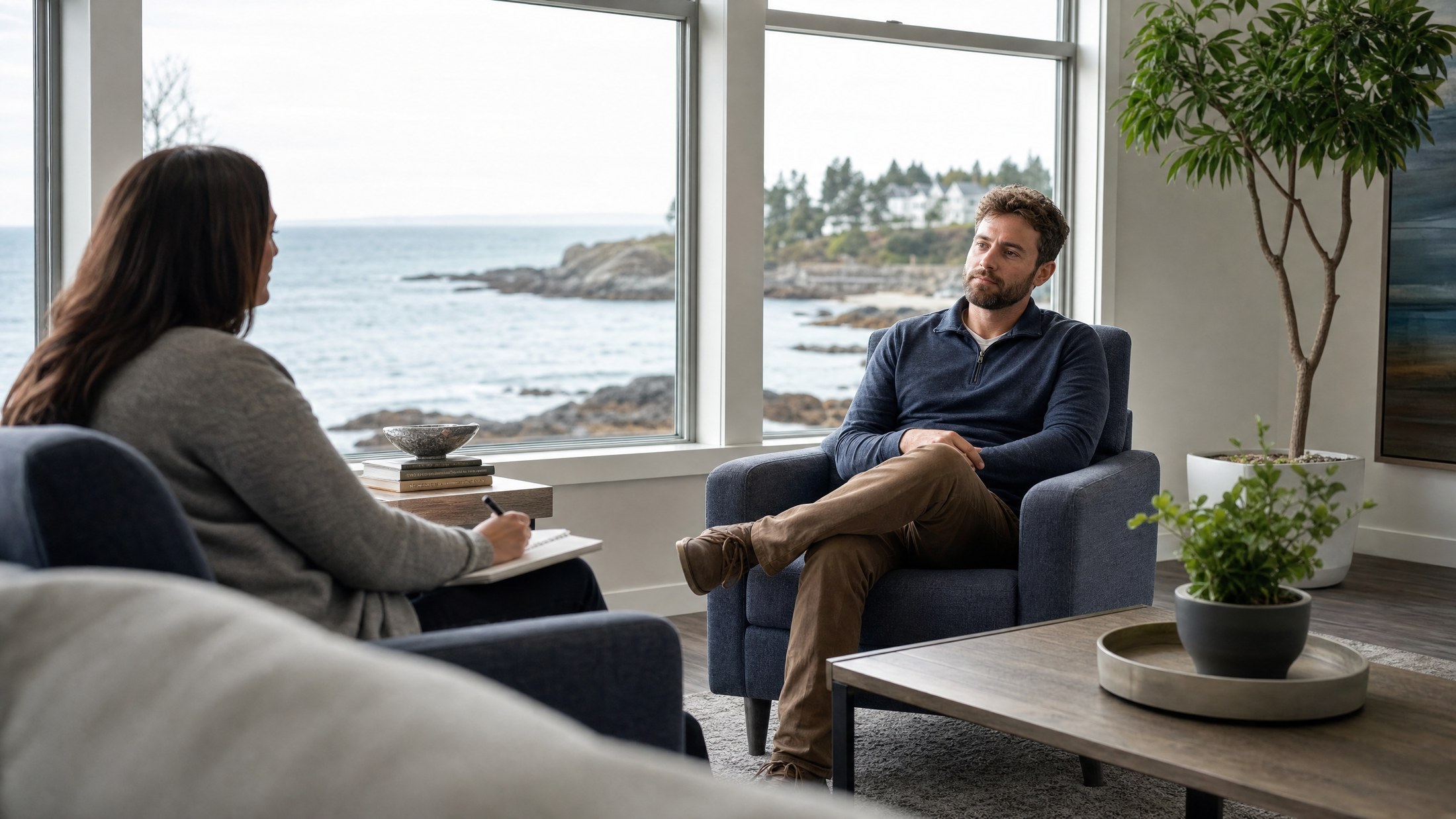
You walk in somewhere between 5:30 and 6, depending on traffic off 295 and how long the line at the daycare pickup ran. There's coffee. There's water. Nobody asks you to perform anything in the doorway. You sign in, you sit down, and you breathe for a minute. That part matters more than it sounds like it does.
A typical Intensive Outpatient evening runs about three hours, three nights a week. It usually starts with a brief check-in. Not a speech, not a confession. Just a sentence or two about how the week has been since you were last in the room. Some people are tired. Some people had a hard Saturday. Some people are quietly proud that Sunday went better than the last one. The group leader hears all of it without ranking it.
From there, the night usually moves into a structured group, which is where the actual clinical work happens. One night it might be about spotting the thoughts that show up right before you reach for a drink. Another night it might be about how to handle the family dinner this weekend, or how to talk to your boss, or what to do when the craving hits at 11pm on a Thursday. The skills have clinical names underneath them, but in the room they sound like real conversation between adults who are working on similar things.
If you're on medication-assisted treatment, you'll have a brief medical check-in built into the evening as well, so you're not making a separate trip in the morning. If something is coming up that needs one-on-one attention, individual sessions get scheduled around your week, not stacked on top of it.
The group itself usually looks like the city does. A nurse who just came off shift. A contractor still in work pants. A teacher. A grad student. A grandfather. People who, an hour earlier, were doing entirely different jobs and are now sitting in the same circle for the same reason.
You're home by 9, sometimes a little earlier. You sleep in your own bed. You make your kid's lunch in the morning. You go to work. Three nights a week, you come back. That rhythm is the treatment. It's structured and clinically grounded, the way SAMHSA's guidance on intensive outpatient care describes it 1, and it's built to be repeatable on a Tuesday in February when nothing about your life has paused to make room for recovery. The Partial Hospitalization track at Coastal Recovery Partners works similarly but runs more hours per week for people who need a higher level of support, and standard Outpatient steps the rhythm down as you stabilize. The shape of the evening stays familiar. The intensity moves with you.
Evening rehab is a real level of care, not rehab lite
There's a quiet worry a lot of people carry into an outpatient program: that if you're not sleeping in a treatment bed, you're not really getting treatment. That outpatient is the consolation prize. That evening hours mean a watered-down version of what people get when they go away for thirty days. None of that is true, and the clinical world has been clear about it for a long time.
The American Society of Addiction Medicine maps addiction care across a continuum, with five main levels ranging from outpatient through medically managed inpatient services 9. Intensive Outpatient and Partial Hospitalization sit firmly inside that continuum as distinct, defined levels of care, not as substitutes for it. SAMHSA's TIP 47 describes intensive outpatient as a structured, scheduled, clinically grounded form of treatment that uses group therapy, individual counseling, and case management to address substance use at meaningful intensity 1. The hours happen to be in the evening. The clinical content does not get smaller because the sun went down.
What the continuum is actually built for is movement. Someone leaving a higher level of care, say a hospital stay or detox, often steps into PHP, then into IOP, then into standard OP, then into alumni support. Someone walking in off the street with a serious but stable situation might start at IOP directly. The point is that the levels talk to each other. Stepping down is the design, not a downgrade. At Coastal Recovery Partners, that ladder runs from PHP through IOP and OP into aftercare and alumni programming, with evening tracks on the IOP and OP rungs so the schedule keeps working as your week keeps moving. You're not graduating out of treatment the day your weekly hours drop. You're moving along a path that was built to flex with how recovery actually unfolds.
How the evening program treats the whole picture
Substance use rarely shows up alone. There's usually something underneath it, or alongside it, or tangled into it. The drinking that started after a divorce. The pills that kept going long after the surgery healed. The anxiety that's been there since you were a kid, and the bourbon that finally made it quiet for an hour. An evening program that only treated the substance and ignored the rest would be missing most of the work.
Coastal Recovery Partners builds its evening tracks to treat the whole picture: the drinking or the using, the medication side of stabilizing your body, and the anxiety, depression, or trauma history that's often sitting right next to it. The pieces below describe what that actually looks like in plain language, without the acronym soup.
Talk therapy, translated
You'll hear clinical names for what happens in group and in your one-on-one sessions. Cognitive behavioral therapy. Dialectical behavior therapy. Motivational interviewing. Here's what those actually feel like in the room.
One kind of work is about spotting the thoughts that show up right before you reach for a drink, and learning to interrupt the loop. Another is about handling big feelings without numbing them, so a hard Sunday doesn't have to become a hard Monday. Another is the conversation where a counselor sits with you and helps you find your own reasons to change, instead of arguing you into them. The methods are evidence-based and have been studied for decades 1. In the room, they sound like an honest conversation between adults.
Medication-assisted treatment, on your schedule
If you're working with opioid or alcohol use, medication can take the edge off the physical part so you can actually do the rest of the work. Maine's behavioral health system recognizes MAT as a standard option in the continuum, not as something separate or lesser 3. At Coastal Recovery Partners, the medication piece is coordinated with your therapy, so your prescriber, your counselor, and your group leader are all on the same page about how you're doing.
Practically, that means your medical check-ins get built into your evening visits when possible. No extra trip across town in the morning. No splitting your care between three offices that don't talk to each other.
When anxiety or depression is part of it
A lot of people walk in carrying two things at once. The substance use is one of them. The panic attacks, the long flat stretches of depression, the trauma history that never really got addressed, those are the other. Treating one without the other usually doesn't hold.
Dual diagnosis care means the same team works on both, in the same evening, with the same understanding of how they feed each other. The Surgeon General's report on addiction is clear that well-designed outpatient programs can be as effective as inpatient care when the treatment matches the severity and the support around you 12. For a lot of working adults in South Portland, that match is exactly what an integrated evening track is built to provide.
What trauma-informed care actually feels like in the room
Here's what trauma-informed care is not: a sign on the wall. A buzzword in the brochure. A required line on the intake form. It's a way the room feels when you walk in, and it's something you can sense by the end of your first night.
In practice, it means nobody is going to ask you to tell the story of your worst day on day one. You get to choose what you share, when you share it, and how much. SAMHSA describes trauma-informed programs as ones built around safety, trust, choice, collaboration, and a sense that you have some power over what happens to you in the room 4. Those words sound clinical on a page. In an evening group, they look like a counselor checking before pushing on a hard topic. They look like an exit you can use without explaining yourself. They look like nobody being surprised when something brings up tears, and nobody being weird about it after.
A lot of people walking into treatment have already had bad experiences with systems that didn't feel safe. A previous detox that felt like punishment. A doctor who shamed them about their use. A family meeting that turned into an ambush. Coastal Recovery Partners builds the evening environment with that history in mind. You'll be asked what you need, not just what's wrong. You'll be told what's coming before it happens. And when something is hard, you'll be met by people who know that pushing harder isn't the answer. That's the felt difference. It's quieter than you'd expect, and it's the thing that lets the rest of the work actually happen.
Recovery Starts With a Conversation
Whether you’re exploring recovery for yourself or seeking guidance for someone you care about, Coastal Recovery Partners is here to help. Our team offers trauma-informed, evidence-based support grounded in structure, compassion, and real connection—without pressure or judgment.
When you’re ready, we’ll meet you where you are and help you take the next step forward.
A hopeful hinge: why Maine is moving in the right direction
Here's something worth knowing while you're sitting with whatever brought you to this page. Maine is, slowly and unevenly, moving in the right direction. Fatal drug overdoses in the state fell to 390 in 2025, a 20 percent decrease from the year before, and 2025 marked the third consecutive year of significant reductions 6. That's not a victory lap. Four hundred families still got the worst phone call. But it's a real number, and it's pointing the right way for the first time in a long stretch.
Why does that matter to you, on a Tuesday night, reading about evening rehab? Because numbers like that don't move on their own. They move because more people picked up the phone. More people walked into a first appointment. More people stayed on medication-assisted treatment long enough for it to work. More people found a program with hours they could actually keep.
That last part is where evening tracks come in. Every adult who can get to a 6pm group after work is one more person who didn't have to choose between treatment and a paycheck. The trend line in Maine is the sum of a lot of quiet decisions like the one you're considering right now. Showing up is how the curve keeps bending.
If you're worried about your job
This is one of the quietest fears people carry into a first phone call. You're not afraid of the work. You're afraid of getting fired for doing the work.
Here's the practical piece: evening hours exist partly so you don't have to have that conversation at all. If you can be at your desk or on the job site during your normal hours and in a group from 6 to 9 three nights a week, there's nothing about your schedule that needs explaining to a supervisor. Your treatment is your business.
If you do want or need to involve your employer, federal job-protection laws and HR confidentiality rules exist for exactly this reason, and a growing number of employer guides now treat flexible scheduling around substance use treatment as a basic retention practice rather than a special accommodation. A Kentucky small business toolkit, for one out-of-state example, recommends that employers build flexible scheduling around treatment and recovery meetings as a core way to keep good people on the team 10. That kind of thinking is becoming standard, even in industries that used to be the least forgiving about it.
Insurance, cost, and starting this week
The money question is usually the second one people ask, right after "will this actually work." It's a fair question, and the honest answer is that most working adults in South Portland have more coverage than they think.
Most commercial insurance plans cover outpatient substance use treatment, including Intensive Outpatient and Partial Hospitalization, because federal parity law requires behavioral health coverage to be treated comparably to medical coverage. MaineCare also covers substance use treatment across the continuum, including medication-assisted treatment for opioid use 3. Coastal Recovery Partners works with most major insurance carriers and has a care coordination team whose job is to call your plan, run the benefits, and tell you in plain numbers what your part would be before you commit to anything.
If you want to start this week, here's the shape of it. You call or fill out a contact form. Someone gets back to you quickly, usually the same business day, to do a short intake conversation about what's going on and what your schedule looks like. Insurance gets verified. An assessment gets scheduled. If evening IOP is the right fit, you're often in a group within days, not weeks. That's the point of building the program this way.
What happens after the program ends
Recovery doesn't end the night you finish your last IOP group. That's a milestone, and it deserves to be marked, but the work shifts shape. Your hours in the building go down. The skills you've been practicing get tested against ordinary weeks. The risk isn't that you forget what you learned. It's that life gets loud again.
That's why the program is built with what comes next already attached. Standard Outpatient is often the next rung down, with fewer hours per week and the same evening availability, so you can keep one foot in clinical support while your schedule opens back up. After that, aftercare and alumni programming keep you connected to the people who walked through it with you. A weekly check-in. A group you can come back to. A counselor you can call when a hard week shows up.
The research is clear that staying engaged matters. Outpatient treatment works best when it's part of a longer arc, not a single chapter 2. Coastal Recovery Partners builds that arc on purpose, so the question on graduation night isn't "what now," it's "what's next Tuesday." You already know the answer. You'll be here.
Frequently Asked Questions
Can I keep working full-time while attending evening rehab in South Portland?
Yes. That's the whole reason evening tracks exist. Coastal Recovery Partners' Intensive Outpatient evenings run about three hours, three nights a week, so you can finish your workday, eat dinner, get to group, and still be home in time to sleep. Most people don't need to tell their employer anything, because the schedule doesn't touch business hours.
Is evening outpatient treatment as effective as inpatient or residential rehab?
For appropriately matched adults, yes. The Surgeon General's report on addiction concludes that well-designed outpatient and intensive outpatient programs can be as effective as inpatient care when matched to severity and support 12. A systematic review of IOPs also found outcomes comparable to inpatient services across most measures studied 2. Evening rehab isn't a downgrade. It's a different fit.
What actually happens during an evening session?
You arrive around 5:30 or 6, sign in, and settle in with coffee. The night usually opens with a short check-in, then moves into a structured group focused on practical skills, like spotting the thoughts before a craving or handling a hard family weekend. If you're on medication-assisted treatment, a brief medical check-in is built in. You're home by 9.
Does evening rehab include medication-assisted treatment for alcohol or opioid use?
Yes. Maine recognizes MAT as a standard part of substance use treatment, not a separate track 3. At Coastal Recovery Partners, the medication piece is coordinated with your therapy, so your prescriber and your counselor are working from the same plan. Whenever possible, medical check-ins happen during your evening visits, so you're not making an extra morning trip.
Do I have to tell my employer I'm in treatment?
No. If you're working a standard daytime schedule and attending evening groups, there's nothing to disclose. Your treatment is private. If you do want to involve your employer for scheduling flexibility, federal job-protection and confidentiality rules apply, and many employer guides now treat flexible scheduling around treatment as a basic retention practice rather than a special accommodation 10.
What if I need help tonight, before business hours?
If you're in crisis or just can't wait until morning, call 988 for the Suicide and Crisis Lifeline, or call SAMHSA's National Helpline at 1-800-662-HELP. It's free, confidential, and available 24/7/365 8. When the Coastal Recovery Partners team opens in the morning, you can call or submit a contact form, and someone will reach back out the same business day to talk through next steps.
References
- TIP 47 - Clinical Issues in Intensive Outpatient Treatment - SAMHSA. https://www.samhsa.gov/resource/ebp/tip-47-substance-abuse-clinical-issues-intensive-outpatient-treatment
- Substance Abuse Intensive Outpatient Programs: Assessing the Evidence. https://pmc.ncbi.nlm.nih.gov/articles/PMC4152944/
- Substance Use Disorder Treatment. https://www.maine.gov/dhhs/obh/support-services/substance-use-disorder-services/treatment-services
- Trauma-Informed Approaches and Programs - SAMHSA. https://www.samhsa.gov/mental-health/trauma-violence/trauma-informed-approaches-programs
- Drug Overdose Mortality | Stats of the States - CDC. https://www.cdc.gov/nchs/state-stats/deaths/drug-overdose.html
- Governor Mills Announces 20 Percent Decline in Fatal Drug Overdoses in 2025. http://www.maine.gov/governor/mills/news/governor-mills-announces-20-percent-decline-fatal-drug-overdoses-2025-2026-02-24
- South Portland city, Maine - U.S. Census Bureau QuickFacts. https://www.census.gov/quickfacts/fact/table/southportlandcitymaine/PST045224
- National Helpline for Mental Health, Drug, Alcohol Issues - SAMHSA. https://www.samhsa.gov/find-help/helplines/national-helpline
- Chapter 3. Intensive Outpatient Treatment and the Continuum of Care. https://www.ncbi.nlm.nih.gov/books/NBK64088/
- Kentucky Small Business Toolkit for Retaining Employees in Recovery. https://kiprc.uky.edu/sites/default/files/2026-04/retaining-workers-toolkit.pdf
- Maine Opioid Summary - National Institute on Drug Abuse. https://nida.nih.gov/sites/default/files/21963-maine-opioid-summary.pdf
- Facing Addiction in America: The Surgeon General’s Report on Alcohol, Drugs, and Health. https://addiction.surgeongeneral.gov/sites/default/files/surgeon-generals-report.pdf
- Behavioral Health - Division of Licensing and Certification - Maine.gov. https://www.maine.gov/dhhs/dlc/licensing-certification/behavioral-health