
How Do You Find Medication Assisted Treatment Near Me?

Key Takeaways
- Proximity matters less than program quality when searching for MAT, so weigh medication options, counseling, scheduling, and insurance alongside distance from your home.
- Only 25.1% of adults who needed opioid use disorder treatment received the medications that treat it, making program choice the difference between real care and falling through the cracks.3
- Buprenorphine, methadone, and naltrexone are all FDA-approved and effective, but they differ in access, dosing, and fit, so the right choice depends on your history and schedule.2
- Medication works best paired with counseling and behavioral therapy, the "whole-patient" approach SAMHSA endorses, so avoid programs that treat therapy as optional or external.4
- Federal locator tools like SAMHSA's National Helpline, Buprenorphine Practitioner Locator, and OTP Directory filter out marketing noise and confirm which providers are actually authorized to deliver MAT.12,13,14
- Vet programs by phone before your first visit, asking about medications offered, counseling integration, assessment practices, scheduling flexibility, and how co-occurring conditions are handled.
- Outpatient tiers like OP, IOP, and PHP let you keep working and parenting while in treatment, and structured outpatient care can work as well as inpatient for many people.9
- Ask both your insurer and the program about coverage, copays, prior authorization, and sliding-scale options early, since Medicare covers OTP services under a specific MOUD benefit.6
What 'near me' really means when you're looking for MAT
When you type "medication-assisted treatment near me" into a search bar, the closest pin on the map isn't always the best answer. Distance matters, sure. You're more likely to keep showing up to appointments that are a short drive or bus ride away. But the program itself matters more than the address.
MAT, sometimes called medications for opioid use disorder or MOUD, pairs an FDA-approved medication with counseling and other support. The medication side is what most people picture first. The counseling side is what helps the change stick.4
So "near me" is really shorthand for a handful of questions you're trying to answer at once:
- Does this place actually prescribe the medications I might need?
- Will I get real therapy, not just a refill?
- Can I keep my job and still make it to sessions?
- Will they take my insurance?
- Will they treat me like a person who is trying, not a problem to be managed?
If you're searching from somewhere in or around South Portland, you have outpatient options that fit different schedules and intensity levels, from a few hours a week to most of the day. The trick is matching the program to your life, not the other way around. The next few sections walk through how to do that, step by step, without feeling like you have to figure it all out today.
The treatment gap that makes program choice matter
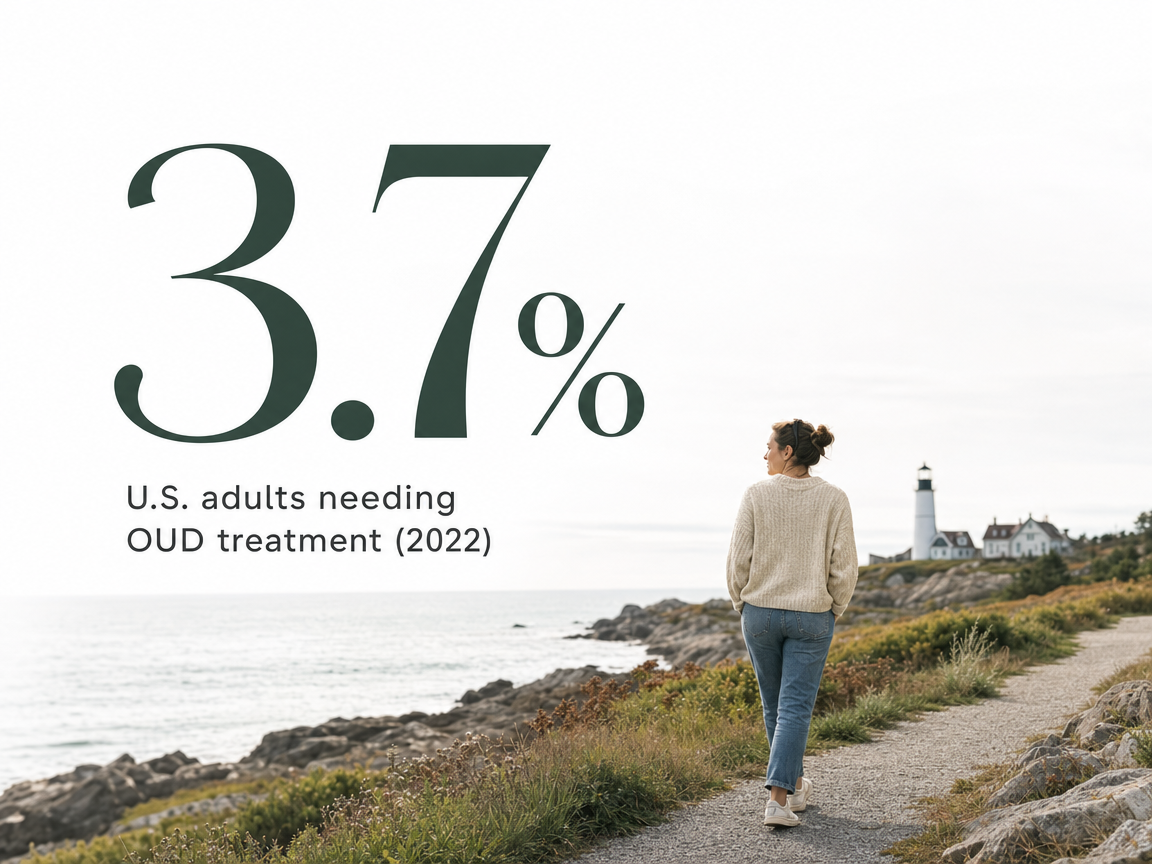
In 2022, 3.7% of U.S. adults aged 18 and older needed treatment for opioid use disorder. Of those who needed it, only 25.1% received the medications that actually treat it. This significant gap highlights why choosing the right program is crucial.3
This gap is not because the medications don't work. They do. Medication treatment for opioid use disorder has been linked to a lower risk of overdose and lower overall mortality. It is the standard of care, not an experimental add-on.5,10
The gap is about access, fit, and stigma. Some people live too far from a clinic that prescribes. Some get pushed toward abstinence-only programs that skip medication altogether. Some try once, feel judged, and don't go back. Some can't take time off work for a program that only meets at 10 a.m. on Tuesdays.
This is why "near me" deserves a second layer of thought. The closest clinic might not offer all three FDA-approved medications. The cheapest option might be medication only, with no counseling attached. A program with a long waitlist might cost you weeks you don't have.
When you weigh your options, you're not just picking a location. You're picking whether you'll be in that 25.1% who get real medication-based care, or in the larger group that falls through the cracks. The rest of this guide is about how to land in the first group, and how to make the program work with the life you already have.
The three FDA-approved medications, in plain language
You'll hear three medication names come up again and again when you read about MAT: buprenorphine, methadone, and naltrexone. The FDA has approved all three for opioid use disorder, and all three are considered safe and effective. They work in different ways, and they fit different lives. Knowing the basics before you call a program will help you ask better questions.2
Buprenorphine is a partial opioid agonist. In plain words, it activates the same brain receptors opioids do, but only partway. That's enough to quiet cravings and ease withdrawal without the high. You'll often see it sold as Suboxone, which combines buprenorphine with naloxone. It's usually taken as a daily film or tablet that dissolves under your tongue, and a long-acting monthly injection is also available. Since 2023, any DEA-registered clinician with the right schedule can prescribe it, so you can often get it from a regular doctor's office instead of a specialty clinic. That makes it one of the most accessible options for working adults.12
Methadone is a full opioid agonist, taken once a day as a liquid or tablet. It has the longest track record of the three and is especially helpful for people with a heavy or long-running opioid history. The catch is where you get it. Methadone for opioid use disorder can only be dispensed through a federally certified opioid treatment program, or OTP. Early on, that usually means showing up in person most days to take your dose under supervision. As you stabilize, you can earn take-home doses.6
Naltrexone is different from the other two. It's an opioid blocker, not an agonist. It doesn't activate the receptors at all; it sits on them so opioids can't take hold. The extended-release form, Vivitrol, is given as a monthly injection at a doctor's office. You have to be fully off opioids for about a week before starting it, which is the main hurdle. People who have already completed detox, or who want a medication with no daily dose to remember, often gravitate toward this one.5
None of these is automatically the "best." The right fit depends on your history, your schedule, and your goals. A good program will walk you through the options instead of handing you one by default.
Why a full program beats a prescription alone
You can technically get a buprenorphine prescription, take it home, and never see a therapist. Some people do exactly that, and it's better than nothing. But the research and the federal guidance both point in the same direction: medication works best when it comes with counseling and human support around it.
SAMHSA calls the pairing of medication with counseling and behavioral therapies a "whole-patient" approach to treating substance use disorders. ASAM, the addiction medicine guideline body, lays out what good MAT prescribing actually looks like in practice, including assessment, appropriate dosing, and ongoing monitoring rather than a one-and-done visit.4,11
A medication-only setup can leave you holding the hardest parts by yourself. Cravings still show up. Old triggers still live in your neighborhood, your phone, your family group chat. Sleep is rough for a while. If you have anxiety, depression, or trauma running underneath the substance use, the medication won't touch that on its own.
A coordinated program is built differently. You get the medication piece from a clinician who actually follows up with you. You also get individual therapy, group sessions, and skills work for the moments when the medication isn't the issue. Programs structured as intensive outpatient (IOP) or partial hospitalization (PHP) make that integration the whole point. For many people with alcohol and drug use disorders, well-run IOPs have been shown to be as effective as inpatient treatment. You get the structure without leaving your home, your job, or your family.9
There's also the dual diagnosis piece. If you're dealing with PTSD, depression, or another mental health condition alongside opioid use, a prescriber working alone usually can't address both. A program that offers trauma-informed care and treats co-occurring conditions in the same place keeps you from being shuttled between providers who don't talk to each other.
So when you're comparing options near you, ask one specific question early: is counseling built into the program, or is it something I'd have to find on my own? If the answer is the second one, keep looking.
Locator tools that actually show you who is nearby
Search engines will hand you a long list of clinic names with star ratings and not much else. That's a rough way to pick a place that will help shape the next year of your life. Federal locator tools are slower to scroll through, but they're built for this exact moment. They filter out pain clinics, marketing front pages, and outdated listings, and they tell you which providers are actually authorized to offer MAT.
Three tools cover most of what you need:
- One puts a real person on the phone with you.
- One helps you find a doctor's office that can prescribe buprenorphine.
- One maps the federally certified programs that can dispense methadone.
You don't have to pick just one. Many people use the helpline first to talk through what kind of program fits, then use the directories to confirm specific locations in their area.
A few things to keep in mind as you use these tools. Listings can lag behind real openings, so always call before you drive anywhere. Ask whether the provider treats opioid use disorder specifically, since some clinicians prescribe buprenorphine only for pain. And if you have a preference between daily dosing, a daily film, or a monthly shot, say so up front. That one sentence will narrow the list quickly.
SAMHSA's National Helpline for a real person on the phone
If you don't know where to start, start here. SAMHSA's National Helpline is free, confidential, and open 24 hours a day, every day of the year. You can call 1-800-662-HELP (4357) and talk to someone who will listen, ask a few questions, and point you toward local treatment options, including MAT.14
The helpline doesn't bill you, and you don't have to give your name. If English isn't your first language, Spanish-speaking specialists are available. It's a good first call when you want a human voice instead of a search results page.
The Buprenorphine Practitioner Locator for office-based care
If a regular doctor's office sounds less intimidating than a specialty clinic, SAMHSA's Buprenorphine Practitioner Locator is the tool to use. It lists clinicians who can prescribe buprenorphine for opioid use disorder, searchable by ZIP code and distance.12
One thing to know: in 2023, Congress eliminated the old buprenorphine waiver, so any DEA-registered clinician with the right schedule can now prescribe it. That means more options, but also more variation in experience. When you call a listed practitioner, ask how many patients with OUD they currently treat and whether counseling is offered on-site or through a partner.12
The Opioid Treatment Program Directory for methadone access
Methadone for opioid use disorder is only available through a federally certified opioid treatment program, or OTP. SAMHSA's Opioid Treatment Program Directory lists every certified OTP in the country, organized by state. If you're considering methadone, or you want a program that can offer all three FDA-approved medications under one roof, this is where to look.13
OTPs must be certified by SAMHSA and accredited by an independent body, so listing here is a quality signal in itself. Call ahead to ask about intake hours, dosing schedules, and how soon you can be assessed.6
How to vet a MAT program before your first appointment
Once you have a short list of programs near you, the phone call before your first visit is where you learn the most. You're not interviewing them for a job, but you are checking fit. A good program won't be thrown off by questions. A program that gets defensive when you ask what medications they offer is telling you something.
Start with the medications. Ask which of the three FDA-approved options they prescribe or coordinate: buprenorphine, methadone, naltrexone, or all three. Some outpatient programs prescribe buprenorphine and naltrexone on site and refer to a certified OTP for methadone. That's a reasonable setup, as long as the referral is real and someone helps you make it happen. If they only offer one medication and steer everyone toward it regardless of history, keep that in mind.2
Next, ask how the medication piece connects to therapy. The right answer sounds like: you'll see a prescriber for assessment and follow-ups, and you'll also be in individual and group counseling as part of the same program. SAMHSA frames this medication-plus-counseling pairing as the "whole-patient" approach for a reason. If counseling is described as optional, separate, or something you'd arrange yourself, that's a medication-only setup wearing a program label.4
Ask about assessment and monitoring. ASAM's national guideline lays out what high-quality MAT looks like in practice: a real intake assessment, appropriate dosing, and regular follow-up rather than a quick script. You can phrase it simply: "How often will I see the prescriber after I start? Who checks in with me between appointments?"11
Ask about scheduling. Do they offer intensive outpatient (IOP), partial hospitalization (PHP), and standard outpatient (OP), and can you step down between them as you stabilize? Are there morning, afternoon, or evening tracks? You want a program that can flex with your life, not one that meets at a single time slot.
Ask about trauma-informed care and co-occurring conditions. If anxiety, depression, or PTSD is part of your picture, the program should treat both in the same place rather than handing you a separate referral and wishing you luck.
Finally, ask about insurance, sliding-scale options, and what your first week would actually look like. A program that can answer those questions clearly on a first call is usually the same kind of place that will answer your questions clearly once you're a patient.
Recovery Starts With a Conversation
Whether you’re exploring recovery for yourself or seeking guidance for someone you care about, Coastal Recovery Partners is here to help. Our team offers trauma-informed, evidence-based support grounded in structure, compassion, and real connection—without pressure or judgment.
When you’re ready, we’ll meet you where you are and help you take the next step forward.
Fitting treatment into a working, parenting, real-life schedule
One of the quiet reasons people put off MAT is the fear that treatment will swallow their week. You picture missing shifts, scrambling for childcare, or trying to explain a midday appointment to a boss who doesn't need to know. That fear is real, and it's also one of the main things a well-built outpatient program is designed to solve.
Outpatient care comes in tiers:
You can move between these tiers as you stabilize. The goal is to give you enough structure to actually change something, without pulling you out of the rest of your life.
For many people with substance use disorders, this kind of structured outpatient care has been shown to work as well as inpatient treatment. That matters when you're a parent who can't leave the kids for 30 days, or a worker who would lose the job that pays the rent if you disappeared for a month.9
When you call a program, ask about tracks. Are there morning groups for second-shift workers? Evening groups for people on a nine-to-five? Are appointments stacked so you make one trip instead of three? Can the prescriber visit and the therapy session happen the same day? Small logistics like that decide whether you actually keep going at week six.
One more thing worth knowing: MAT is not a sprint. SAMHSA notes that these treatments can be delivered safely over months to a lifetime, depending on what you need. The early weeks may feel busy. As things settle, appointments often spread out, and the program becomes something that fits around your life instead of replacing it.4
Insurance, Medicare, and what to ask about cost
Cost is one of those things people avoid asking about until the first bill shows up. Asking early saves you a lot of stress later. Most outpatient MAT programs work with private insurance, Medicaid, and Medicare, but the details vary by plan and by program, so a five-minute phone call with both the program and your insurer is worth more than an hour of online searching.
If you have Medicare, opioid treatment programs that dispense methadone are covered under a specific benefit. CMS pays for MOUD services delivered at OTPs as long as the program is certified by SAMHSA and accredited by an approved body. That accreditation requirement is also a quality signal. If a methadone program is listed in the SAMHSA OTP directory, it has cleared a real bar. Office-based buprenorphine and naltrexone are typically billed differently, often under regular medical or behavioral health benefits, so ask the program which billing path applies to you.6
When you call your insurance, keep the questions short and concrete:
- Is medication-assisted treatment for opioid use disorder a covered benefit?
- Is the program in-network?
- What is my copay or coinsurance for the prescriber visits, the medication itself, and the counseling sessions?
- Is prior authorization required before I start?
- Do I have a deductible to meet first?
When you call the program, ask whether they bill your insurance directly, whether they offer a sliding scale or financial assistance if something isn't covered, and what the cash-pay rate looks like for the first month. A program that handles billing for you, instead of handing you a stack of forms, is one less thing to manage while you're focused on getting steady.
Taking the first step in or near South Portland
If you've read this far, you're already past the hardest part, which is admitting that something needs to change. The next step is smaller than it feels. You don't have to pick a program today. You don't have to know which medication you want. You just have to make one call or one search.
A reasonable first move: dial SAMHSA's National Helpline at 1-800-662-HELP (4357) and tell them your ZIP code. Or open the buprenorphine practitioner locator or the OTP directory and write down two or three names within driving distance. Then call those programs and ask the questions from earlier in this guide: which medications, what counseling, what schedule, what insurance.12,13,14
If you're in or near South Portland, Maine, and you want a program that pairs FDA-approved medication with trauma-informed counseling, IOP and PHP options, and scheduling built around working adults and parents, Coastal Recovery Partners is one local option worth a phone call. Whatever you choose, the goal is the same: a program that treats you like a whole person, not a prescription. You've already done the hard thinking. One call is the next step.
Frequently Asked Questions
What is the difference between MAT and MOUD?
They mean almost the same thing. MAT stands for medication-assisted treatment, which has been the common term for years. MOUD stands for medications for opioid use disorder, and it's the term federal agencies and clinicians use more often now. The shift is intentional. "Medications for opioid use disorder" makes it clear that the medicine is treating a medical condition, the same way insulin treats diabetes. You'll hear both terms at programs near you.4
Which medication is right for me: buprenorphine, methadone, or naltrexone?
There's no single right answer, and that's actually good news. All three are FDA-approved and safe and effective. The fit depends on your opioid history, how long you've been using, your schedule, and whether you've already detoxed. Buprenorphine often works well for people who want office-based care. Methadone fits heavier or longer histories. Naltrexone suits people fully off opioids who want a monthly shot. A real assessment with a prescriber will sort this out with you, not for you.2
Can I keep working and taking care of my family while in a MAT program?
Yes, that's exactly what outpatient MAT is built for. Standard outpatient might be a few hours a week. Intensive outpatient runs around nine to twelve hours across three or four days, often with morning or evening tracks. For many people, structured outpatient care has been shown to work as well as inpatient treatment. Ask about session times when you call. A program with flexible scheduling lets you keep your job, your kids' routine, and your treatment all in the same week.9
Does insurance or Medicare cover medication-assisted treatment?
Usually, yes. Most private insurance and Medicaid plans cover MAT, though copays and prior authorization rules vary. If you have Medicare, services at federally certified opioid treatment programs are covered under a specific MOUD benefit, as long as the program is certified by SAMHSA and accredited. Office-based buprenorphine and naltrexone are typically billed under regular medical or behavioral health benefits. Call your plan and the program both. Ask about copays, deductibles, and whether sliding-scale options exist.6
How do I know if a MAT program offers real counseling and not just a prescription?
Ask directly on the first call. A coordinated program will describe individual therapy, group sessions, and a prescriber all under the same roof. SAMHSA calls this medication-plus-counseling pairing a "whole-patient" approach. If counseling is described as optional, separate, or something you'd arrange yourself, that's a medication-only setup. Also ask about trauma-informed care and how often you'll see the prescriber. Programs following ASAM guidelines build in real assessment and ongoing follow-up, not a one-time script.4,11
What happens at my first MAT appointment?
Mostly talking. A clinician will ask about your opioid use history, your physical and mental health, any past treatment, and what your daily life looks like. Expect questions about other substances, sleep, and stress. This intake assessment is the foundation for your treatment plan and is required by federal guidance for quality programs. You may or may not start medication that same day, depending on the medication and where you are in withdrawal. Bring an ID and insurance card if you have them.7
References
- Medications for Opioid Use Disorder. https://nida.nih.gov/research-topics/medications-opioid-use-disorder
- Information about Medications for Opioid Use Disorder (MOUD). https://www.fda.gov/drugs/information-drug-class/information-about-medications-opioid-use-disorder-moud
- Treatment for Opioid Use Disorder: Estimates of Need and Treatment Receipt Among U.S. Adults, 2022. https://www.cdc.gov/mmwr/volumes/73/wr/mm7325a1.htm
- Treatment Options for Substance Use Disorder. https://www.samhsa.gov/substance-use/treatment/options
- Medications for the Treatment of Opioid Use Disorder. https://oasas.ny.gov/providers/medications-treatment-opioid-use-disorder
- Opioid Treatment Programs (OTP). https://www.cms.gov/medicare/payment/opioid-treatment-program
- Substance Use Disorders: Statutes, Regulations, and Guidelines. https://www.samhsa.gov/substance-use/treatment/statutes-regulations-guidelines
- Opioid Prescribing. https://www.ncbi.nlm.nih.gov/books/NBK551720/
- Substance Abuse Intensive Outpatient Programs: Assessing the Evidence. https://pmc.ncbi.nlm.nih.gov/articles/PMC4152944/
- Opioid Use Disorder: Treating | Overdose Prevention - CDC. https://www.cdc.gov/overdose-prevention/hcp/clinical-care/opioid-use-disorder-treating.html
- American Society of Addiction Medicine (ASAM) National Practice Guideline for the Use of Medications in the Treatment of Addiction Involving Opioid Use. https://pmc.ncbi.nlm.nih.gov/articles/PMC4605275/
- Buprenorphine Treatment Locator for Opioid Dependency - SAMHSA. https://www.samhsa.gov/substance-use/treatment/find-treatment/buprenorphine-practitioner-locator
- Opioid Treatment Program Directory - SAMHSA. https://www.samhsa.gov/find-help/locators/opioid-treatment-program-directory
- National Helpline for Mental Health, Drug, Alcohol Issues - SAMHSA. https://www.samhsa.gov/find-help/helplines/national-helpline