
What Does the PHP Medical Abbreviation Mean?

Key Takeaways
- PHP stands for partial hospitalization program — a structured daytime treatment for serious mental health or substance use needs where you do clinical work by day and sleep at home.1
- Medicare and ASAM both define PHP by a 20-hour-per-week minimum of therapeutic services, placing it between IOP and inpatient on the care continuum.8,2
- PHP fits people who need more support than weekly therapy or IOP can hold but aren't in acute medical or psychiatric crisis requiring 24-hour monitoring.3,10
- A multidisciplinary team treats co-occurring mental health and substance use together, with insurance, Medicare, and most state Medicaid programs covering PHP under medical-necessity criteria.10,11
Do I Have to Check Into a Hospital? The Question Behind the Acronym
If you're reading this, you've probably already done something hard. You typed three letters into a search bar — maybe at midnight, maybe in a parking lot, maybe while someone you love is asleep in the next room — and you're trying to figure out what kind of help is real and what kind of help is just brochures.
So let's start with the question you actually came here with: do you have to check into a hospital?
The short answer is no, not necessarily. PHP — partial hospitalization program — is a level of care designed for people who need serious clinical support but don't need a hospital bed at night. You go to a structured program during the day. You sleep at home. You keep your phone. You can still see your kids before bedtime.1
That's it. That's what the acronym is hiding behind.
The word "hospitalization" scares people, and it should be taken seriously — it signals that this is real treatment, not a weekly counseling appointment. But "partial" is doing important work in that phrase. It means the intensity is hospital-level, while the rest of your life stays yours.3
If you've been wondering whether you have to disappear from your job, your home, or your routine to get well, keep reading. There's a middle path between checking in and white-knuckling it alone, and it's worth understanding before you decide anything.
PHP, Defined Without the Jargon
Here's the plain version: a partial hospitalization program is a structured daytime treatment program for people dealing with serious mental health symptoms, substance use, or both. You show up in the morning or afternoon, you do real clinical work for several hours, and you go home at the end of the day.1
The federal definition adds a few specifics worth knowing. Medicare describes PHP as outpatient psychiatric care that's more intensive than what you'd get in a regular therapist's office, and it sets a clear floor: at least 20 hours of therapeutic services per week. That's not a marketing number. It's the threshold that separates PHP from lighter outpatient care in the eyes of insurers and clinicians.8
Think of it this way. A typical outpatient appointment is one hour, once a week. A PHP is closer to a part-time job's worth of treatment — most of a weekday, most days of the week.
What fills those hours is also defined, not improvised. CMS describes PHP as "active treatment" built around an individualized treatment plan and a multidisciplinary team — usually a psychiatrist or medical director, therapists, nurses, and case managers working together on your care. For substance use specifically, this is what ASAM calls Level 2.5, sometimes labeled "day treatment," with the same 20-plus hours of clinically intensive programming per week.2,10
So when you see PHP in a brochure or an insurance document, this is what's underneath the acronym: a day-hospital level of care for people who need more than weekly therapy but don't need a bed at night. It's serious treatment. It's also designed so you can keep being a person — a parent, an employee, a neighbor — while you do the work.3
Where PHP Sits on the Care Continuum
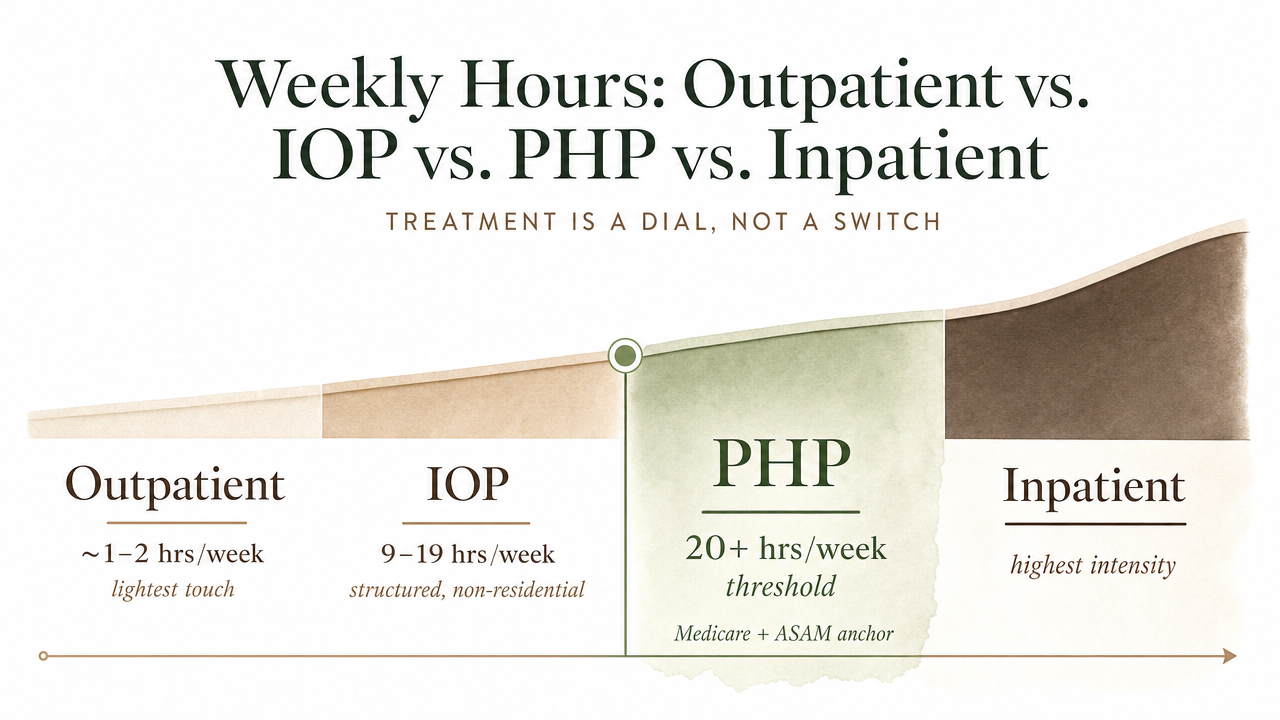
Weekly Hours: Outpatient vs. IOP vs. PHP vs. Inpatient
One of the most useful things you can do right now is stop thinking of treatment as a yes-or-no question. It's a dial, not a switch. The clearest way to see where PHP lands on that dial is to look at how many hours per week each level of care actually asks of you.
Standard outpatient care is the lightest touch. Picture a once-a-week therapy hour, maybe a check-in with a prescriber every few weeks. You're talking about roughly one to two hours of clinical contact per week. It works well for people who are stable, motivated, and not in crisis.
Intensive outpatient — IOP — steps things up. State and clinical definitions describe IOP (ASAM Level 2.1) as group-based, non-residential, structured treatment built around counseling and psychoeducation. In practice, that usually lands somewhere between nine and nineteen hours per week, with phases of care often running 90 days or longer. You go a few evenings or mornings a week, and you keep most of your schedule intact.4,9
PHP is where the hours jump. Medicare sets the threshold plainly: at least 20 hours of therapeutic services per week to qualify as partial hospitalization. ASAM uses the same floor for Level 2.5, sometimes called "day treatment," describing it as 20 or more hours of clinically intensive programming each week. That's a real commitment — most of a workday, most days of the week — but you still go home at night.2,8
Inpatient is the top of the dial. It's 24-hour care in a hospital or residential facility, with staff on site around the clock.
Look at it side by side and the picture gets simple. Outpatient is a slice of your week. IOP is a part-time job. PHP is closer to full-time treatment with evenings off. Inpatient is full immersion.
If weekly therapy isn't holding you, but you're not in immediate medical danger, PHP is often the level the numbers point to. The 20-hour threshold isn't arbitrary — it's the dose of structure clinicians and payers agreed is roughly equivalent to what someone would get in a short inpatient stay, minus the bed.8
ASAM Levels in Plain Language
You'll see the letters ASAM a lot when you read about treatment. ASAM stands for the American Society of Addiction Medicine, and they wrote the rulebook most insurers and treatment programs use to decide what level of care someone needs. Think of it as a shared map.
The map has five main levels for substance use treatment. Here's the plain-language version.9
When a clinician says you're "appropriate for Level 2.5," they're saying your symptoms or substance use need more than weekly therapy can hold, but you don't need a bed. That single phrase is doing a lot of work, and now you know what's behind it.
What a PHP Day Actually Looks Like
The hardest part of picturing PHP isn't the acronym — it's the day. Twenty hours a week sounds like a lot until you break it into actual moments, with breaks and coffee and people you start to recognize.
Here's a realistic shape of a PHP day, built from the service components CMS and SAMHSA describe as standard.7,10
Morning starts with a check-in. You arrive, you sign in, and a staff member usually does a quick wellness pulse — how did you sleep, how are cravings, are you safe. It's brief and human, not a clipboard interrogation.
Next is group therapy. This is the backbone of the day. A clinician leads a structured conversation — often cognitive behavioral therapy or dialectical behavioral therapy work, sometimes a process group where people talk about what came up this week. You're not expected to perform. You're expected to show up.
Somewhere in the morning or early afternoon, you'll meet one-on-one with your individual therapist or case manager, at least weekly and sometimes more often. PHP is built around an individualized treatment plan, not a one-size schedule, and that plan gets reviewed and adjusted in these sessions.10
Medication management fits in here too. If you're on medication for depression, anxiety, or substance use — including medication-assisted treatment for opioid or alcohol use disorder — a nurse or prescriber checks in regularly. PHP is a multidisciplinary setup, so the person handling your meds is talking to the people handling your therapy.10
Lunch is a break. Real food, real downtime. Some programs eat together; some let you step out. It's not therapy, but it's not nothing — eating in the middle of treatment days is part of how your body remembers what stability feels like.
Afternoons usually bring skills groups and psychoeducation. Skills groups teach the practical stuff: grounding when a craving hits, communication when a hard conversation is coming, sleep hygiene, relapse-prevention planning. Psychoeducation is the "why" — how addiction changes the brain, how trauma shows up in the body, what a panic attack actually is.7
The day usually wraps with a closing group or a brief check-out. You name one thing you're taking home, one thing you're worried about, one thing you'll do tonight. Then you go home — to your bed, your dog, your kid's bedtime story.
Four or five days a week, that rhythm repeats. That's how 20-plus hours stop sounding abstract and start feeling like a routine you can actually keep.
Recovery Starts With a Conversation
Whether you’re exploring recovery for yourself or seeking guidance for someone you care about, Coastal Recovery Partners is here to help. Our team offers trauma-informed, evidence-based support grounded in structure, compassion, and real connection—without pressure or judgment.
When you’re ready, we’ll meet you where you are and help you take the next step forward.
Who PHP Is Actually For
When PHP Fits Better Than Inpatient
There's a version of you that needs a hospital bed, and a version of you that needs hospital-level structure without the bed. PHP exists for that second version.
If you're not in immediate medical danger — not actively suicidal with a plan, not in severe withdrawal that needs medical monitoring overnight, not so disorganized that you can't keep yourself safe between sessions — inpatient may be more than the moment calls for. CMS describes PHP as the level of care designed specifically for people who would otherwise need inpatient psychiatric admission but can be safely treated during the day.10
That's a meaningful line. It means the clinical intensity is there. The team is there. What's different is the bed.
For a lot of people, that distinction matters more than it sounds. Keeping your home, your routine, your dog, your job — these aren't luxuries. They're often the things you're trying to protect by getting treatment in the first place. PHP lets the treatment be serious without asking you to dismantle your life to receive it.1
If a clinician says you're a candidate for PHP instead of inpatient, that's not a downgrade. It's a clinical judgment that you can do this work and still go home at night.
When PHP Fits Better Than IOP
IOP is real treatment. For some people it's exactly the right level. But there's a point where a few evenings a week of group work isn't enough to hold what you're carrying, and pretending otherwise just delays the harder conversation.4
PHP fits better than IOP when your symptoms or substance use are interfering with daily life in a way that nine to nineteen hours a week can't catch. Common signs include:
- You're missing work anyway.
- You're not sleeping.
- Cravings are loud most of the day.
- Depression is making it hard to get out of bed.
- You've tried weekly therapy or IOP and the wheels are still coming off.
McGovern Medical School describes PHP as day-hospital-level care for people who need more than IOP can provide but don't require 24-hour treatment — that gap is real, and it's where PHP lives.3
More hours mean more eyes on you. A nurse who notices a medication side effect on Tuesday instead of three weeks from now. A therapist who sees the pattern across five days, not one. That density of care is the whole point.
When PHP Isn't the Right Call
Honest answer: PHP isn't right for everyone, and you deserve to hear that plainly.
If you're in active medical withdrawal from alcohol or benzodiazepines, you likely need medical detox first — that's a setting with 24-hour monitoring, not a daytime program. PHP can pick up after detox, but it isn't built to replace it.
If you're in acute psychiatric crisis — actively suicidal with a plan and means, or unable to keep yourself safe between sessions — inpatient is the level of care that matches the risk. Going home at night is part of what makes PHP work, and it's also what makes it the wrong fit when nights are the dangerous part.10
On the other end, if you're already stable, working steadily, and your symptoms are manageable with weekly therapy and a prescriber, 20-plus hours a week may be more structure than your life needs right now. Standard outpatient or IOP can hold a lot of recovery.9
The right level isn't the most intense one you can get into. It's the one that matches where you actually are.
Dual Diagnosis: When Substance Use and Mental Health Show Up Together
A lot of people searching for the PHP definition aren't just dealing with one thing. They're drinking too much and also haven't slept right in months. They're using to quiet a panic that started long before the using did. They're sober for stretches and then a depressive wave pulls everything under again.
If that sounds familiar, you're not unusual. You're describing what clinicians call dual diagnosis — substance use and a mental health condition showing up at the same time, in the same person, often feeding each other.
PHP is one of the few levels of care actually built for this. The federal definition of partial hospitalization specifically names "serious mental disorder" as a reason for the program, and CMS describes PHP as active treatment delivered by a multidisciplinary team under a physician's direction. In plain words: the same team that's helping you stop drinking can also be treating the depression underneath, in the same building, on the same day.1,10
That matters more than it might sound. When substance use and mental health get treated separately — one clinic for the drinking, another for the anxiety — things fall through the cracks. A medication change on one side doesn't reach the other. A trauma response gets read as a relapse. PHP keeps the conversation in one room.
For substance use specifically, ASAM Level 2.5 programs are designed to address co‑occurring concerns within the same 20-plus hours of weekly programming, including psychoeducation, individual therapy, and medication support. If you're on medication for opioid or alcohol use disorder, that fits in here too — medication-assisted treatment isn't a separate track, it's part of the plan.2,7
You shouldn't have to choose which problem to treat first. PHP is one of the places where you don't have to.
Life Outside the Program: Work, Family, and Sleeping in Your Own Bed
One of the quietest gifts of PHP is the part nobody puts in a brochure: you go home at night.
That sounds small. It isn't. Sleeping in your own bed means your dog is at your feet. It means you hear your kid breathing down the hall. It means the smell of your own coffee in the morning, not a hallway. SAMHSA describes partial hospitalization as care delivered while people continue living at home — and that detail is doing real therapeutic work, not just logistical work.7
Work is the harder conversation. PHP is a serious time commitment — more than most jobs will let you flex around without a plan. Some people take short-term disability or FMLA leave to do PHP fully. Others negotiate reduced hours. A few programs offer afternoon or evening tracks that let you keep mornings for work, though availability varies.
Family life keeps moving too. You can still make dinner. You can still go to the parent-teacher conference. You can still be the person who tucks someone in. Recovery that lets you stay inside your own life is recovery you're more likely to keep.1
That's not a small thing to protect. That's the whole point.
What Happens After PHP: Step-Downs and Care Coordination
PHP isn't meant to last forever. The whole design assumes you'll step down — usually to IOP, then to standard outpatient, then to whatever long-term support keeps you steady. The question isn't whether you'll leave PHP. It's whether the handoff is built well enough that you don't lose what you gained.9
This is where care coordination earns its keep. A good PHP doesn't just discharge you with a list of phone numbers. The case manager who knew you during the day is the one helping line up your next therapist, your prescriber, your support group schedule, your medication-assisted treatment if you're on it. Continuity matters because the first few weeks after a step-down are when the wheels most often come off.
The evidence here is honest, not hyped. A systematic review of case management interventions for substance use disorders found that treatment adherence mostly improved with coordinated case management, while substance use decreased in about 33% of the studies and overall functioning improved in roughly 50%. That's a review of case management studies broadly, not PHP outcomes specifically — but the takeaway holds: people are more likely to stay engaged in care when someone is actively connecting the dots between providers, and engagement is the precondition for everything else.5
A solid step-down plan usually includes a few concrete pieces:
- A scheduled IOP or outpatient start date — not "call us next week."
- A named prescriber for medication continuity.
- A relapse-prevention plan you actually wrote.
- A way to reach someone if things wobble before your next appointment.
- Alumni or peer support if the program offers it.
The goal isn't to graduate from treatment. It's to keep enough scaffolding around you that the work you did during PHP has somewhere to live.
Paying for PHP: Insurance, Medicare, and Medicaid Basics
Money is usually the question right behind the clinical one, and it deserves a straight answer.
Most commercial insurance plans cover PHP as a recognized level of care, though they typically require prior authorization and ongoing documentation that you meet medical-necessity criteria — usually framed around ASAM Level 2.5 standards. Translation: a clinician has to show your insurer that 20-plus hours a week of structured care is the right match for what you're dealing with, not too much and not too little.11
Medicare Part B covers partial hospitalization specifically as an alternative to inpatient psychiatric care, with the requirement that your treatment plan calls for at least 20 hours of therapeutic services per week and that a physician certifies you would otherwise need inpatient treatment. Coverage applies when services are delivered by a hospital outpatient department or a qualifying community mental health center.6,8,10
Medicaid coverage varies state by state, but most state Medicaid programs include PHP as part of their ASAM-based behavioral health benefits.11
If this part feels overwhelming, that's fair. Verifying benefits, getting prior authorization, and lining up coverage isn't something you should have to do alone while you're also trying to get well. Most programs — including Coastal Recovery Partners — handle insurance verification and care coordination as part of intake, so you can focus on the harder work.
Remember that recovery is a journey of rebuilding trust—in yourself, in others, and in the process of healing. If you are ready to explore your options, reach out to Coastal Recovery today. We're here to help guide you toward a future defined not by your past, but by your resilience and hope.
Frequently Asked Questions
What does PHP stand for in medical terms?
PHP stands for partial hospitalization program. It's a structured daytime treatment program for serious mental health symptoms, substance use, or both, where you do intensive clinical work during the day and go home at night. It's not a hospital admission. It's hospital-level care without the bed.1
How is a PHP different from an IOP?
The biggest difference is hours and intensity. IOP (intensive outpatient) usually runs around nine to nineteen hours a week of group-based, structured treatment. PHP requires at least 20 hours per week and tends to include more clinical oversight, often with a physician or nurse involved in your care. PHP is for people who need more than IOP can hold.3,4,8
Do you sleep at the facility during a PHP?
No. That's the "partial" part of partial hospitalization. You attend the program during the day and return home each evening. You keep your own bed, your routine, and your responsibilities at home. PHP is specifically designed as an alternative to overnight inpatient care for people who can stay safe between sessions.1,10
How many hours per week does a PHP require?
Most PHPs run at least 20 hours of therapeutic services per week. Medicare specifically requires that your care plan call for 20 or more hours weekly for the program to qualify as partial hospitalization. ASAM uses the same threshold for Level 2.5 day treatment. In practice, that usually means four to five days a week, several hours each day.2,10
Can a PHP treat both substance use and mental health conditions?
Yes, and that's one of the strongest reasons people land in PHP. The federal definition of partial hospitalization specifically names serious mental disorders as a reason for the program, and CMS describes PHP as active treatment delivered by a multidisciplinary team. That setup lets the same clinical team address depression, anxiety, trauma, and substance use together rather than in separate buildings.1,10
Does insurance or Medicare cover a PHP?
Usually, yes. Medicare Part B covers partial hospitalization when a physician certifies you would otherwise need inpatient psychiatric care and your plan includes at least 20 weekly hours of therapeutic services. Most commercial insurance plans cover PHP under ASAM Level 2.5 criteria, and most state Medicaid programs include it as part of behavioral health benefits. Coverage almost always requires prior authorization.6,8,11
References
- Definition of partial hospitalization. The National Association of Private Psychiatric Hospitals.. https://pubmed.ncbi.nlm.nih.gov/10106610/
- Level 2.5 by Service Characteristics. https://www.pa.gov/content/dam/copapwp-pagov/en/ddap/documents/documents/asam/level%202.5%20by%20service%20characteristics.pdf
- Partial Hospitalization Program (PHP) | McGovern Medical School. https://med.uth.edu/psychiatry/center-for-interventional-psychiatry/levels-of-care/partial-hospitalization-program-php/
- Adult Substance Use Disorder Intensive Outpatient Level 2.1. https://dhhs.ne.gov/Behavioral%20Health%20Service%20Definitions/Adult%20Substance%20Use%20Disorder%20Intensive%20Outpatient%20Level%202.1.pdf
- Effect of Case Management Interventions for Patients with Substance Use Disorders: A Systematic Review. https://pmc.ncbi.nlm.nih.gov/articles/PMC5382199/
- Medicare Benefit Policy Manual Chapter 6 – Hospital Services Covered Under Part B. https://www.cms.gov/regulations-and-guidance/guidance/manuals/downloads/bp102c06.pdf
- Treatment Types for Mental Health, Drugs and Alcohol. https://www.samhsa.gov/find-support/learn-about-treatment/types-of-treatment
- Mental health care (partial hospitalization). https://www.medicare.gov/coverage/mental-health-care-partial-hospitalization
- Chapter 3. Intensive Outpatient Treatment and the Continuum of Care. https://www.ncbi.nlm.nih.gov/books/NBK64088/
- CMS Manual System – Pub 100-02 Medicare Benefit Policy (Partial Hospitalization). https://www.cms.gov/files/document/r12425bp.pdf
- Overview of substance use disorder (SUD) care clinical guidelines. https://www.medicaid.gov/state-resource-center/innovation-accelerator-program/iap-downloads/reducing-substance-use-disorders/asam-resource-guide.pdf