
How to Find Addiction Counseling Near Me That Fits Your Life

Key Takeaways
- Treat 'near me' as a fit question, not a distance one — a program that clashes with your work or family schedule isn't truly nearby.
- Pick the right level of care first (OP, IOP, or PHP) by matching intensity to your available hours, home stability, and any co-occurring mental health needs 9.
- Start your search with trusted tools like FindTreatment.gov, SAMHSA's National Helpline, Maine DHHS listings, and NIAAA's Alcohol Treatment Navigator instead of generic search results 2.
- Vet any program on five points: state licensing and credentialed staff, evidence-based therapies, real trauma-informed practice, medication support, and how quickly they can see you 1.
- Treat telehealth and hybrid options as a fit-to-life feature, since flexible access helps more people stay engaged through the weeks that get loud 5.
- Consider medication-assisted treatment when opioids or alcohol are part of your story — remote buprenorphine initiation has been linked to higher retention and lower overdose rates 7.
- Use a short, written question list on the first call to check timing, schedule options, therapies, co-occurring care, medication, and insurance before committing.
- Expect the call itself to feel hard, and lower the bar to one action — 'I'm looking into outpatient counseling and I have some questions' is enough to start 2.
What "near me" really means when you're trying to keep your job and your life
When you type "addiction counseling near me" into your phone at 11 p.m., you're not really asking Google for the closest address. You're asking whether help exists on a schedule you can actually keep — around a shift, a school pickup, a partner who doesn't know yet, a boss who can't know yet. That's a different question, and it deserves a better answer than the top pin on the map.
Here's the shift worth making early: "near me" is less about miles and more about fit. A program ten minutes away that only meets weekday mornings may be further from your real life than one twenty minutes away with evening groups and a hybrid telehealth option. Nearness that costs you your paycheck isn't nearness at all.
National guidance backs this up. NIDA's research-based principles for effective treatment stress that care needs to be readily available and matched to the person's actual circumstances, not squeezed into a slot that breaks the rest of their week 9.
So before you scroll listings, take sixty seconds and sketch your week. When are you free? Mornings before work? Evenings after the kids are down? Lunch breaks? What's non-negotiable — the job, the custody schedule, the class you're finishing? That short list is the real filter. Everything from here on is about matching a program to that list, not the other way around.
Start with the right level of care, not the closest clinic
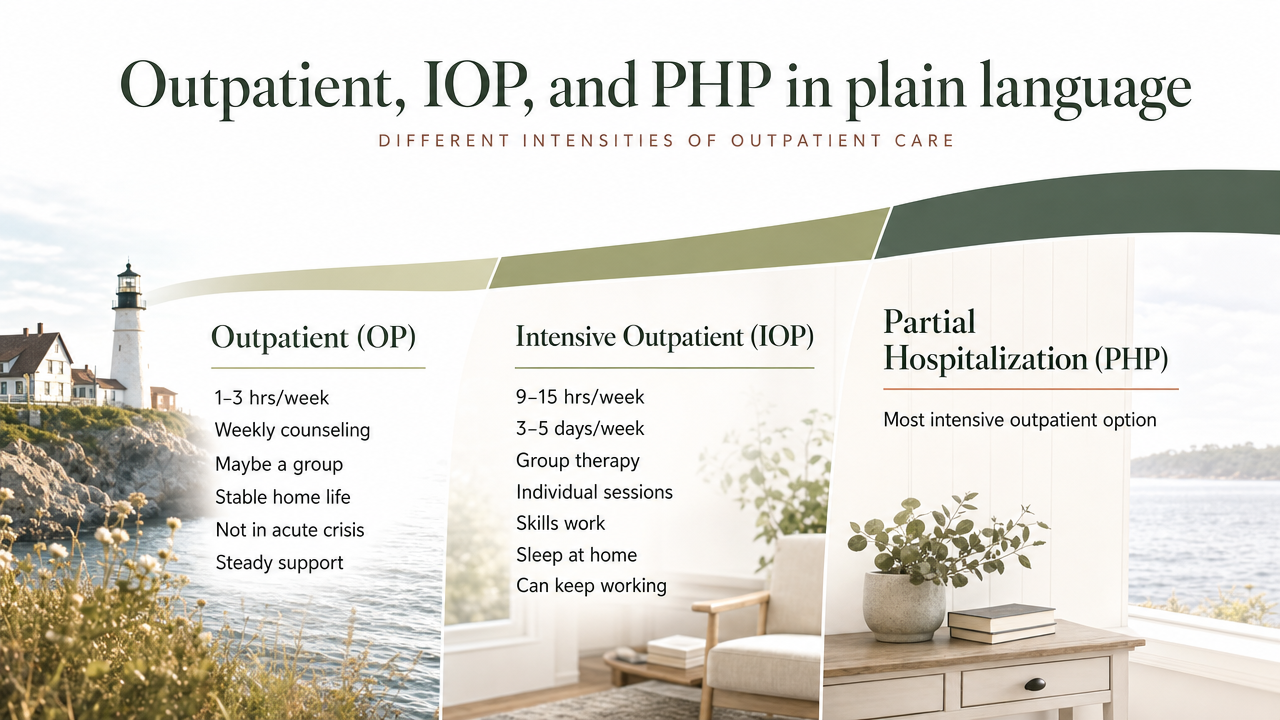
Outpatient, IOP, and PHP in plain language
Three letters keep showing up when you search: OP, IOP, PHP. They're not a ranking, and one isn't "better" than another. They're different intensities of the same kind of care, and picking the right one matters more than picking the nicest waiting room.
- Outpatient (OP)
- The lightest touch. Usually one to three hours a week — think weekly individual counseling, maybe a group. Good fit if your home life is stable, you're not in acute crisis, and you need steady support to hold recovery in place.
- Intensive Outpatient (IOP)
- Steps things up to roughly nine to fifteen hours a week, spread across three to five days. You'll get group therapy, individual sessions, and skills work. You still sleep at home, still go to work — but recovery becomes a real part of your week, not a weekly check-in.
- Partial Hospitalization (PHP)
- The most intensive option that still lets you go home at night. Usually twenty to thirty hours a week, most weekdays. It's often used when someone is stepping down from a hospital stay, managing serious co-occurring mental health needs, or needs more structure than IOP can give.
NIDA's guidance is straightforward: effective treatment matches intensity to the person's actual needs and integrates mental health care when it's part of the picture 9. That's the frame. Start there, not with the map.
Match the schedule to your actual week
Now take the sketch of your week you made earlier and lay it next to those three levels. This is where the choice gets real.
Ask yourself three honest questions:
How many hours a week can I actually give? Not "should" — actually. If you have a full-time job with no flex, twenty hours of PHP during weekdays isn't sustainable without short-term leave or FMLA. IOP with an evening track might be. If you're between jobs or on medical leave, PHP for a few weeks could be exactly the runway you need before stepping down to IOP.
How stable is home? If the people around you are supportive and your living situation is safe, lower-intensity outpatient care can hold. If home is chaotic, if there's active use nearby, or if you're isolated, you probably need more hours in a structured setting — more contact with clinicians, more group support, more accountability built into your week.
Is there a mental health piece too? Anxiety, depression, PTSD, and substance use often travel together. NIDA's principles are clear that treatment should integrate mental health care rather than treat it as an afterthought 9. If you've got a co-occurring diagnosis — or suspect one — a program that handles both under one roof (often called dual diagnosis care) will save you from bouncing between providers who don't talk to each other.
Here's a rough map to work from:
- OP (1–3 hrs/week) — Stable home, no acute mental health crisis, full work schedule, need steady maintenance.
- IOP (9–15 hrs/week) — Working or parenting, need real structure, co-occurring symptoms present but manageable, morning or evening tracks available.
- PHP (20–30 hrs/week) — Stepping down from a hospital or residential stay, significant co-occurring needs, or home environment that can't yet hold lighter care.
Programs built for working adults will offer morning, afternoon, and evening IOP tracks so you can keep the paycheck and the parenting schedule intact. If a local program only meets during your work hours and won't budge, that's not a schedule problem — that's a fit problem. Keep looking.
Trusted places to actually search from South Portland
Once you know roughly what level of care fits your week, the next move is picking where to search from. Not Google. Not a random directory. Start with tools built by people whose job is to keep the listings accurate.
FindTreatment.gov is the federal locator run by SAMHSA. You can filter by ZIP code, level of care (outpatient, IOP, PHP), payment options, and services like MAT or dual diagnosis. The CDC points anyone looking for mental health or substance use help to this same tool as the trusted starting point 2. From South Portland, plug in your ZIP and start narrowing.
SAMHSA's National Helpline (1-800-662-HELP) is free, confidential, and open 24/7. If a website feels like too much, a person on the phone can walk you through options in your area 2.
Maine DHHS Office of Behavioral Health maintains a state page listing regulated substance use treatment providers, including outpatient counseling, group programs, and opioid maintenance options for Mainers 10. It's a good cross-check against the federal locator, especially if you're looking for state-supported or MaineCare-friendly programs.
For alcohol specifically, NIAAA's Alcohol Treatment Navigator walks you through questions to ask and helps you spot signs of evidence-based care 3.
Open one of these right now if you can. That single click counts.
A five-point filter for vetting any local program
State licensing and qualified staff
The first filter is simple: is this program actually licensed to do what it says it does? In Maine, substance use treatment providers are regulated through the Department of Health and Human Services, and legitimate outpatient programs will list their licensing openly on their website or hand it over the phone without hesitation 10.
Ask who's on the clinical team. You want to see licensed clinicians — LCSWs, LCPCs, licensed alcohol and drug counselors — plus a medical director if the program offers medication support. SAMHSA's guidance on choosing quality treatment includes qualified, credentialed staff as one of its core signs of a program worth your time 1.
If a program dodges the question, changes the subject, or leans on vague language like "our team of caring professionals," that's your answer. You're not being picky. You're being a good advocate for yourself.
Evidence-based therapies like CBT and DBT
Second filter: what actually happens in the room? A quality program will name the therapies it uses, and those names should include a few specific ones.
Cognitive Behavioral Therapy (CBT) helps you notice the thoughts that pull you toward using and build different responses. Dialectical Behavior Therapy (DBT) teaches emotional regulation and distress tolerance — useful when strong feelings are a trigger. Motivational interviewing meets you where you actually are about change, not where someone thinks you should be. Relapse prevention gives you a real plan for the hard days.
NIAAA is direct about this: matching the right therapy to the person matters, and no single treatment works for everyone 3. Their guidance for clinicians also names CBT and FDA-approved medications as core signs of evidence-based care 4. SAMHSA lists evidence-based behavioral therapies among the five signs of quality treatment 1.
When you ask a program what therapies they use, listen for specifics. "We do talk therapy" isn't enough. "We use CBT, DBT, and motivational interviewing, and here's how they show up in group and individual sessions" is what you want to hear.
Trauma-informed practice you can actually evaluate
"Trauma-informed" gets used a lot. Sometimes it means something real. Sometimes it's a phrase on a website. You deserve to know which one you're dealing with.
SAMHSA's TIP 57 defines trauma-informed care around a few concrete principles: physical and emotional safety, choice and collaboration, empowerment, and treatment plans that address co-occurring disorders instead of pretending they aren't there 8. That last piece is important — trauma symptoms shouldn't block you from getting substance use care, and a good program treats them together, not in separate silos.
Here's how to test a program's language against practice. Ask:
- How do you handle it if a group discussion brings up something painful for me?
- Can I pass in group without being pushed to share before I'm ready?
- How do you coordinate care if I have a trauma diagnosis or a mental health condition alongside substance use?
- What does your intake process look like — does it feel like an interrogation or a conversation?
You're listening for answers that treat you as a person with choices, not a case being processed. Programs built around trauma-informed care will describe things like grounding skills, pacing, and giving you options within the treatment plan. If the answers feel rushed or dismissive on the phone, they'll probably feel that way in group too.
Medication support when it's part of the plan
Fourth filter: does the program offer medication when medication is part of what works?
For opioid use disorder, medications like buprenorphine and naltrexone are the standard of care. For alcohol use disorder, there are FDA-approved options too — naltrexone, acamprosate, and disulfiram. NIAAA highlights medication as a core feature of evidence-based treatment 4, and SAMHSA includes access to FDA-approved medications among the signs of a quality program 1.
Medication-assisted treatment doesn't replace counseling. It works alongside it. In a well-run outpatient program, you might be on buprenorphine while also attending IOP groups, doing individual CBT sessions, and building a relapse prevention plan. The medication steadies the ground so the therapy can do its work.
Ask any program you're considering: Do you prescribe or coordinate MAT? If you don't prescribe on-site, how do you work with a prescriber to keep everything connected? A program that treats medication as taboo, or that pressures you to taper before you're ready, isn't following the evidence. Keep looking.
How fast they can see you
Last filter, and it matters more than people think: timing.
Ask on the first call: How soon can I start? What's your intake process? Can we do the assessment this week?
A program that respects the courage it took to pick up the phone will move quickly. That's not a red flag on their end. That's the standard.
Recovery Starts With a Conversation
Whether you’re exploring recovery for yourself or seeking guidance for someone you care about, Coastal Recovery Partners is here to help. Our team offers trauma-informed, evidence-based support grounded in structure, compassion, and real connection—without pressure or judgment.
When you’re ready, we’ll meet you where you are and help you take the next step forward.
Why telehealth flexibility is a fit-to-life feature, not a nice-to-have
You already know why you're searching at 11 p.m. and not 11 a.m. Between shifts, kids, appointments, and the mental load of just holding it together, a program that only meets in-person on weekdays can feel like one more thing you can't quite reach. That's where hybrid and telehealth options stop being a perk and start being what makes staying in treatment actually possible.
The evidence here is real, and it's specific. A study of Medicaid claims data looked at people starting buprenorphine for opioid use disorder and tracked whether they stayed in treatment for 90 continuous days. In Kentucky, 48% of those who started via telehealth hit that 90-day mark, compared with 44% who started in person. In Ohio, the numbers were 32% versus 28% 5. Same medication. Same goal. The difference was that telehealth met people where they already were — at home, on a lunch break, in the car before a shift.
That's a narrow study — Medicaid data, opioid use disorder, buprenorphine specifically — so don't stretch it into a promise about every kind of care. But the direction it points matters. When treatment bends to your week instead of the other way around, more people stick with it. And staying is where recovery actually happens.
What this looks like in a good outpatient program: some group sessions on-site so you get the human connection that carries a lot of the work, and some sessions you can join remotely on the days a commute would cost you the appointment altogether. If a program you're vetting is rigid about this — no telehealth, no hybrid, no exceptions for the weeks life gets loud — ask why. Flexibility isn't lowering the bar. It's how the bar gets reached.
Medication-assisted treatment and remote access: what the research shows
If opioids or alcohol are part of your story, medication is worth understanding as its own tool — not a shortcut, not a moral question, just part of what works. And when that medication piece can start remotely, more people stay with it.
One study looked at adults starting buprenorphine for opioid use disorder and compared two groups: those who began treatment through telehealth and those who began in person. The telehealth group stayed engaged with OUD treatment at a rate of 54.5%, compared with 48.4% for the in-person group. The same study also found a 36% lower overdose rate among the telehealth-initiated patients 7. This was specifically about buprenorphine for opioid use disorder — not every medication, not every substance — but the signal is worth taking seriously if you're weighing MAT as part of your plan.
Why does remote initiation help? Because the barrier isn't usually motivation. It's a two-hour round trip on the one weekday your schedule is already stretched thin. When the first appointment can happen from your kitchen table, more people actually make it to the second one.
What this looks like in a real outpatient program: buprenorphine or naltrexone prescribed and monitored by a medical provider, paired with group and individual counseling, with some of that contact happening on video when the week gets tight. Coordinated MAT — where the prescriber, the counselor, and your relapse prevention plan are all in the same conversation — is what SAMHSA is pointing at when it lists FDA-approved medications among the signs of quality treatment 1. Ask any program you're considering how they handle that coordination. The answer will tell you a lot.
Questions to ask on the first phone call
The first call is short. Ten, maybe fifteen minutes. You don't have to explain your whole life. You just need enough information to know if this program can actually work for you — or if you should keep looking.
Keep this list on your phone or a sticky note. Read straight from it if that's easier. Nobody on the other end will judge you for having questions written down.
- How soon can I start? SAMHSA says a good program should see you within 48 hours 1. If they can't, ask why and what the wait looks like.
- What levels of care do you offer — OP, IOP, PHP? Confirm they have the intensity you actually need.
- What are your schedule options? Morning, afternoon, evening tracks? Any hybrid or telehealth days?
- What therapies do you use? Listen for specifics — CBT, DBT, motivational interviewing, relapse prevention 3.
- Do you treat co-occurring mental health conditions? If anxiety, depression, or trauma is part of your story, you want one program handling both 9.
- How do you handle medication if I need it? Buprenorphine, naltrexone, or coordination with a prescriber 4.
- Do you take my insurance? Have your card ready. Ask about sliding-scale fees if you don't have coverage.
- What does the first appointment look like? A calm answer here tells you a lot about how the program treats people.
You're allowed to hang up and think about it. You're allowed to call two or three places before deciding. Every question you ask is a small act of taking your recovery seriously — and that already counts.
Making the first call when it feels impossible
Here's the truth nobody puts on a website: the hardest part isn't the treatment. It's the call before the treatment.
You'll rehearse what to say. You'll pick up the phone and put it down twice. You might tell yourself you'll do it tomorrow, and tomorrow will move. That's not weakness. That's what asking for help feels like when you've been carrying something for a long time.
A few things that help. Pick a time when you have fifteen quiet minutes — not right before a meeting, not while the kids are still up. Have your insurance card nearby if you have one, but don't let not having one stop you. Programs that take this seriously will talk about sliding scales and MaineCare options with you 10. You do not need to know what you want yet. "I'm looking into outpatient counseling and I have some questions" is a complete sentence.
If the phone feels like too much, SAMHSA's National Helpline (1-800-662-HELP) is free, confidential, and open around the clock — sometimes a first conversation with someone who isn't a program is easier 2.
One call. That's the whole task today. Everything else can wait until you hang up.
Frequently Asked Questions
Does insurance cover addiction counseling in Maine?
Most commercial insurance plans and MaineCare cover outpatient addiction counseling, IOP, PHP, and medication-assisted treatment, though what you'll pay out of pocket depends on your specific plan. Call the number on the back of your card and ask about behavioral health benefits, or let the program's admissions team run a benefits check for you. Maine DHHS also lists state-supported options if you're uninsured 10.
Can I keep my job while attending outpatient counseling or IOP?
Yes — that's exactly what outpatient care is built for. Standard OP is usually one to three hours a week, and IOP programs designed for working adults offer morning, afternoon, or evening tracks so you can keep your schedule intact. If you need short-term flexibility, FMLA may protect your job during treatment. Ask the program about hybrid or telehealth days for weeks when your calendar gets tight.
How long does addiction counseling usually last?
There's no single answer, and that's honest, not evasive. IOP often runs eight to twelve weeks, PHP a few weeks before stepping down, and standard outpatient can continue for months as steady maintenance. NIDA's guidance is that duration should match your needs, not a fixed calendar 9. Many people move through levels of care as life stabilizes — more hours early on, fewer as recovery holds.
What should I bring or have ready for the first appointment?
Keep it simple: a photo ID, your insurance card if you have one, and a list of any medications you take. If you've been seen by another provider, having their name handy helps with care coordination. You don't need to prepare a speech or explain everything. The intake is a conversation, not a test. Show up as you are — that's already the hardest part done.
How quickly can I get into a program after I call?
A quality program should be able to see you within 48 hours — SAMHSA is explicit that if a provider can't meet that window, you should keep looking 1. Many outpatient programs offer same-week intakes, and some can start an assessment the day you call. Ask directly on the first call: "How soon can we do the intake?" A fast, calm answer is a good sign.
What if I can't afford treatment or don't have insurance?
You still have options. Maine DHHS supports treatment access for uninsured residents and lists community providers who accept MaineCare or offer state-funded slots 10. NIAAA notes that many programs use sliding-scale fees based on income 3. SAMHSA's National Helpline (1-800-662-HELP) is free and can point you toward low-cost or no-cost care in your area 2. Cost is a real barrier — it's not a dead end.
References
- Finding Quality Treatment for Substance Use Disorders. https://library.samhsa.gov/sites/default/files/pep18-treatment-loc.pdf
- Find Services and Treatment. https://www.cdc.gov/howrightnow/find-services/index.html
- Treatment for Alcohol Problems: Finding and Getting Help. https://www.niaaa.nih.gov/publications/brochures-and-fact-sheets/treatment-alcohol-problems-finding-and-getting-help
- Recommend Evidence-Based Treatment: Know the Options. https://www.niaaa.nih.gov/health-professionals-communities/core-resource-on-alcohol/recommend-evidence-based-treatment-know-options
- Telehealth supports retention in treatment for opioid use disorder. https://nida.nih.gov/news-events/news-releases/2023/10/telehealth-supports-retention-in-treatment-for-opioid-use-disorder
- Effects of Telehealth on Dropout and Retention in Care among Patients with Substance Use Disorders. https://pubmed.ncbi.nlm.nih.gov/36710568/
- Telehealth Initiation of Buprenorphine for Opioid Use Disorder: Patient Characteristics and Outcomes. https://pubmed.ncbi.nlm.nih.gov/37670069/
- TIP 57: Trauma-Informed Care in Behavioral Health Services (PDF). https://library.samhsa.gov/sites/default/files/sma14-4816.pdf
- Principles of Drug Addiction Treatment: A Research-Based Guide (Third Edition) - NIDA. https://nida.nih.gov/publications/principles-drug-addiction-treatment-research-based-guide-third-edition
- Substance Use Disorder Treatment - Maine DHHS Office of Behavioral Health. https://www.maine.gov/dhhs/obh/support-services/substance-use-disorder-services/treatment-services