
What to Expect from Alcohol Rehab Inpatient Treatment

Key Takeaways
- Inpatient care is the safer starting point when withdrawal risk is severe, home isn't sober, or medical and psychiatric issues sit on top of drinking 2, 11.
- Treatment works as a ladder from intensive inpatient down through PHP, IOP, and standard outpatient, and most people step down over time rather than staying at one level 3, 12.
- The length of an inpatient stay predicts less than what follows it; structured continuing care for three to twelve months is what's linked to durable recovery 6, 17.
- Before discharge, confirm which medications continue, who refills them, and when the first outpatient appointment is scheduled, since the handoff is where most relapses happen 8, 17.
The Decision Before the Decision: Do You Actually Need Inpatient Care?
Before you ever pack a bag or make a phone call, there's a quieter question you're probably wrestling with: is inpatient rehab really where I need to start? It's an honest question, and it deserves an honest answer instead of a marketing one.
Here's the clinical shorthand doctors use. If your alcohol withdrawal is likely to be mild or moderate, outpatient care can often manage it safely. If your withdrawal is likely to be severe, or you've had seizures, delirium tremens, or a serious medical condition on top of drinking, inpatient care is the safer place to begin 2, 11. That's not a judgment. That's just physiology.
A few other signals tend to push people toward an inpatient bed: an unstable or unsafe home environment, a previous outpatient attempt that didn't hold, or drinking that's tangled with untreated mental health symptoms you can't manage alone 1, 10. On the other hand, if you're still working, still connected to people who support you, and your body isn't in acute crisis, intensive outpatient care may fit you better than a 28-day stay away from everything you know 3.
You don't have to figure this out by yourself. A clinical assessment will match the intensity of care to what your body and life actually need, not the other way around.
How Inpatient Care Fits Into the Bigger Picture of Recovery
The Four Levels of Alcohol Treatment, in Plain Language
Treatment for alcohol use disorder isn't one thing. It's a ladder, and each rung has a different intensity depending on what your body, mind, and life need at that moment. Knowing the rungs helps you locate yourself on the map.
The NIAAA describes four basic levels of care 3. From lowest to highest intensity, they look like this:
- Outpatient (OP). Regular therapy sessions, usually a few hours a week, while you continue living your normal life.
- Intensive Outpatient or Partial Hospitalization (IOP/PHP). More hours per week of group and individual therapy, still living at home, often the step people take after detox or as a stronger alternative to standard outpatient.
- Residential. 24-hour support in a non-hospital setting, with varying intensity, focused on structure and community.
- Intensive inpatient. Medically directed 24-hour services that can manage withdrawal and stabilize acute medical or psychiatric issues 3.
Most people move down this ladder over time, not up. You might start at intensive inpatient for detox, step down to PHP or IOP once you're medically stable, and eventually land at standard outpatient as the ground under you gets firmer 12. Inpatient is one rung. It's a real and sometimes lifesaving one, but it's not the whole ladder.
Who Genuinely Needs a Bed, and Who Does Better in Outpatient Care
Here's where a lot of people get stuck, so let's be direct with you.
You likely need an inpatient bed if any of the following are true:
- You're at risk of severe withdrawal, including seizures or delirium tremens.
- You've had complicated withdrawal in the past.
- You have a serious medical condition alongside heavy drinking.
- Your home isn't safe or sober enough for you to detox there 11, 14.
- Prior outpatient attempts that didn't hold, or a co-occurring mental health crisis you can't manage on your own, also point toward starting with 24-hour care 10, 1.
You may do better in intensive outpatient or partial hospitalization if your withdrawal is likely to be mild to moderate, you have people at home who support your recovery, you're medically stable, and stepping away from work or caregiving for a month would create more chaos than it solves 2, 5. Outpatient doesn't mean "less serious." It means a different fit.
The honest truth: this isn't a decision you can perfectly self-diagnose from a website. A clinical assessment — the kind that looks at your drinking history, medical picture, mental health, and home environment together — is what actually places you on the right rung. Picking up the phone to ask for that assessment counts as a real step, even if the answer changes what you thought you needed.
Inside the Stay: What the First Days Actually Look Like
Intake, Assessment, and the First Conversation
The first few hours are usually quieter than you'd expect. You'll sign paperwork, hand over anything that isn't allowed on the unit, and sit down with a nurse or clinician for an intake conversation. They'll ask about your drinking history, past withdrawal experiences, medications, medical conditions, mental health, and what home looks like. It's a lot of questions, and the honest answers matter more than the polished ones.
This first conversation isn't a test. It's how the team builds your care plan. Inpatient programs are staffed by licensed clinicians who provide 24-hour, professionally directed evaluation and treatment, and that evaluation starts the moment you walk in 1. If you're already in early withdrawal, they'll take your vitals often and start monitoring symptoms right away.
You may also be screened for co-occurring mental health conditions during intake, since depression, anxiety, and trauma often ride alongside heavy drinking and shape what treatment should look like 16.
Medically Supervised Detox: Withdrawal, Monitoring, and Medications
Detox is the part most people are afraid of, and that fear is fair. Alcohol withdrawal is one of the few withdrawals that can actually be dangerous on its own, which is exactly why medical supervision exists.
In an inpatient detox, you're under 24-hour observation by clinical staff who are watching for the signs that matter: rising blood pressure, tremor, sweating, confusion, and any hint of a seizure or delirium tremens 1, 14. Nurses typically check on you every few hours during the acute phase, using a symptom scale to decide how much medication you need and when. You aren't left to white-knuckle it.
The medication piece is more straightforward than it sounds. Benzodiazepines are the standard of care for acute alcohol withdrawal, and they work by calming the nervous system down while your brain readjusts to life without alcohol 11, 14. Doses are usually higher at the start and taper off as symptoms settle, which is why the first 24 to 72 hours tend to be the most intense and the days after get noticeably easier.
For some people, detox is also when longer-term alcohol use disorder medications are introduced or discussed. Naltrexone, acamprosate, or disulfiram may be started during the stay or planned for right after, and they're designed to be continued in outpatient care once you're discharged 8, 15. Nobody expects you to memorize any of this. The team walks you through what each medication does, why they're recommending it, and what side effects to watch for. Ask questions. Ask them twice if you need to.
A Day on the Unit After Detox: Groups, Therapy, and Downtime
Once the acute withdrawal fog lifts, usually somewhere between day three and day five, the shape of your day changes. Detox recedes. Structure takes over.
A typical weekday tends to look something like this: breakfast, a morning check-in or community meeting, a psychoeducation group about how alcohol affects the brain and body, lunch, an afternoon therapy group (often using cognitive behavioral or motivational approaches), a one-on-one session with your counselor a few times a week, and an evening group or 12-step meeting. There's downtime built in too — journaling, quiet reading, walking outside if the unit allows it 1, 7.
The groups can feel awkward at first. Most people don't love speaking up in a room of strangers. But those rooms are also where you'll hear someone else describe the exact thought pattern you thought was yours alone, and something shifts. Recovery is described in the clinical literature as an iterative process that uses multiple therapies, medications, and community supports over time 7. Your inpatient days are where that process starts, not where it finishes.
How Long You'll Be There, and Why Length Matters Less Than You Think
The number most people want up front is the number of days. Here it is: a typical inpatient rehabilitation stay runs about 21 to 28 days, usually followed by a step-down to outpatient care 10. Some residential programs run longer, sometimes several months, but the three-to-four-week window is what most first-time patients encounter.
That figure can feel enormous when you're staring at a work calendar or thinking about who will pick up the kids. It's a real disruption. It's also, in the arc of a life, a short stretch.
So if you're negotiating with yourself about whether you can "afford" 28 days, try reframing the math. Those days aren't the finish line. They're the runway. The plan that gets built during that stay — what medications you'll continue, which outpatient program picks you up, who checks on you in week six — is where the durability of your recovery actually lives. A shorter stay with a strong handoff often outperforms a longer stay with no plan attached.
The Emotional Terrain: Fear, Shame, and What Family Will Think
Nobody talks enough about this part. The clinical stuff is easier to explain than the knot in your chest when you imagine telling your boss, your kids, or your mother that you're checking into rehab.
The fears tend to cluster around a few honest questions. Will withdrawal hurt? Will I lose my job? Will my kids look at me differently? Will I do all of this and still fail? These aren't irrational worries. They're the reasonable calculations of someone who has been holding a lot together for a long time.
Here's what's worth knowing. Shame is almost universal at intake, and it tends to soften once you're in a room with people who have carried the same weight. Alcohol use disorder often travels with depression, anxiety, or unresolved trauma, and inpatient teams are trained to look at both at once rather than pretending drinking is the only story 16. If part of what's kept you drinking is something you've never said out loud, there is finally space for that.
The fear of failing again deserves its own honest answer. Recovery is described in the clinical literature as an iterative process, meaning setbacks are part of the map, not proof you're broken 7. Reaching out for an assessment isn't a promise you'll do this perfectly. It's a small, real decision that counts on its own.
Recovery Starts With a Conversation
Whether you’re exploring recovery for yourself or seeking guidance for someone you care about, Coastal Recovery Partners is here to help. Our team offers trauma-informed, evidence-based support grounded in structure, compassion, and real connection—without pressure or judgment.
When you’re ready, we’ll meet you where you are and help you take the next step forward.
The Discharge Cliff: What Happens on Day 22 or Day 29
Why Unsupported Step-Downs Fail
Here's a pattern that shows up over and over. Someone completes a solid inpatient stay, feels stronger than they've felt in years, and walks out with a folder of paperwork and a vague plan to "stay in touch." Three weeks later, they're back where they started, wondering what went wrong.
Nothing went wrong with the person. What often goes wrong is the handoff. Continuing care after residential treatment is consistently linked to lower substance use and better functioning, while stays without structured follow-up tend to lose ground once the daily scaffolding of the unit disappears 17. The clinical version of this is straightforward: an inpatient stay stabilizes you, but stabilization isn't the same as recovery.
The reason is human, not clinical. Inside the unit, your schedule is decided for you. Meals, groups, medications, sleep. On day 22 or day 29, all of that vanishes at once, and you're back in the same kitchen where you used to drink, next to the same phone that used to buzz at 5 p.m. Without a warm handoff to the next level of care, the gap between discharge and "figuring it out" is where most relapses live.
What Continuing Care Actually Looks Like: PHP, IOP, and Outpatient
The good news is that the next chapter is well mapped. Most people step down from inpatient into one of two structured outpatient options before eventually settling into standard outpatient therapy.
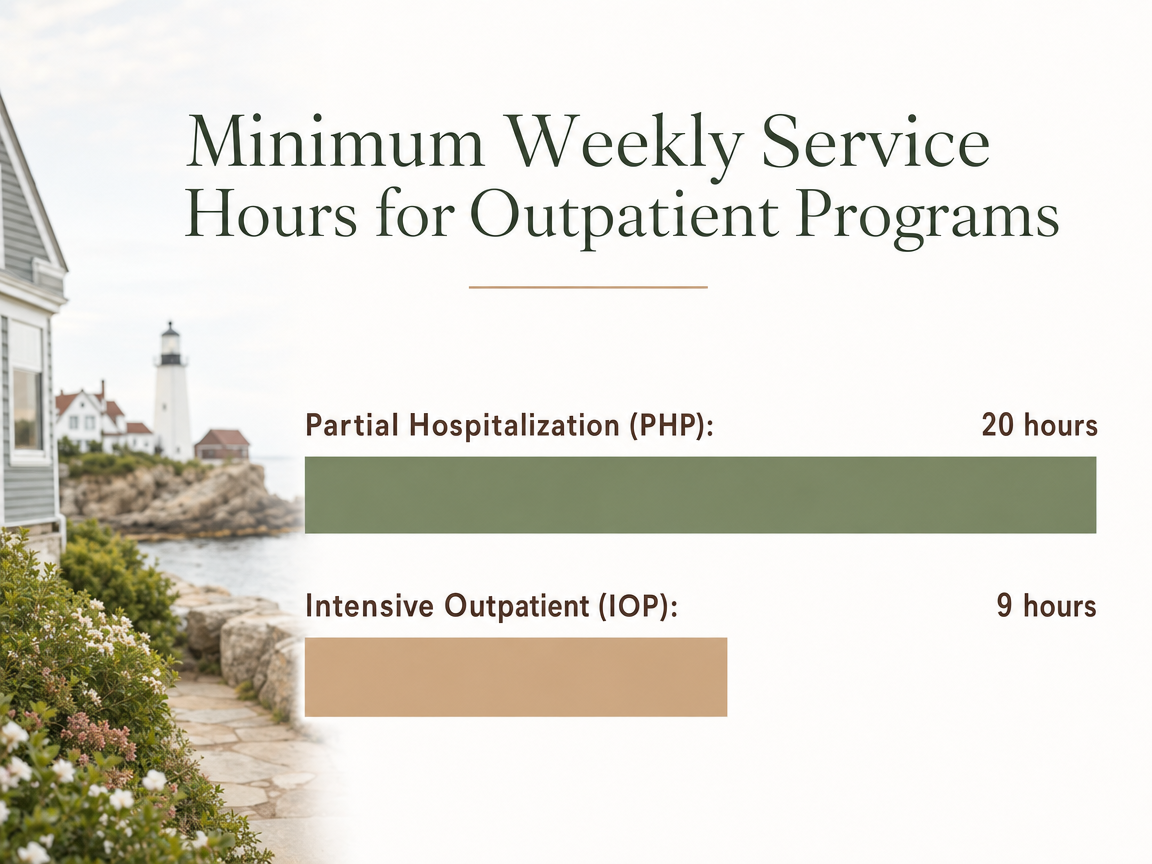
Partial Hospitalization Programs (PHP) are the closest thing to inpatient without the overnight stay. The clinical standard is a minimum of five days a week and at least 20 hours of direct service per week 6. You go home at night, but your days look a lot like they did on the unit: groups, individual sessions, psychoeducation, medication management. It's often where people land in the first weeks after discharge, especially if home is stable but still fragile.
Intensive Outpatient Programs (IOP) run at a lower intensity, with a minimum of three days a week and at least 9 hours of service per week 6. That's the level most people can hold alongside work, school, or caregiving. Morning, afternoon, and evening scheduling options exist specifically so you don't have to choose between recovery and the rest of your life.
How long should this continue? The evidence is more definite than most people expect. Structured continuing care for a minimum of three to six months, and often up to twelve months, is what's linked to durable recovery 6. Shorter stretches tend to show little added benefit. That's the real timeline of getting well: not 28 days, but closer to a year of gradually decreasing support.
Standard outpatient therapy — a weekly session or two — is usually where you land after PHP and IOP, and it can continue as long as it's useful. Think of the three levels as a staircase down, not a cliff.
Medications That Often Continue After Discharge
If a medication for alcohol use disorder was started or discussed during your inpatient stay, discharge isn't the end of it. It's the middle. Naltrexone, acamprosate, and disulfiram are designed to be part of long-term management, and they're most effective when combined with ongoing counseling rather than taken in isolation 8, 15.
The practical piece is coordination. Someone needs to write the refill, monitor how you're tolerating the medication, and adjust the plan if something isn't working. That someone is usually your outpatient prescriber, working alongside your therapist. When the handoff between the inpatient team and the outpatient program is clean, your prescription doesn't lapse and your progress doesn't reset.
Weighing Inpatient Against Intensive Outpatient: An Honest Comparison
If you've read this far, you probably already sense that the choice isn't as black-and-white as most rehab websites make it sound. Here's the part rarely said out loud: for many people with alcohol use disorder, intensive outpatient programs produce outcomes broadly comparable to inpatient or residential care. A systematic review of IOP research for substance use disorders concluded that outcomes do not differ significantly between inpatient and intensive outpatient settings for patients who don't need medical detox or 24-hour supervision 5. Some studies have even shown better detox completion in outpatient settings for certain patients, while at least one longer-term study favored inpatient 9. The evidence is genuinely mixed, and that mix matters.
What that means for you: inpatient isn't automatically the stronger choice, and outpatient isn't a compromise. They're different tools for different clinical pictures.
Inpatient earns its place when withdrawal is likely to be severe, when medical or psychiatric complications are stacked on top of drinking, or when home simply isn't a place you can get sober 2, 14. Intensive outpatient earns its place when you're medically stable, have some support around you, and would lose more than you'd gain by disappearing from work or family for a month 4. Neither is a moral verdict on you.
The one thing both paths share: whatever level you start at, the plan that carries you for the next several months is what actually moves the needle.
Questions to Ask Before You Choose a Program
When you call a program, you're allowed to interview them. In fact, please do. A few direct questions will tell you more than any glossy website.
- How do you assess whether inpatient is the right level of care for me? A good program will describe an actual clinical assessment, not just an admissions form 1.
- What does your detox protocol look like, and who supervises it? Listen for 24-hour clinical monitoring and standard withdrawal medications 11, 14.
- Do you treat co-occurring mental health conditions during the stay? Depression, anxiety, and trauma need to be part of the plan, not a footnote 16.
- What medications for alcohol use disorder do you offer, and how are they continued after discharge? Naltrexone, acamprosate, and disulfiram should be on the table 8, 15.
- What does your discharge plan and step-down to PHP or IOP look like? The answer should be specific, not vague 6, 17.
If the answers feel scripted, keep asking. You're not being difficult. You're being careful with your own life.
Finding Coordinated Care After Inpatient Rehab
The most important phone call you'll make isn't the one that gets you into a bed. It's the one that lines up what happens next. A coordinated handoff means someone who knows your history is already scheduled to see you the week you discharge, your medications are ready at the pharmacy, and your first outpatient group is on the calendar before you unpack your bag.
In Maine, that step-down often looks like a trauma-informed PHP or IOP that fits around work and family, integrates dual diagnosis care, and continues any medications started during your stay 6, 16. If you're piecing this together for yourself or someone you love, Coastal Recovery Partners offers Recovery Planning and Care Coordination to help bridge that gap. Asking for that plan is a real step forward. It counts.
Frequently Asked Questions
How do I know if I need inpatient rehab or if outpatient care is enough?
The clearest signals for inpatient are a history of severe withdrawal (seizures, delirium tremens), heavy daily drinking with medical complications, an unsafe home for detox, or a prior outpatient attempt that didn't hold 2, 11. If your withdrawal is likely mild to moderate and you have support at home, intensive outpatient often fits. A clinical assessment makes the call.
Is alcohol detox dangerous, and will I be safe during withdrawal?
Alcohol withdrawal can be serious, which is exactly why medically supervised detox exists. In an inpatient setting, staff monitor you around the clock and use benzodiazepines to calm the nervous system as your brain adjusts 11, 14. The first 24 to 72 hours are usually the hardest, then symptoms ease. You won't be white-knuckling it alone.
What happens after I'm discharged from inpatient rehab?
Discharge is a handoff, not a finish line. Most people step down into a Partial Hospitalization Program or Intensive Outpatient Program for the next several weeks, then move to standard outpatient therapy. Structured continuing care for three to twelve months is what's linked to durable recovery 6, 17. Ask before you leave who picks you up on week one.
Can I keep taking medications like naltrexone or acamprosate after I leave?
Yes, and you usually should. Naltrexone, acamprosate, and disulfiram are designed for long-term management and work best combined with counseling 8, 15. Your outpatient prescriber refills them and adjusts the plan. Before discharge, confirm three things: which medications you're continuing, who's writing the next refill, and when your first outpatient appointment is scheduled.
Is inpatient treatment more effective than intensive outpatient?
Not automatically. For patients who don't need medical detox or 24-hour supervision, systematic reviews have found outcomes between IOP and inpatient are broadly comparable 5. Inpatient earns its place when withdrawal is severe or home isn't safe. Outpatient earns its place when you're medically stable. Both work when followed by strong continuing care.
What should I tell my employer and family when I go to rehab?
You get to decide how much to share. Many people tell employers they're taking medical leave for a health condition, which is accurate and protected. With family, honest is usually easier than perfect. Integrated treatment often addresses the mental health piece too, so what you name doesn't have to be the whole story 16.
References
- 2 Settings, Levels of Care, and Patient Placement. https://www.ncbi.nlm.nih.gov/books/NBK64109/
- Treatment of Alcohol Use Disorder. https://www.ncbi.nlm.nih.gov/books/NBK561234/
- What Types of Alcohol Treatment Are Available?. https://alcoholtreatment.niaaa.nih.gov/what-to-know/types-of-alcohol-treatment
- Substance Abuse: Clinical Issues in Intensive Outpatient Treatment (TIP 47). https://library.samhsa.gov/product/tip-47-substance-abuse-clinical-issues-intensive-outpatient-treatment/sma13-4182
- Substance Abuse Intensive Outpatient Programs: Assessing the Evidence. https://pmc.ncbi.nlm.nih.gov/articles/PMC4152944/
- The Continuing Care Model of Substance Use Treatment. https://pmc.ncbi.nlm.nih.gov/articles/PMC4007701/
- The Management of Alcohol Use Disorders. https://pmc.ncbi.nlm.nih.gov/articles/PMC4318665/
- TIP 49: Incorporating Alcohol Pharmacotherapies Into Medical Practice. https://library.samhsa.gov/product/tip-49-incorporating-alcohol-pharmacotherapies-medical-practice/sma13-4380
- Summary of Evidence - Inpatient and Outpatient Treatment of Patients With Substance Use Disorders. https://pmc.ncbi.nlm.nih.gov/articles/PMC507689/
- Clinical Review on Alcohol Use Disorders (article containing Table 2). https://pmc.ncbi.nlm.nih.gov/articles/PMC12457915/
- Alcohol Use Disorder: From Risk to Diagnosis to Recovery. https://www.niaaa.nih.gov/health-professionals-communities/core-resource-on-alcohol/alcohol-use-disorder-risk-diagnosis-recovery
- Treatment for Alcohol Problems: Finding and Getting Help. https://www.niaaa.nih.gov/publications/brochures-and-fact-sheets/treatment-alcohol-problems-finding-and-getting-help
- Alcohol and Public Health: Frequently Asked Questions. https://www.cdc.gov/alcohol/faqs.htm
- Alcohol Withdrawal Syndrome: Mechanisms and Management. https://www.ncbi.nlm.nih.gov/pmc/articles/PMC3860535/
- Medical Management of Alcohol Dependence. https://www.ncbi.nlm.nih.gov/pmc/articles/PMC3860932/
- Substance Use and Mental Health. https://www.nimh.nih.gov/health/topics/substance-use-and-mental-health
- Residential Treatment of Substance Use Disorders: Evidence and Controversies. https://www.ncbi.nlm.nih.gov/pmc/articles/PMC4506906/