
What Actually Works? Most Effective Addiction Treatment Methods

Key Takeaways
- Treatment that holds up combines three ingredients working together: the right medication when applicable, an evidence-based behavioral therapy, and enough structured time to make new patterns stick 1.
- For most adults, intensive outpatient care produces outcomes comparable to residential rehab at roughly half the cost, with 50% to 70% reporting abstinence at follow-up 2, 3.
- Three months is the minimum duration linked to meaningful change, which is why a 28-day stay without a real step-down plan often unravels 1.
- Evaluate any program by asking four things: which specific therapies they blend, how they handle medication, how they treat co-occurring conditions, and what continuing care looks like after discharge.
What the Evidence Says (and What Most Brochures Won't Tell You)
If you're reading this at 11 p.m. with a browser full of rehab websites, take a breath. You're already doing the hardest part: looking for care that actually works instead of care that just sounds reassuring.
Here's what the research consistently shows. Addiction is a chronic brain condition, and the treatments with the strongest evidence are the ones that combine three things: the right medication (when it applies), a proven talk therapy, and enough time in structured care to change daily patterns. That's not one program or a 28-day stay. It's a plan, sustained for months, that treats the substance use and the mental health piece together 1.
Most brochures skip the part you most need to hear: for the majority of adults, intensive outpatient care produces outcomes comparable to residential rehab, at roughly half the cost 3. Your adult child does not have to disappear for a month for treatment to be real. In fact, staying connected to their job, home, and family often helps the skills stick, because they're practicing them in the life they actually live.
The rest of this article walks through what each of those pieces looks like, what the numbers behind them actually say, and how to tell a credible program from a well-marketed one.
The Three Ingredients of Treatment That Actually Works
When researchers look at what separates treatment that changes lives from treatment that just fills a calendar, three ingredients keep showing up together.
The first is the right medication, when the substance calls for one. For opioid use disorder, that usually means buprenorphine, methadone, or naltrexone. For alcohol, it can mean naltrexone or acamprosate. These aren't crutches. They stabilize brain chemistry so your adult child can actually do the hard work of therapy without white-knuckling every hour 1.
The second is a behavioral therapy with real research behind it, not just a name on a wall. CBT, DBT, motivational interviewing, and contingency management all have decades of evidence. Each one teaches something specific: how to handle a craving, how to sit with a hard emotion, how to rebuild a life that doesn't revolve around using.
The third is enough structure, sustained long enough, to make those first two ingredients stick. That's where the level of care matters, and where 30-day programs often fall short.
The next sections take each ingredient apart so you can see what a strong program actually delivers.
Medication-Assisted Treatment: What the Medications Actually Do
Buprenorphine, Methadone, and Naltrexone in Plain Language
If you've spent any time on forums or reading pamphlets, you've probably run into all three of these names without a clear sense of what they do differently. Here's the short version, in language you can use when you're talking to a prescriber or your adult child.
Buprenorphine (you may know it as Suboxone when it's combined with naloxone) partially activates the same brain receptors that opioids like heroin, fentanyl, or oxycodone hit. It's just enough activation to stop the physical withdrawal and cut cravings, but not enough to produce the high. Most people take it as a daily film or tablet under the tongue. Some newer versions are monthly injections.
Methadone fully activates those receptors, but slowly and steadily, without the peaks and crashes that drive compulsive use. It's dispensed daily at a licensed opioid treatment program, which sounds inconvenient but gives some people the structure they need in early recovery.
Naltrexone works differently. It blocks the receptors entirely, so opioids simply can't produce an effect. It's used for both opioid and alcohol use disorder, and comes as a daily pill or a monthly injection (Vivitrol). It requires being fully detoxed first, which is why it's often started after a step-down from another medication.
None of these are a substitute for the underlying problem. What they do is quiet the biological noise so your adult child can actually engage in therapy, hold down a job, and rebuild trust. NIDA has been clear about this for years: under medical supervision, these medications stabilize brain function rather than perpetuate addiction 1.
Why Maine Treats MAT Plus Therapy as the Standard of Care
If someone tells you that medication for opioid use disorder is optional, or a compromise, or somehow less serious than an abstinence-only program, they're not describing what the state of Maine actually requires of its clinicians.
Maine's Board of Licensure in Medicine directs clinicians to offer or arrange evidence-based treatment for opioid use disorder, which it defines as medication-assisted treatment with buprenorphine or methadone in combination with behavioral therapies 10. That's not a suggestion in a footnote. It's the standard care that a licensed prescriber is expected to provide or refer for.
A separate joint rule from Maine's licensing boards sets the standards for delivering that treatment in office-based outpatient settings, outside of the traditional methadone clinic, so patients can receive medication and counseling in a normal medical or therapy office 11.
The Behavioral Therapies With the Strongest Track Record
CBT: Skill Practice for the Moments That Usually End in Use
Cognitive behavioral therapy gets thrown around so often that it can start to sound like wallpaper. Here's what it actually looks like in a room.
A CBT session for substance use usually starts with a specific moment from your adult child's week. Maybe it was Thursday night, after a fight with a coworker, when the thought showed up: I've earned a drink. The therapist walks them backward through that moment. What was happening in the body? What was the thought right before the craving? What did they do next? Then they practice a different response, out loud, sometimes on paper, sometimes role-played. The goal isn't insight. It's a rehearsed set of moves for the next Thursday night.
Over a full course of CBT, that skill practice stacks up. A meta-analysis of CBT trials for alcohol and other drug use disorders found outcomes roughly 15% to 26% better than no-treatment or minimal-treatment controls 6. That's not a miracle number, and it shouldn't be sold as one. It's the size of the effect you can reasonably expect when someone actually does the homework between sessions.
CBT also holds up in newer delivery formats. A randomized trial of a computerized CBT program called CBT4CBT found that adults who used it, alongside minimal clinician monitoring, reduced substance use more than those in standard care, with the benefit still showing at the 6-month follow-up 5. That matters because it tells you the skills themselves are what's working, not just a charismatic therapist. If your adult child gets solid CBT and practices between sessions, they carry something useful out the door.
DBT and Trauma-Focused Work for the Co-Occurring Piece
If CBT is skill practice for the thinking part, dialectical behavior therapy (DBT) is skill practice for the feeling part.
DBT was originally built for people whose emotions arrive at 10 out of 10 before they know what happened. That's a description a lot of parents recognize when they think honestly about their adult child. In a DBT session, your adult child learns to name what they're feeling, tolerate it without immediately trying to fix or numb it, and use a specific technique, sometimes as simple as holding an ice cube or slowing their breath, to bring the intensity down before making a decision.
For adults whose substance use sits on top of trauma, depression, or anxiety, this piece is not optional. NIDA's principles are explicit that effective treatment addresses the whole picture, including co-occurring mental health conditions, not just the substance itself 1. When a program treats only the drinking or the pills and ignores what's underneath, relapse is often just a matter of time.
Trauma-focused work happens alongside DBT in strong programs. It doesn't mean forcing your adult child to relive the worst moments of their life on day one. It means a therapist trained to move at their pace, using approaches that help the nervous system stop treating ordinary stress like a threat. If a program cannot tell you clearly how they handle trauma and mental health alongside substance use, keep asking questions.
Contingency Management: Structured Reinforcement That Outperforms Its Reputation
Contingency management (CM) is the therapy most parents have never heard of, and it may be the one with the most surprising evidence behind it.
The idea sounds almost too simple. Your adult child provides a negative urine screen or shows up to a scheduled group, and they receive a small, immediate reward: a gift card, a voucher, a modest cash prize drawn from a fishbowl. The reward grows as the streak grows. Miss a target, and it resets. That's it. No lectures, no shame, no essays about why they used.
The simplicity hides the mechanism. Substances hijack the brain's reward system by delivering huge, immediate reinforcement for using. CM competes on the same terms, delivering small, immediate, reliable reinforcement for not using. Over weeks, that's enough to shift daily choices while other therapies do their slower work.
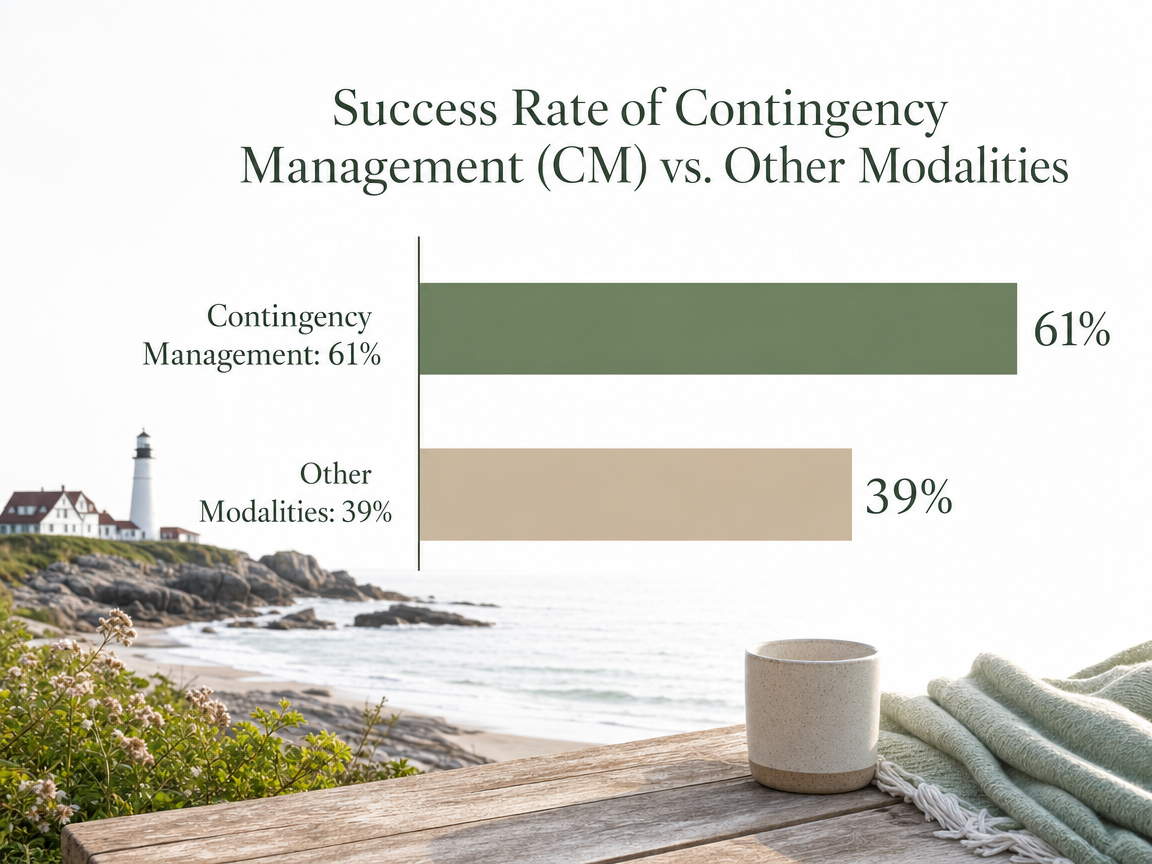
The outcome data is genuinely striking. One meta-analysis found CM produced successful treatment episodes 61% of the time, compared to 39% for other modalities 8. A more recent meta-analysis put the posttreatment abstinence effect size at d = 0.54, and made a strong recommendation for CM as an empirically supported treatment for drug use disorder 7.
CM is especially useful for stimulant use disorders, where no FDA-approved medication exists, and for the growing number of people using both stimulants and opioids together. For that co-use group, CM more than doubles the odds of a urine sample negative for both substances (odds ratio 2.46) compared to control conditions 9. If your adult child is using more than one substance, ask directly whether the program includes CM. Many still don't, out of habit rather than evidence.
Why Programs That Blend Approaches Beat Single-Modality Ones
No single therapy in this section is the answer. That's not a hedge. It's what the SAMHSA Treatment Improvement Protocol on intensive outpatient care actually says: effective programs blend multiple evidence-based approaches, matched to what each patient needs at that stage of recovery 4.
In practice, that looks like a week where your adult child does CBT for high-risk situations, DBT skills for emotional intensity, a CM protocol for weekly abstinence targets, and motivational interviewing when ambivalence about staying in treatment shows up. Each therapy handles a different problem. CBT can't quiet a nervous system on its own. DBT doesn't reinforce showing up. CM doesn't teach coping.
So when you look at a program, don't ask what therapy they use. Ask which combination, and how they decide when to lean on each one for your adult child specifically.
Recovery Starts With a Conversation
Whether you’re exploring recovery for yourself or seeking guidance for someone you care about, Coastal Recovery Partners is here to help. Our team offers trauma-informed, evidence-based support grounded in structure, compassion, and real connection—without pressure or judgment.
When you’re ready, we’ll meet you where you are and help you take the next step forward.
Levels of Care: OP, IOP, PHP, and When Residential Actually Helps
What Outpatient Intensity Really Looks Like in a Week
When people hear "outpatient," they often picture a 50-minute therapy session on a Tuesday afternoon. That's standard outpatient (OP), and for someone in a stable place in recovery, it can be exactly right. But intensive outpatient (IOP) is a different animal, and it's worth seeing what a real week looks like before deciding whether it can carry the weight your adult child needs.
SAMHSA defines an adult IOP as a minimum of 9 hours per week of structured services, delivered across three or more days. That typically breaks down into a mix of group therapy (often 3 groups a week, 2 to 3 hours each), individual counseling, family psychoeducation sessions, case management, and MAT check-ins for anyone on medication 3. Some programs run mornings, some run evenings, and the better ones offer both so a working adult can keep their job while getting real treatment.
Inside those hours, your adult child is doing CBT skill work, DBT emotional regulation practice, relapse-prevention planning, and often a peer group where people are two weeks, two months, or two years ahead of them. Between sessions, they're back in their actual life, testing what they learned against Friday night, the family dinner, the coworker who always wants to get a drink after work.
How long does this last? The median length of stay for adults who complete IOP is 81 days 3. That's roughly three months of structured, sustained care, which lines up with the minimum duration research consistently associates with lasting change.
Outpatient vs. Residential: What the Outcomes Data Actually Shows
Here's the piece of research most parent-facing content quietly leaves out. When SAMHSA-sponsored reviewers pooled 12 studies of intensive outpatient programs and compared them against inpatient and residential treatment, IOPs came out equivalent for most adults. Across the studies, 50% to 70% of participants reported abstinence at follow-up, and the reductions in alcohol and drug use were substantial across the board 2.
Read that again if you need to. For most adults with a substance use disorder, an intensive outpatient program produces outcomes comparable to a residential stay. Not a discount version of it. Comparable outcomes.
And the cost difference is not small. SAMHSA's advisory on IOPs reports that these outcomes come in at roughly half the cost of inpatient treatment 3. That matters not because your adult child's recovery should be about money, but because it changes the calculus. If a residential stay would drain the savings that funds their next year of continuing care, and an IOP would produce the same clinical outcome while preserving that runway, the outpatient option isn't a compromise. It's often the smarter clinical and financial choice.
There's a second reason outpatient often works as well as residential, and it's not in the cost line. In residential care, your adult child practices sobriety in an environment engineered for sobriety. In IOP, they practice it in the environment they actually have to live in, with the same commute, the same relationships, the same triggers waiting on the same street corners. When they hit a hard moment on Wednesday night, they walk into group on Thursday and work through what happened while it's still fresh. Skills that get built under real conditions tend to hold up under real conditions.
The brochures that imply residential is the gold standard are selling something. The evidence tells a different story.
When Residential or PHP Is the Right Match
None of this means residential care is wrong. It means it should be chosen for a clinical reason, not a default assumption.
Residential is often the right call when your adult child needs 24/7 medical supervision through withdrawal, when their home environment is actively unsafe (active use in the household, domestic violence, homelessness), or when severe co-occurring conditions like acute suicidality make daily community living unsafe in the short term. The evidence on matching patients to level of care is still being worked out, but severity, safety, and stability are the honest questions to ask 2.
Partial hospitalization (PHP) sits between residential and IOP. It's typically 20 or more hours a week of structured treatment, five or six days a week, with your adult child sleeping at home or in a sober living residence. PHP is a strong fit for someone stepping down from residential, or someone who needs more clinical support than IOP provides but doesn't require an inpatient bed.
Think of OP, IOP, PHP, and residential as a continuum, not a ranking. The goal is matching the intensity to what your adult child actually needs this month, and stepping down (or up) as that changes.
Duration, Continuing Care, and Why 30 Days Isn't the Finish Line
The 28-day rehab number wasn't picked by scientists. It came from insurance limits and old inpatient scheduling conventions, and it has stuck in the culture ever since.
Here's what the research actually says about time. NIDA's principles are direct: most people with a substance use disorder need at least three months in treatment to see meaningful change, and the best outcomes come from longer durations, not shorter ones 1. Three months is a floor, not a ceiling. It's the minimum window in which the brain begins to consolidate the new patterns your adult child is practicing in therapy.
That's why the 81-day median IOP stay lines up with the evidence, and why a 28-day program followed by nothing else often unravels. The clinical work doesn't end when the calendar page turns.
Continuing care is the part that gets skipped in most brochures. After the intensive phase, your adult child steps down to standard outpatient, then to alumni groups, individual therapy, MAT check-ins, and family sessions that may continue for a year or more. Recovery is a chronic-condition timeline, closer to diabetes management than a broken bone. When a program offers a real step-down plan and stays involved past discharge, that's the signal you're looking for.
A Filter for Evaluating Any Treatment Program's Claims
By the time you've toured a few websites, everything starts to sound the same. "Evidence-based." "Individualized." "Whole-person." Here's a short filter you can use to tell a real clinical program from a well-designed brochure.
Ask which specific therapies they use, and how they decide which one to lean on for your adult child. A credible answer names CBT, DBT, motivational interviewing, and contingency management, and describes how the mix gets matched to the person, not a fixed weekly template 4.
Ask how they handle medication. If your adult child has opioid use disorder and the program doesn't offer or coordinate buprenorphine, methadone, or naltrexone alongside therapy, that's a gap 10.
Ask how they treat co-occurring depression, anxiety, or trauma. A real dual-diagnosis program can describe what that looks like week to week, not just claim it.
Ask what happens after the intensive phase ends. A step-down plan, alumni support, and continued MAT check-ins signal a program that thinks in months, not weeks.
If a program can answer all four clearly, you're likely looking at real care. Coastal Recovery Partners' care coordination team can help you work through those questions for any program you're considering, not just their own.
Frequently Asked Questions
Is outpatient treatment really as effective as residential rehab for my adult child?
For most adults, yes. A SAMHSA-sponsored review of 12 studies found intensive outpatient programs produce outcomes comparable to inpatient and residential care, with 50% to 70% of participants reporting abstinence at follow-up 2. Residential still makes sense when there's a clear safety issue, like unstable withdrawal or an actively dangerous home environment. For most other situations, IOP is a legitimate clinical path, not a lesser one.
Isn't medication-assisted treatment just replacing one addiction with another?
No. Buprenorphine and methadone, taken as prescribed under medical supervision, stabilize the brain chemistry that opioid use disrupted. They don't produce a high, and they don't cause the escalating harm pattern that defines addiction. NIDA is direct on this point: these medications reduce cravings and withdrawal so your adult child can hold a job, engage in therapy, and rebuild daily life 1.
How long does addiction treatment need to last to actually work?
At least three months of active treatment is the floor, and longer durations consistently produce better outcomes 1. That doesn't mean three months of residential care. It means three months of structured therapy, medication when appropriate, and continued engagement. A 28-day program with no step-down plan is usually not enough time for the brain to consolidate new patterns.
What's the difference between CBT, DBT, and contingency management?
CBT teaches specific responses to the moments that usually end in use, like practicing what to do when a craving shows up after a hard day. DBT teaches emotional regulation for people whose feelings arrive at full intensity before they can think. Contingency management provides immediate, tangible rewards for meeting concrete recovery targets, like negative urine screens. Strong programs blend all three 4.
My adult child has depression or trauma along with substance use. Does that change what treatment they need?
Yes, and it changes it significantly. NIDA's principles are clear that effective treatment addresses co-occurring mental health conditions alongside substance use, not after 1. If a program treats only the drinking or the drug use and ignores the trauma or depression underneath, relapse often follows. Ask any program directly how they integrate mental health and trauma care week to week.
How can I tell if a treatment program's claims are actually credible?
Ask four specific questions. Which named therapies do they use, and how do they match them to your adult child? How do they handle medication for opioid or alcohol use disorder? How do they treat co-occurring depression, anxiety, and trauma? What does continuing care look like after the intensive phase ends? Vague answers on any of these are the tell. Clear, specific answers signal real clinical care.
References
- Principles of Drug Addiction Treatment: A Research-Based Guide (Third Edition). https://nida.nih.gov/sites/default/files/podat-3rdEd-508.pdf
- Substance Abuse Intensive Outpatient Programs: Assessing the Evidence. https://pmc.ncbi.nlm.nih.gov/articles/PMC4152944/
- Clinical Issues in Intensive Outpatient Treatment for Substance Use Disorders (SAMHSA Advisory). https://library.samhsa.gov/sites/default/files/pep20-02-01-021.pdf
- Chapter 8. Intensive Outpatient Treatment Approaches (CSAT TIP 47). https://www.ncbi.nlm.nih.gov/books/NBK64102/
- Randomized clinical trial of computerized cognitive-behavioral therapy for substance use disorders. https://pmc.ncbi.nlm.nih.gov/articles/PMC6120780/
- A meta-analysis of cognitive-behavioral therapy for alcohol or other drug use disorders (Journal of Consulting and Clinical Psychology). https://addictions.psych.ucla.edu/wp-content/uploads/sites/160/2020/01/JCCP-A-meta-analysis-of-cognitive-behavioral-therapy-for-alcohol-or-other-drug-use-disorders-Treatment-efficacy-by-contrast-condition.pdf
- Contingency Management for Drug Use Disorders: Meta-analysis and Review. https://pubmed.ncbi.nlm.nih.gov/38863566/
- A review of contingency management for the treatment of substance use disorders. https://pmc.ncbi.nlm.nih.gov/articles/PMC6095117/
- Contingency Management for Stimulant–Opioid Co-Use: A Meta-analysis. https://pmc.ncbi.nlm.nih.gov/articles/PMC13382197/
- Chapter 21 – Maine Board of Licensure in Medicine: Opioid Use Disorder Treatment. https://www.maine.gov/md/sites/maine.gov.md/files/inline-files/Chapter%2021%2005.27.20.pdf
- Chapter 12 – Joint Rule Re Office-Based Treatment of Opioid Use Disorder (Maine). https://www.maine.gov/osteo/sites/maine.gov.osteo/files/inline-files/Chapter%2012%20-%20Joint%20Rule%20Re%20Office%20Based%20Treatment%20of%20Opioid%20Use%20Disorder.pdf