How to Find Free Addiction Help: A Practical Guide
Key Takeaways
- Start with SAMHSA's National Helpline (1-800-662-4357) for free, confidential 24/7 referrals to local state-funded and sliding-scale programs, no insurance or diagnosis required.
- Call or text 988 during crisis moments like overdose scares, relapse spirals, or unsafe feelings, since it offers free confidential support before situations escalate.
- Apply for MaineCare through My Maine Connection even if you assume you won't qualify, because expanded eligibility can eliminate most out-of-pocket costs for addiction services.
- Contact Maine's Office of Behavioral Health to access SAPT Block Grant-funded treatment slots reserved specifically for uninsured, low-income residents that aren't found through general searches.
- Locate a Federally Qualified Health Center or dial 211 for sliding-scale behavioral health services, since FQHCs must serve patients regardless of ability to pay.
- Approach outpatient and IOP as clinically sound care, not a discount option, since research shows outpatient drug-free programs reach abstinence at roughly $6,300 per successful case 5.
- Plan for hidden costs like transportation, missed work hours, and medications such as buprenorphine or naltrexone, and ask providers about bus passes, evening tracks, and 340B pricing.
- If helping someone else, gather referrals and reduce barriers ahead of time, but recognize adults must initiate their own intake and ambivalence is a normal part of the process.
What "free" actually means when you're looking for addiction help
If you're searching for free addiction help, you likely want treatment to be an option, without financial barriers. In the U.S., truly no-cost addiction help exists, typically through federal or state helplines, peer-support meetings, crisis lines like 988, or treatment slots funded by public dollars for those unable to pay. Other options often labeled "free" are usually low-cost care made affordable through a combination of resources like Medicaid (MaineCare in Maine), sliding-scale fees at community health centers, block-grant-funded beds, or insurance plans with minimal copays.
This distinction is important because approximately 26% of individuals with a substance use disorder are uninsured, a higher rate than the general public. This means many face the same financial challenges you might be experiencing, and the system has developed specific avenues to address this need.
Rather than seeking a single "free rehab," it's more effective to approach it as a sequence. Begin with genuinely no-cost resources such as helplines, 988, peer groups, and screenings at community health centers. Then, layer on coverage options like MaineCare eligibility, sliding-scale fees, or state-funded slots to reduce the cost of ongoing care as much as possible. This practical approach is detailed throughout this guide.
The five doors to knock on first, in order
Call SAMHSA's National Helpline (1-800-662-HELP)
This is an excellent starting point because it offers broad access with minimal barriers. SAMHSA's National Helpline is free, confidential, available 24/7, and operates in both English and Spanish. You don't need insurance, a full name, or a clear idea of the treatment you need to call.
During the call, a trained specialist will ask about your substance use, location, and insurance status. They will then provide referrals to local treatment options, including state-funded programs and providers offering sliding-scale fees for those who cannot afford full price. For residents of Southern Maine, this list will include local outpatient providers, community health centers, and public programs.
Remember to have a pen and paper ready. The specialist will provide names and numbers quickly, and you'll want to contact a few of these referrals the same day if possible. The number is 1-800-662-4357.
Use 988 if you're in crisis or close to it
If you're experiencing an urgent situation—such as thoughts of self-harm, an overdose scare, a spiraling relapse, or feeling unsafe—call or text 988. Maine's Office of Behavioral Health describes 988 as a free, confidential, 24/7 crisis support service available to anyone in the state.
988 is not exclusively for extreme emergencies. It's also there for difficult moments, like a late-night struggle, a weekend when your usual support is unavailable, or any time you feel a need to talk to someone to prevent a situation from worsening. The counselor can provide immediate support, help you plan for the next few hours, and connect you to local crisis services or ongoing treatment if desired.
Check MaineCare eligibility, even if you think you don't qualify
Many people overlook MaineCare, assuming their income is too high or that it's only for families with young children. This misconception can delay access to care. Maine has expanded Medicaid, and the income thresholds are often higher than anticipated, especially if your income has recently decreased due to substance use, job changes, or health issues.
Qualifying for MaineCare can significantly reduce your treatment costs. Most addiction services, including outpatient counseling, intensive outpatient programs, medication for opioid or alcohol use disorder, and care coordination, are covered with minimal to no out-of-pocket expenses. SAMHSA advises Maine residents with MaineCare to call the number on their insurance card or use SAMHSA's provider search (or 1-800-662-4357) to find programs that accept it.
You can check your eligibility by applying online through My Maine Connection or by calling the Maine DHHS Office for Family Independence. The application is free, and applying costs nothing but time. If approved, it could mean the difference between paying nothing and thousands for the same treatment.
Contact Maine's Office of Behavioral Health (OBH)
The OBH is the state agency responsible for publicly funded mental health and substance use services in Maine. Its website is a central hub for state-level resources, offering provider guides, crisis lines, and links to treatment locators. This is the agency SAMHSA refers uninsured callers to when suggesting they contact their state mental health and substance use agency.
OBH is crucial for accessing free care because many treatment slots funded by the federal Substance Abuse Prevention and Treatment (SAPT) Block Grant are distributed through state agencies like OBH to community providers. These funds are specifically allocated to cover care for uninsured, low-income individuals. This means there are beds and outpatient slots reserved for people in your situation, which are accessed through the state rather than general online searches.
When contacting OBH staff, inquire about providers in Cumberland or York County that have block-grant-funded or state-contracted slots, current wait times, and necessary documentation. Then, reach out to two of those providers the same day.
Find your local FQHC or dial 211 Maine
Federally Qualified Health Centers (FQHCs) are community health centers legally obligated to provide services regardless of a patient's ability to pay. They offer a sliding-scale fee structure based on income, and many provide on-site behavioral health services or have direct referral networks with local addiction programs. SAMHSA specifically recommends FQHCs as a primary resource for free or low-cost care.
If you need help locating your nearest FQHC or prefer a direct connection rather than another search, call 211. This free statewide information line connects Mainers to various social services, including addiction treatment, housing assistance, food, and transportation. A 211 specialist can help you identify the closest FQHC, recovery community center, or outpatient program in your area, such as South Portland.
Making these five calls in order can quickly transition you from feeling stuck to having scheduled appointments.
What to say when you call: a plain script
It's common to feel uncertain during the first call for help. You might worry about how much to share, potential judgment, or what information is needed. Here's a simple script you can use:
Opening line: "Hi, I'm looking for help with substance use. I don't know exactly what I need yet, and I want to understand my options."
This opener is sufficient. You don't need a diagnosis, a specific "level of care" in mind, or to prove the severity of your situation. The specialist on the SAMHSA line is trained to guide the conversation from there.
Then answer their questions honestly. They will likely ask about the substances you use, frequency, your general location, and your insurance status. If you're uninsured, state it clearly: "I don't have insurance right now." If you have MaineCare, say so. If you're unsure, communicate that. There are no incorrect answers.
Ask these four things before you hang up:
- "What programs near South Portland accept people without insurance or with MaineCare?"
- "Are any of them state-funded or sliding-scale?" State-funded slots are specifically for uninsured, low-income individuals.
- "What's the fastest way to get an intake appointment this week?"
- "Can you give me two or three phone numbers to call today?"
Document everything: names, phone numbers, and operating hours. If you reach voicemail at a referred program, leave a concise message: your first name, a callback number, and a brief statement like, "I was referred by SAMHSA and I'm looking for outpatient treatment." Then, proceed to call the next number on your list without waiting by the phone.
It's also perfectly acceptable to become emotional during the call. The individuals answering these lines are accustomed to such situations and are there to support you.
Why outpatient and IOP are usually the smartest affordable path
Outpatient isn't the discount version of real treatment
A common misconception is that residential inpatient rehab is the only "real" treatment, and outpatient care is a lesser alternative chosen due to cost. This perspective is inaccurate and can lead to unnecessary financial strain and delays in seeking help.
Research indicates that outpatient drug-free programs are often the most cost-effective path to abstinence. One study found the cost per successfully treated abstinent case for outpatient drug-free programs to be approximately $6,300, with a 95% confidence interval of $5,200 to $7,900. This demonstrates that outpatient care is a highly effective treatment modality, not merely a budget option.
Outpatient and intensive outpatient (IOP), which involves attending treatment several days a week while living at home, offer significant advantages. They allow you to maintain your job, housing, and family life, enabling you to practice recovery within your everyday environment. This means you learn to stay sober in your own home and community, rather than in a distant facility. Upon completion, you're not re-entering your life; you've been living it throughout treatment.
Therefore, if outpatient or IOP is suggested by a helpline specialist or intake coordinator, view it as sound clinical advice rather than a compromise. For most individuals, especially those with limited savings, it represents the most practical and accessible level of care.
What each level of care typically costs, and what makes it free or low-cost
Here's an overview of the four primary levels of addiction care, their approximate costs without coverage, and the specific avenues that can reduce your out-of-pocket expenses to near zero. Costs are cited where research provides figures; otherwise, descriptions remain qualitative.
| Level of care | Typical cost without coverage | Common pathways to free or low-cost | Realistic out-of-pocket |
|---|---|---|---|
| Standard Outpatient (OP) — weekly counseling | Lower end; hourly session fees | MaineCare, FQHC sliding scale, private insurance copay, SAPT block-grant-funded slots | Often $0 with MaineCare; small copay with insurance |
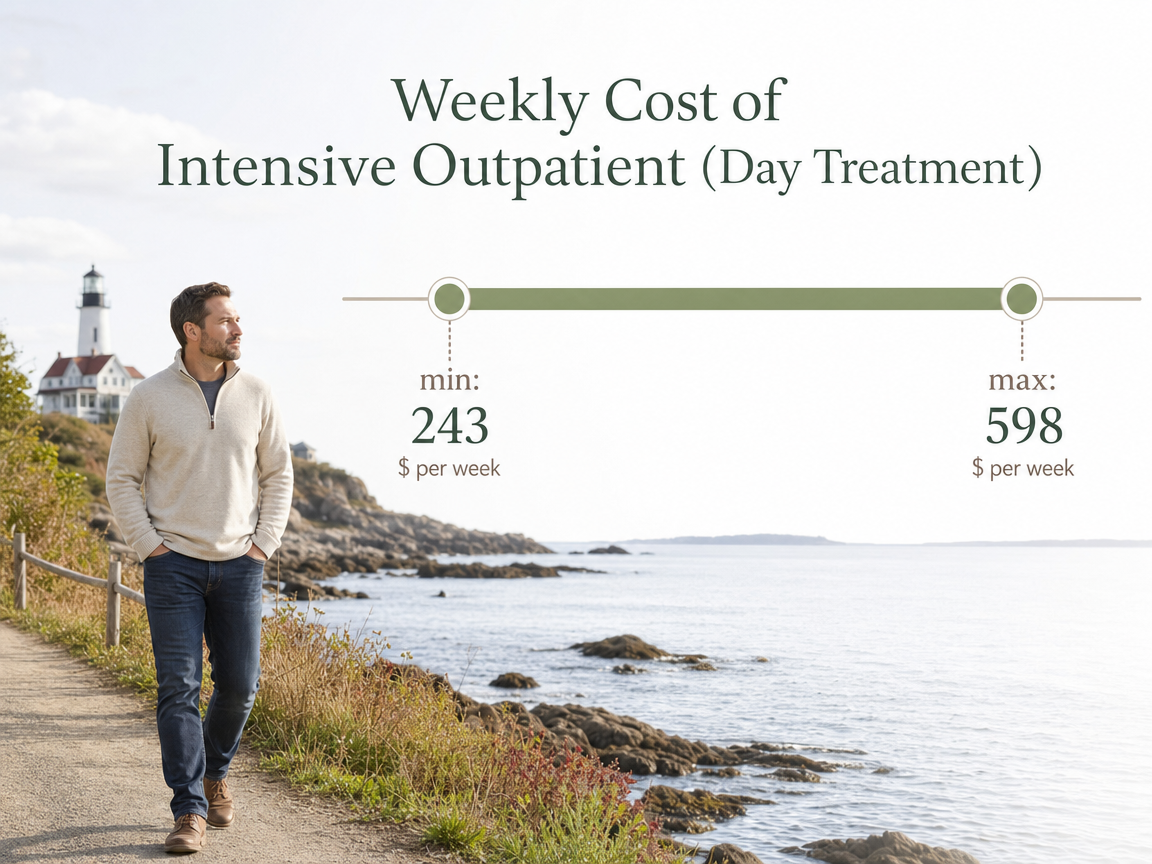
| Intensive Outpatient (IOP) — several days/week, sleep at home | $243–$598 per week; $1,384–$5,780 per full episode | MaineCare, commercial insurance, sliding scale at community providers, state-contracted slots | Often fully covered by MaineCare; modest client cost even in subsidized programs — one study found $37.80 per visit and $771 per episode from the client's perspective |
| Partial Hospitalization (PHP) — most days/week, longer hours | Higher than IOP; below residential | MaineCare, commercial insurance with prior authorization, some block-grant funding | Usually covered by MaineCare; commercial plans may require a copay or coinsurance |
| Residential / Inpatient | Highest upfront cost; large payment often required | State-funded beds through OBH, MaineCare-contracted facilities, limited scholarship programs | Highly variable; a 2024 NIDA report on adolescent residential care found nearly 48% of facilities required partial or full payment upfront |
Consider the IOP row: a complete course of intensive outpatient care typically ranges from $1,384 to $5,780. With MaineCare, commercial insurance, or a state-contracted slot, much of this cost is absorbed before it reaches you. This makes outpatient and IOP a practical middle ground, offering sufficient structure for recovery at a cost that can often be reduced to zero through available funding mechanisms.
For residential care, the concept of "free" becomes more complex. While state-funded beds exist and are worth inquiring about through OBH, private facilities often have significant upfront payment requirements. If IOP or PHP can meet your clinical needs—which they can for many individuals—these options are generally more accessible and faster to enter.
Recovery Starts With a Conversation
Whether you’re exploring recovery for yourself or seeking guidance for someone you care about, Coastal Recovery Partners is here to help. Our team offers trauma-informed, evidence-based support grounded in structure, compassion, and real connection—without pressure or judgment.
When you’re ready, we’ll meet you where you are and help you take the next step forward.
The hidden costs "free rehab" articles don't mention
Even when a treatment program itself is free, the overall cost of engaging in treatment is rarely zero. Acknowledging these hidden costs helps prevent unexpected challenges that could disrupt your recovery.
Transportation. Attending IOP three to five days a week incurs costs for gas, parking, or public transit fares, plus travel time. A study examining addiction treatment from the client's perspective found that intensive outpatient and aftercare clients spent an average of $37.80 per visit and $771 for a full episode, accounting for transportation, time, and residual out-of-pocket costs. While significantly less than program list prices, it's not zero. Ask your program if they offer bus passes, gas cards, or telehealth options, as many do but may not mention it unless asked.
Time off work. IOP typically requires 9 to 12 hours per week. Programs offer various schedules—mornings, evenings, or split blocks—making flexible scheduling crucial for those who cannot afford to lose income. If your employment is FMLA-eligible, consult HR about intermittent leave. If not, directly ask the intake coordinator about evening tracks, explicitly stating, "I can't afford to lose income while I do this."
Medication. This is a frequently overlooked cost. Medications such as buprenorphine, naltrexone, and Vivitrol can be substantial out-of-pocket expenses if not fully covered by insurance. Historically, financing structures have limited coverage for counseling and recovery support, even under parity rules. For opioid use disorder, one study reported monthly out-of-pocket costs reaching $973 for intensive behavioral health pathways and $1,294 for inpatient starts. MaineCare covers most medication-assisted treatment (MAT) medications. If you are uninsured, ask the prescribing clinician about manufacturer patient-assistance programs and 340B pharmacy pricing at FQHCs, as these are effective ways to reduce medication costs.
If you're helping someone else find care
If you are a partner, parent, adult child, or coworker researching addiction treatment for someone else, the same five initial steps apply. You can call SAMHSA's National Helpline on their behalf; the specialist will still provide referrals, explain options for uninsured or MaineCare-eligible individuals, and clarify what's available in Southern Maine. You do not need permission from the person you care about to gather this information.
However, you cannot enroll them in treatment. Adults must initiate the call, complete intake paperwork, and attend appointments themselves. Your role is to reduce obstacles. Prepare by having phone numbers ready and knowing which local programs accept uninsured individuals. Understand that state-funded slots, financed by the SAPT Block Grant and managed by Maine's Office of Behavioral Health, exist specifically for those who cannot pay. This preparation ensures that when they express willingness, even tentatively, you are ready to act without delay.
Remember two key points: First, ambivalence is a normal part of the process; people often decline help multiple times before accepting. Second, prioritize your own well-being during this time. Free resources like Al-Anon meetings are available, and 988 is also there for your support. You cannot be the sole support system for another person.
A realistic first week: from phone call to seat in a program
Here's a practical timeline for your first week, moving from initial contact to starting a program. While wait times vary and you might encounter voicemails, this sequence reflects a common path to treatment.
Day 1 (afternoon). Call SAMHSA's National Helpline at 1-800-662-4357. A 20-minute call can yield two or three local referrals. Contact the first two before the day ends, leaving concise voicemails if necessary.
Day 2. If you haven't already, apply for MaineCare through My Maine Connection, even if you're unsure about eligibility. Follow up with any programs that didn't answer yesterday. Ask each about their earliest intake slot and availability of state-contracted or block-grant-funded openings.
Day 3. Schedule an intake appointment. Most outpatient and IOP programs can conduct screenings within 48 to 72 hours of your initial call. If a program requests records, insurance details, or an ID you don't have, communicate this; a supportive intake coordinator will help find solutions rather than turn you away.
Days 4–5. Attend your intake. Inquire about scheduling options (morning, afternoon, evening tracks), transportation assistance, and how they coordinate care with any other healthcare providers you see. Programs offering trauma-informed IOP with flexible hours, such as Coastal Recovery Partners in South Portland, can often facilitate a start within days of intake.
Days 6–7. Attend your first group or session. You are now engaged in treatment.
While not every week unfolds this smoothly, achieving this progress in one week is more feasible than you might imagine.
Frequently Asked Questions
Will a program turn me away if I don't have an ID or insurance card?
Generally, no, especially at federally funded health centers, which are mandated to serve you regardless of your ability to pay. Bring any identification you have, even a piece of mail with your address can be helpful. If a program insists they cannot see you without specific documents, contact SAMHSA's helpline for alternative referrals. A good intake coordinator will help resolve paperwork issues rather than use them as a barrier to care.
Can I keep working while I'm in an intensive outpatient program?
Yes, maintaining employment is a key benefit of IOP. These programs allow you to attend treatment several days a week while continuing to live at home. Many offer morning, afternoon, or evening tracks specifically designed for working individuals. Directly ask the intake coordinator, "Do you have an evening track?" If your job is covered by FMLA, your HR department can assist in arranging intermittent leave. Losing your income is not a prerequisite for recovery.
What's the difference between calling SAMHSA's helpline and calling 988?
SAMHSA's National Helpline (1-800-662-4357) is a free, confidential, 24/7 referral service that connects you to local treatment options, including state-funded and sliding-scale programs. In contrast, 988 is for crisis situations—such as thoughts of self-harm, an overdose scare, or feeling unsafe—providing Mainers with free, confidential, one-on-one support around the clock. Use SAMHSA to find a treatment program; use 988 when you need immediate crisis support.
If I'm on MaineCare, what does it actually cover for addiction treatment?
MaineCare covers most essential addiction services, including outpatient counseling, intensive outpatient programs, partial hospitalization, medication-assisted treatment, and care coordination. SAMHSA's guidance for Maine residents advises members to call the number on their MaineCare card or use the 1-800-662-4357 line to locate providers who accept it. Out-of-pocket costs are typically minimal. The primary challenge is often finding a program with an open slot, so it's best to make two or three calls on the same day.
Is free or state-funded treatment lower quality than paying out of pocket?
No, there is no evidence to suggest that free or state-funded treatment is of lower quality. In fact, research indicates that outpatient drug-free programs achieve abstinence at the lowest cost per successful case among various modalities studied, at approximately $6,300 per case. State-funded and sliding-scale programs utilize the same evidence-based therapies—such as CBT, motivational interviewing, and relapse prevention—as private-pay options. Price does not equate to quality in this context. The crucial factors are whether the program is trauma-informed and accommodates your schedule.
What if I need medication like Suboxone or naltrexone and can't afford it?
MaineCare typically covers most MAT medications. If you are uninsured, inquire about two key options: whether the prescriber participates in 340B pharmacy pricing through an FQHC, and if there's a manufacturer patient-assistance program for your specific medication. These two avenues are the most reliable for reducing medication costs. Historical financing gaps have made medications like naltrexone expensive when not covered, so always ask about pricing before filling a prescription; do not assume the sticker price is your final cost.
References
- National Helpline for Mental Health, Drug, Alcohol Issues | SAMHSA. https://www.samhsa.gov/find-help/helplines/national-helpline
- Free & Low Cost Treatment Options for Mental Health and Substance Use Disorders. https://www.samhsa.gov/find-support/how-to-pay-for-treatment/free-or-low-cost-treatment
- Help for mental health, drugs, alcohol: ME Medicaid, CHIP. https://www.samhsa.gov/find-support/health-care-or-support/professional-or-program/medicaid-or-chip/maine
- OBH Home | Department of Health and Human Services - Maine.gov. https://www.maine.gov/dhhs/obh
- The Substance Abuse Prevention and Treatment Block Grant is still important in a changing health care environment. https://www.samhsa.gov/data/sites/default/files/report_2080/ShortReport-2080.html
- The Economic Costs of Substance Abuse Treatment. https://www.ncbi.nlm.nih.gov/pmc/articles/PMC2614666/
- The cost of treating addiction from the client’s perspective: Results from a multi-modality application of the Client DATCAP. https://www.ncbi.nlm.nih.gov/pmc/articles/PMC2737263/
- Treatment, Financing, and Costs (NCBI Bookshelf). https://www.ncbi.nlm.nih.gov/books/NBK24639/
- Effectiveness and Cost-effectiveness of Four Treatment Modalities for Substance Use Disorder. https://www.ncbi.nlm.nih.gov/pmc/articles/PMC1360883/
- Insurance barriers to substance use disorder treatment and overdose prevention. https://www.ncbi.nlm.nih.gov/pmc/articles/PMC9948907/
- Residential addiction treatment for adolescents is scarce and expensive. https://nida.nih.gov/news-events/news-releases/2024/01/residential-addiction-treatment-for-adolescents-is-scarce-and-expensive
- Assessment of Annual Cost of Substance Use Disorder in US Hospitals. https://pmc.ncbi.nlm.nih.gov/articles/PMC7936257/
- Relative Cost Differences of Initial Treatment Strategies for Newly Diagnosed Opioid Use Disorder. https://www.ncbi.nlm.nih.gov/pmc/articles/PMC7641182/