
Outpatient Care from a Behavioral Health Hospital

Key Takeaways
- Outpatient care runs on a continuum of hours: PHP fills close to a full weekday, IOP averages three hours a day for at least nine weekly, and standard OP stays under nine hours a week 4, 16.
- The right level depends on current safety and stability, not the severity label—PHP fits acute or step-down needs, IOP holds active cravings alongside work, and standard OP supports maintenance 3, 16.
- Legitimate Maine programs carry MAT or medication management on their license and can state IOP hours clearly, coordinating buprenorphine, naltrexone, or similar medications alongside therapy under one roof 17.
- Trauma-informed care means early screening without forcing the story, collaborative treatment plans, and grounding skills taught before deep trauma work—safety and stabilization come before hard conversations 11, 10.
When Sleeping in Your Own Bed Is Part of the Treatment Plan
You already know something has to change. What you're not sure about is whether that change means packing a bag, telling your boss you'll be gone for 30 days, and hoping your family, your job, and your health insurance are all still there when you come back.
Here's what a lot of people don't realize: outpatient care from a behavioral health hospital is not a scaled-down version of that. It's a different level of care entirely, built on purpose so you can get real clinical treatment for substance use and the anxiety, depression, or trauma often tangled up with it, while you sleep at home, drive your kids to school, and keep your paycheck coming in 5.
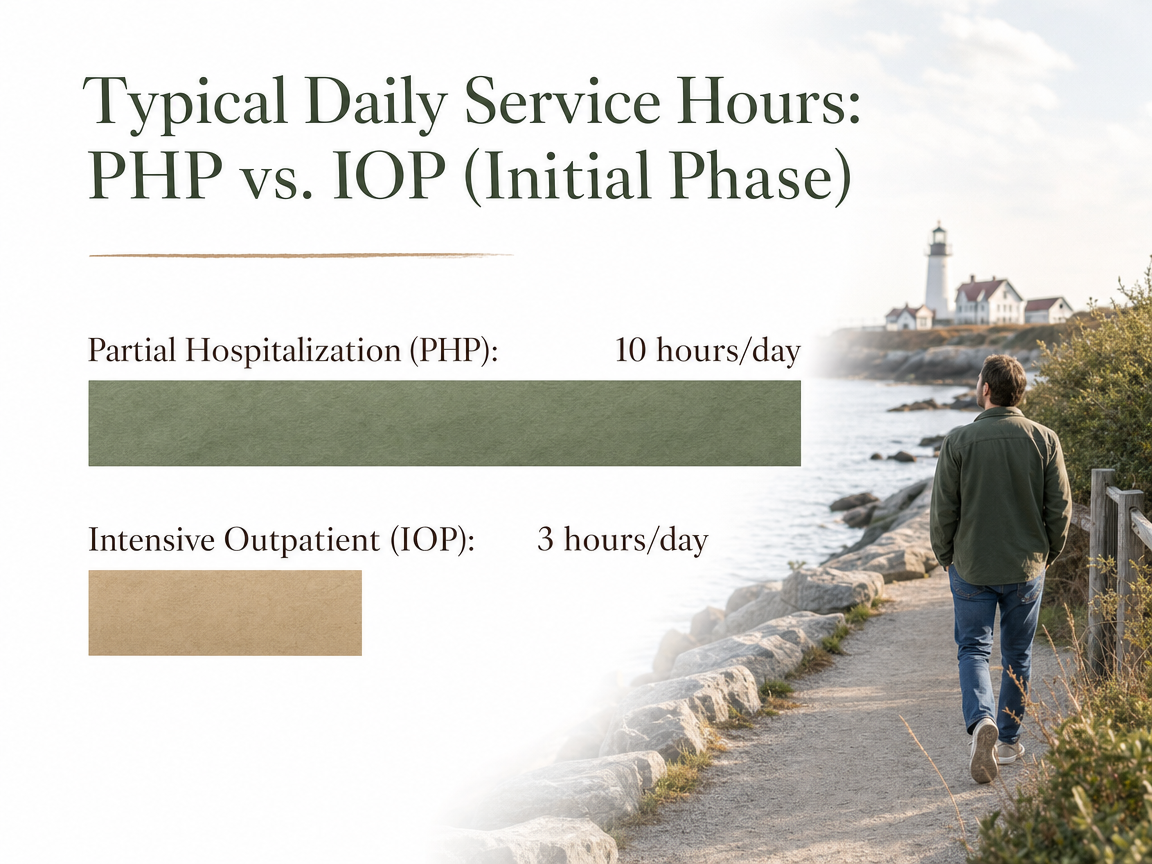
Outpatient care lives on a continuum. At the most structured end, partial hospitalization programs (PHP) can run up to about 10 hours a day. In the middle, intensive outpatient programs (IOP) usually meet for around 3 hours a day, several days a week. At the lighter end, standard outpatient care is fewer than 9 hours a week in Maine, often just a couple of therapy visits and a medication check-in 4, 16.
The point of this piece is simple. You're going to learn what actually happens inside each level, what the hours really look like on a Tuesday, what trauma-informed care means in practice (not on a website), and how to tell where you fit right now. No jargon dumps. No pretending this is easy. Just the information you need to make a call you can live with.
The Three Levels of Outpatient Care, by the Hours
PHP, IOP, and Standard OP: What the Weekly Grid Actually Looks Like
The clearest way to understand outpatient care is to stop thinking in labels and start thinking in hours. Because that's really what separates these three levels: how much of your week the program takes, and what fills those hours.
Start at the top. Partial hospitalization (PHP) is the most structured version of outpatient care. Under SAMHSA's TIP 47 guidance, PHP can run up to about 10 hours per day, which in practice usually means a full weekday schedule of therapy, groups, medication management, and skills work 4. You go home at night. You sleep in your own bed. But the daytime is essentially reserved for treatment.
Intensive outpatient (IOP) sits in the middle. SAMHSA describes IOP as running between 6 and 30 contact hours per week, with a minimum of 9 hours per week for adults 1, 3. Medicare uses the same 9-hour floor when it decides whether a program qualifies as IOP for coverage purposes 6. Nine hours a week is often built as three days of three-hour blocks, though morning, afternoon, and evening options exist specifically so working adults don't have to choose between treatment and their paycheck.
Standard outpatient (OP) is the lightest touch. Maine DHHS defines outpatient mental health and substance use services for adults as less than 9 hours per week of in-person services, including individual and group therapy, peer support, psychiatric visits, and MAT when it's clinically appropriate 16. For most people at this level, that's one or two therapy sessions plus a periodic medication check.
Put those three side by side and the picture gets clearer. Standard OP is measured in a handful of hours a week. IOP is measured in something closer to a part-time job's worth of clinical time. PHP is closer to a full workday, five days a week.
None of this is a hierarchy of worth. Someone stabilizing after a hospital stay may need PHP for two weeks. Someone six months into recovery may only need OP. The number of hours matches the intensity of what you're working through right now, not the seriousness of your problem 2.
PHP vs. IOP: A Daily Hours Comparison
If you're trying to decide between PHP and IOP, the weekly numbers only tell part of the story. What really matters is what a single day looks like, because that's what determines whether you can keep working, keep parenting, and keep the rest of your life running.
PHP is a day program. TIP 47 describes partial hospitalization at ASAM Level II.5 as running up to 10 hours per day 4. Think of it as clocking in around mid-morning, moving through a full sequence of group therapy, individual sessions, medication management, and skills training, breaking for lunch, and finishing in the late afternoon. Most people in PHP are not working during treatment. The program is doing the heavy lifting that would otherwise require an inpatient bed.
IOP is fundamentally different in shape. The same TIP 47 guidance describes IOP at ASAM Level II.1 as roughly 3 hours per day, with clients typically starting at around 5 days per week and tapering from there as they stabilize 4. Three hours is a chunk of time you can put around a work schedule. Morning IOP before your shift. Afternoon IOP after school pickup. Evening IOP once the kids are in bed. That's why hospital-based outpatient programs build multiple session times into the same week.
The tapering piece matters, too. IOP is not designed to hold you at maximum intensity forever. As you build skills and stability, days per week drop. That's not being cut loose. That's the program doing what it's supposed to do.
The practical read: if a full-day schedule is what safety requires right now, PHP is honest about that. If you can hold three hours a day and still keep the rest of your life intact, IOP is built for exactly that person.
A Week Inside an IOP: What Fills Those Hours
Group Therapy, Individual Sessions, and Skills Training
Nine hours a week sounds abstract until you break it down into what's actually happening in the room. Then it starts to look less like a schedule and more like a routine you can plan around.
A typical IOP week is built from a small set of core services. SAMHSA's Advisory on intensive outpatient treatment describes IOP as"a prearranged schedule of core services (e.g., individual counseling, group therapy, family psychoeducation, and case management) for a minimum of 9 hours per week for adults"3. That's the skeleton. Everything else hangs off it.
Group therapy is the biggest single block. You'll usually spend the bulk of your three-hour session in a group of six to twelve people working through relapse prevention, coping skills, and honest conversation about what happened this week. Groups sound intimidating when you're imagining them from the outside. In practice, they're often the part people miss when they finish, because it's the first place a lot of adults meet other people who understand exactly what they're up against.
Individual counseling is where the private work happens. One-on-one with a clinician, usually weekly, you dig into what's actually driving the substance use, what your specific triggers look like, and what your recovery plan needs to include. This is also where cognitive behavioral therapy (CBT) and dialectical behavior therapy (DBT) show up as real conversations instead of textbook terms. CBT helps you catch the thought patterns that lead to using. DBT hands you concrete tools for emotional regulation when everything feels like too much.
Family psychoeducation brings the people who live with you into the loop, so they understand what recovery actually requires and stop guessing. Case management is the person who helps you sort out the practical stuff—insurance, work notes, coordinating with your prescriber. Skills training is where you practice: grounding techniques, communication scripts, relapse prevention plans you can actually use on a bad Wednesday.
MAT Coordination Inside Outpatient Care
If you're dealing with opioid or alcohol use, medication is often part of what makes the therapy stick. Medication-assisted treatment (MAT) is the plain name for medications like buprenorphine (Suboxone), naltrexone, or acamprosate that quiet cravings and blunt withdrawal so you can actually show up for the work.
In Maine, MAT isn't an add-on—it's baked into how outpatient substance use care is supposed to run. The state's Treatment Connection page notes that outpatient substance use services can "provide medication assisted treatment as needed" as part of standard programming 16. And Maine DHHS's 2025 licensing bulletin goes further: substance use disorder IOPs"must have the Medication-Assisted Treatment (MAT) service on their license"17. That regulatory floor tells you something useful. A legitimate Maine IOP is set up to prescribe, monitor, and coordinate your medication under the same roof as your therapy.
Practically, what this looks like inside an IOP week is short: a check-in with the prescriber every few weeks, a dose adjustment if cravings are creeping back, refills handled without you having to chase a separate doctor across town. Your group facilitator and your prescriber can talk. Your therapist knows what you're on. When something's not working, you find out in days, not months.
That coordination is the point. Medication alone is not treatment. Therapy alone leaves a lot of people fighting cravings they don't need to fight. Together, inside one program, they do more than either can do apart.
Recovery Starts With a Conversation
Whether you’re exploring recovery for yourself or seeking guidance for someone you care about, Coastal Recovery Partners is here to help. Our team offers trauma-informed, evidence-based support grounded in structure, compassion, and real connection—without pressure or judgment.
When you’re ready, we’ll meet you where you are and help you take the next step forward.
Trauma-Informed Care Is a Set of Practices, Not a Slogan
What Trauma-Informed Actually Looks Like on a Tuesday
You've probably seen the phrase "trauma-informed" on more than a few treatment center websites. It's easy to write. It's harder to actually run a program that way.
SAMHSA defines a trauma-informed program as one that"realizes the widespread impact of trauma" and "responds by fully integrating knowledge about trauma into policies, procedures, and practices, while seeking to actively resist retraumatization."The guiding principles are safety, trustworthiness, peer support, collaboration, empowerment, and cultural and historical awareness 12. That's the framework. What matters for you is how it shows up on a normal Tuesday when you walk in the door.
Safety is the first thing you'll notice, though you may not name it that way. The room is set up so no one is trapped in a corner. Chairs face each other, not a lectern. Staff introduce themselves and tell you what's going to happen before it happens. You're allowed to sit near the door. You're allowed to step out of a group if something lands hard, and no one will chase you down the hallway to demand why.
Trustworthiness looks like the schedule being what the schedule says. If group is 6:00 to 7:30, it ends at 7:30. If your counselor said she'd call your prescriber Monday, she called Monday. Small things, but they add up for someone whose baseline is that adults break promises.
Collaboration shows up in the treatment plan. It's written with you, not handed to you. You get to say what you want to work on first, what you're not ready to touch yet, and what has and hasn't helped before. TIP 57 frames this as a core practice shift: outpatient programs are supposed to build routines and policies that resist retraumatization, not just avoid it accidentally 8. A 2025 study of trauma-informed outpatient psychiatry found that formalizing this approach across a whole team, not just one clinician, changed how patients engaged with treatment and how staff thought about symptoms 14.
Empowerment is the smallest and biggest one. It means you get real choices—about your therapist, your medication, your group, your pace—instead of being processed through someone else's protocol.
Screening Early, Without Forcing the Story
One of the biggest fears people bring to outpatient treatment is that they'll be asked to tell the worst story of their life to a stranger on day one. That's not what trauma-informed screening is supposed to look like.
SAMHSA's practice guidance is explicit on two points that sound almost contradictory until you sit with them. First:"Do not delay screening for trauma."Second:
"Do not require clients to describe emotionally overwhelming traumatic events in detail"11. Universal screening happens early because trauma history changes how your care should be delivered—what medications make sense, which group dynamics to watch for, whether certain interventions could backfire. But screening is not the same as reliving.
In practice, this often means a short set of validated questions during intake. Yes or no. Rough categories. Enough for your clinician to know what she's working with, not enough to crack you open before there's any safety net underneath you.
The story part, if you want to tell it, comes later, at your pace, with grounding skills already in your pocket. SAMHSA's practice components document lists exactly those tools—grounding exercises, routine-building, managing triggers, resilience skills—as things a trauma-informed outpatient program should be teaching before deep trauma work begins 10.
That sequence is the difference between a program that treats you and one that just processes you.
How to Tell Which Level Fits Where You Actually Are
There's no perfect quiz for this. But there are honest questions you can sit with, and the answers usually point somewhere.
Start with safety. If you've had a recent overdose, a suicide attempt, a psychiatric hospitalization in the last few weeks, or withdrawal that needs medical management, you're probably looking at PHP or a step-down from inpatient. SAMHSA's guidance describes IOP candidates as people with"little risk of acute intoxication or withdrawal"and manageable medical and psychiatric needs 3. That's not a judgment. It's a matching problem. PHP exists because some weeks need more hours around you.
Now the middle question. If you're using regularly, cravings are running the show, and a weekly therapy hour has not been enough to hold the line, IOP is usually the honest fit. Nine or more structured hours a week gives you enough clinical contact to actually change what's happening, plus the group and skills work that a solo therapist can't provide 6. If you're also managing depression, anxiety, or trauma alongside the substance use, IOP is built to hold both at once rather than sending you to two disconnected providers 2.
Standard outpatient tends to fit two kinds of people. One: you've completed a higher level of care and you're maintaining, doing well, and want ongoing support and medication management as you keep building your life back. Two: your use is at an earlier stage, you have strong stability at home and work, and a couple of therapy visits plus MAT if needed can meet you where you are 16.
One more thing worth saying out loud. Where you start isn't where you have to stay. Outpatient care is designed to move. People step up from OP to IOP when things get harder. People step down from PHP to IOP to OP as they stabilize. Moving isn't failure or graduation. It's the program adjusting to your actual week 2.
Maine's Rules: What Legitimacy Looks Like on Paper
You should not have to take a program's word for the fact that it's real. Maine has actual rules on the books, and they give you a short checklist you can use to separate serious outpatient care from marketing.
Start with the license. Maine DHHS's 2025 provider bulletin on IOP licensing says mental health programs"must have the medication management service on their license"and substance use disorder treatment programs
"must have the Medication-Assisted Treatment (MAT) service on their license"17. That's not a suggestion. If a program says it treats opioid or alcohol use disorder but can't prescribe or coordinate Suboxone, naltrexone, or similar medications under its own license, that's a real gap. You're allowed to ask.
Second, ask how they define outpatient. A legitimate Maine outpatient program should be able to explain that standard OP is under 9 hours a week and IOP starts at 9, matching how the state's Treatment Connection page defines these services for adults 16. If the hours are vague or shift depending on who you talk to, that's a signal.
Third, know that Maine is expanding integrated outpatient care through Certified Community Behavioral Health Clinics (CCBHCs), which are required to offer outpatient mental health and substance use treatment—including therapy and medications—as part of a coordinated service array 18. That framework is one more sign the state expects outpatient behavioral health to be integrated, not fragmented across three different offices.
Two questions on a first call cover most of it: What's on your license? How many hours a week is your IOP? Clear answers mean the program has done the work you'd want it to have done.
Keeping Your Job, Your Family, and Your Privacy
Let's name the thing most people are actually scared of. It isn't the therapy. It's what happens to the rest of your life while you're in it.
The scheduling piece is the most solvable. Outpatient care in Maine is built specifically so adults can"continue work, attend school or remain in their home structure"while getting treatment 16. That's not a marketing line—it's how the state defines the level of care. Morning IOP tracks exist so you can be at your desk by lunch. Evening tracks exist so you can work your regular shift and still make group. If a program only offers one time slot, that's a program problem, not a you problem.
For your job, you have more protection than you probably think. You don't owe your employer a diagnosis. In most cases, you owe them a schedule. FMLA, short-term disability, or a simple conversation with HR about a medical appointment schedule covers most working adults without anyone learning what condition you're being treated for.
Family gets easier when they're actually in the loop. Family psychoeducation, one of the core IOP services SAMHSA describes, exists so the people who live with you understand what recovery requires and how to help without hovering 3.
Privacy is the floor. Your treatment records are protected by federal law, including the stricter 42 CFR Part 2 rules that apply to substance use care. A good program will walk you through exactly who can see what, and when, before you sign anything. If you live in South Portland or nearby and want to talk through how a flexible outpatient schedule could actually fit around your week, that conversation is what teams like Coastal Recovery Partners are set up to have.
Frequently Asked Questions
Can I keep working full-time while in an intensive outpatient program?
Yes, and that's a large part of why IOP exists. Maine defines outpatient care as designed for adults to "continue work, attend school or remain in their home structure" during treatment 16. Programs typically offer morning, afternoon, or evening tracks so your three-hour block fits around your shift. You don't have to choose between your paycheck and getting help.
How do I know if I need PHP, IOP, or standard outpatient care?
The honest signal is safety and recent stability. If you're stepping down from a hospital stay or need daily structure to stay safe, PHP fits. If cravings are running the show and weekly therapy isn't holding, IOP's 9-plus structured hours make sense 3. If you're stable and maintaining recovery, standard OP under 9 hours weekly is usually enough 16. A clinical assessment sorts it faster than guessing.
Does outpatient care include medication for cravings, like Suboxone?
Yes. Maine explicitly allows outpatient substance use services to "provide medication assisted treatment as needed" 16, and the state's 2025 licensing bulletin requires substance use IOPs to have MAT on their license 17. That means buprenorphine, naltrexone, or similar medications are prescribed and monitored inside the same program handling your therapy—not through a separate doctor you have to chase across town.
Will I have to talk about my trauma in detail on day one?
No. SAMHSA's trauma-informed guidance is clear on this: "Do not require clients to describe emotionally overwhelming traumatic events in detail" 11. Screening happens early because it shapes your care, but screening is short questions, not reliving. The deeper story stays yours to tell at your pace, once grounding skills and safety are actually in place 10. A good program earns that conversation, not extracts it.
How can I tell if a Maine outpatient program is legitimate?
Two quick questions cover most of it. First, ask what's on their license—Maine DHHS requires substance use IOPs to have MAT service licensed and mental health programs to have medication management licensed 17. Second, ask how many hours their IOP runs weekly. A real program answers 9 or more without hesitation 16. Vague answers on either question are a signal to keep looking.
What happens if outpatient care isn't enough, or if I finish and need less?
You move. Outpatient care is built as a continuum, not a one-shot placement. If IOP isn't holding you, stepping up to PHP or a higher level is a normal clinical decision, not a failure 2. If you're stabilizing well, stepping down from IOP to standard OP with ongoing therapy and medication check-ins is the plan working as designed. Your level of care should match your actual week.
References
- Substance Abuse: Clinical Issues in Intensive Outpatient Treatment (TIP 47 original manual). https://library.samhsa.gov/product/tip-47-substance-abuse-clinical-issues-intensive-outpatient-treatment/sma13-4182
- TIP 47 - Clinical Issues in Intensive Outpatient Treatment - SAMHSA Evidence-Based Resource. https://www.samhsa.gov/resource/ebp/tip-47-substance-abuse-clinical-issues-intensive-outpatient-treatment
- Clinical Issues in Intensive Outpatient Treatment for Substance Use Disorders (SAMHSA Advisory). https://library.samhsa.gov/sites/default/files/pep20-02-01-021.pdf
- Clinical Issues in Intensive Outpatient Treatment (full TIP 47 PDF). https://library.samhsa.gov/sites/default/files/sma13-4182.pdf
- Treatment Types for Mental Health, Drugs and Alcohol - SAMHSA. https://www.samhsa.gov/find-support/learn-about-treatment/types-of-treatment
- Intensive Outpatient Program Services | Medicare Coverage. https://www.medicare.gov/coverage/mental-health-care-outpatient-intensive-outpatient-program-services
- Mental Health Intensive Outpatient Services and Partial Hospitalization – Provider Manual Training. https://www.dmas.virginia.gov/media/3498/mh-iop-php-provider-manual-training-5-2521_final.pdf
- TIP 57: Trauma-Informed Care in Behavioral Health Services (full PDF). https://library.samhsa.gov/sites/default/files/sma14-4816.pdf
- TIP 57: Trauma-Informed Care in Behavioral Health Services – SAMHSA Product Page. https://library.samhsa.gov/product/tip-57-trauma-informed-care-behavioral-health-services/sma14-4816
- Trauma-Informed Care in Behavioral Health Services (Practice Components). https://library.samhsa.gov/sites/default/files/sma15-4420.pdf
- Trauma-Informed Care in Behavioral Health Services – Screening and Safety Strategies. https://library.samhsa.gov/sites/default/files/sma15-4912.pdf
- Trauma-Informed Approaches and Programs – SAMHSA. https://www.samhsa.gov/mental-health/trauma-violence/trauma-informed-approaches-programs
- Trauma-Informed Care in Behavioral Health Services – NCBI Bookshelf. https://www.ncbi.nlm.nih.gov/books/NBK207201/
- A Trauma-Informed Approach to Outpatient Psychiatric Services. https://pubmed.ncbi.nlm.nih.gov/39943840/
- Matrix Intensive Outpatient Treatment for People With Stimulant Use Disorders – Counselors' Treatment Manual. https://library.samhsa.gov/product/matrix-intensive-outpatient-treatment-people-stimulant-use-disorders-counselors-treatment
- Treatment Connection – Maine Department of Health and Human Services. https://www.maine.gov/dhhs/treatment-connection
- Licensing Requirements for Intensive Outpatient Program (IOP) Providers – Maine DHHS OMS Provider Bulletin. https://www.maine.gov/dhhs/oms/providers/provider-bulletins/licensing-requirements-intensive-outpatient-program-iop-providers-2025-06-06
- Certified Community Behavioral Health Clinics (CCBHC) – Maine DHHS. https://www.maine.gov/dhhs/oms/providers/value-based-purchasing/ccbhc
- Substance Abuse: Clinical Issues in Intensive Outpatient Treatment – PubMed Entry. https://pubmed.ncbi.nlm.nih.gov/22514853/