
What Does Cocaine Addiction Rehab Involve?

Key Takeaways
- Modern cocaine rehab usually runs as outpatient care — three weekly groups, individual counseling, and medication check-ins — so you keep your home, job, and family routine intact.
- Contingency management, CBT, the Matrix Model, motivational interviewing, and trauma-informed care do the heavy lifting, with contingency management showing the strongest evidence for cocaine-negative urine tests.6
- No FDA-approved medication exists for cocaine use disorder, so behavioral therapy leads while prescriptions address co-occurring depression, anxiety, ADHD, or PTSD inside one integrated plan.13,14
- Match level of care — PHP, IOP, or standard outpatient — to your life rather than chasing intensity, since fit and consistent attendance drive outcomes more than hours logged.4,10
What a Real Week of Outpatient Cocaine Rehab Looks Like
You're probably picturing a 28-day stay somewhere far from home. That's not what most cocaine rehab looks like in 2025. For a lot of people, it's an outpatient schedule built around three group sessions a week, one individual counseling appointment, and a few check-ins for medication or psychiatry as needed. You sleep in your own bed. You see your kids. You keep your job if you can.9
Here's what a typical week in an intensive outpatient program (IOP) tends to look like, drawn from the Matrix Model and federal IOP treatment protocols. Programs commonly run three group sessions of about three hours each, spread across Monday through Friday, plus a separate weekly individual therapy session. Many centers also offer morning, afternoon, and evening tracks so you can pick the time that doesn't blow up your work schedule.9,16
A Monday evening might be a relapse prevention group — practical talk about triggers, cravings, and what to do when you drive past the apartment where you used to buy. Wednesday could be a CBT-focused group, working on the thoughts that keep pulling you back. Friday might be a process group where people share what came up that week. Somewhere in there, you'd meet one-on-one with your counselor for 45 to 60 minutes to work on your own treatment plan, and if you're on medication for a co-occurring condition like depression or ADHD, you'd see the prescriber every few weeks.
That's the rhythm. It's enough structure to interrupt the using pattern and build new habits, but it's flexible enough that you're still living your life. If you need more support than that, partial hospitalization (PHP) adds more hours during the day. If you need less, standard outpatient steps the schedule down. The framework is the same — group, individual, and coordinated care — just dialed up or down to match where you are right now.9
The Therapies That Do the Work
Contingency Management: Earning Your Way Back
Contingency management has a clinical name, but the idea is simple: you earn small, tangible rewards for the things that actually move your recovery forward. A negative urine screen. Showing up to every group that week. Hitting a 30-day milestone. The rewards might be gift cards, vouchers for groceries, or prize draws — small enough to be practical, consistent enough to matter.
If that sounds almost too straightforward to be a serious treatment, the evidence will surprise you. The current ASAM/AAAP clinical guideline for stimulant use disorder names contingency management as the frontline behavioral intervention for cocaine and other stimulant addictions, with the largest effect sizes among the available psychosocial tools. NIDA's research summary on cocaine reinforces the same point: behavioral therapies, especially contingency management, are what the science actually backs.5,14
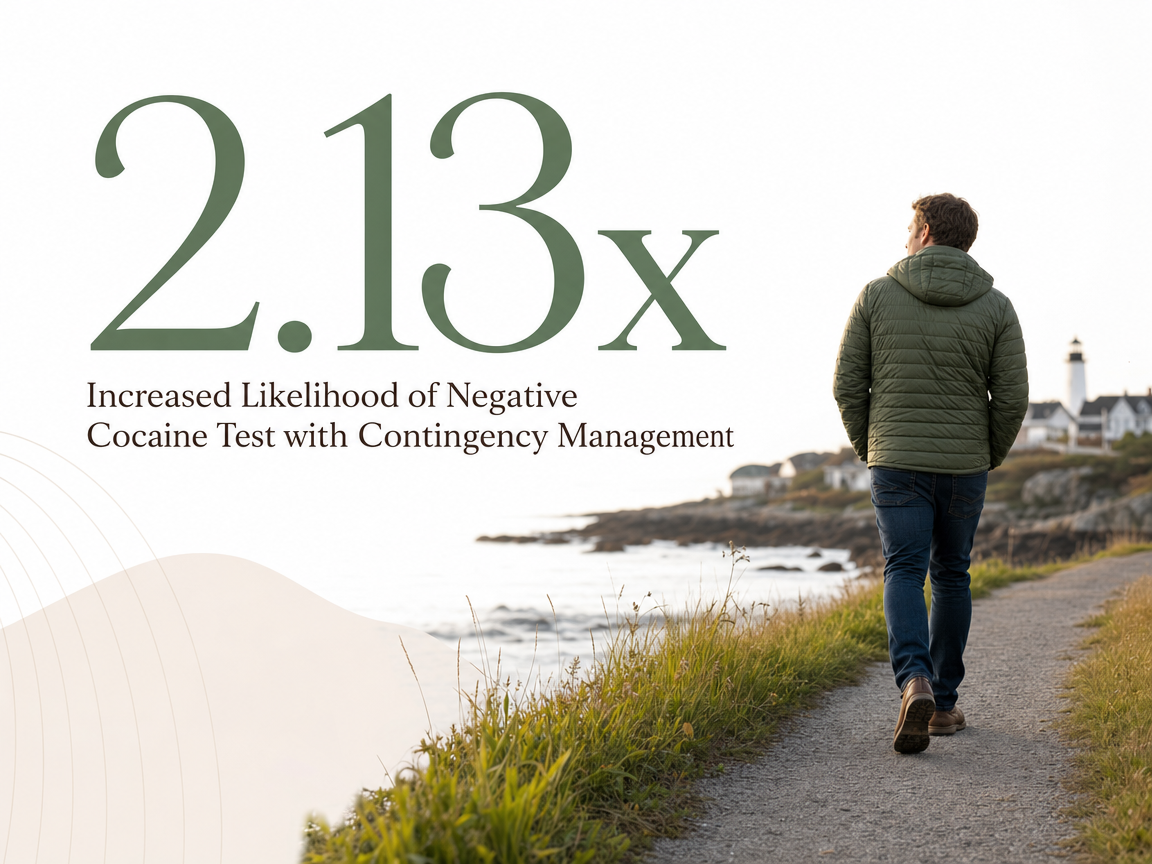
Here is the hinge number to know. In pooled meta-analytic data, contingency management programs were associated with an odds ratio of 2.13 (95% CI, 1.62–2.80) for producing a cocaine-negative urine test compared to control conditions. That is the odds of any single test coming back clean during treatment — not a cure rate, not a guarantee about life five years from now. But it is the strongest, most consistent signal we have for any intervention aimed at cocaine use, and it is why a well-run outpatient program builds rewards into the structure from day one.6
What this means for you in practice: when you walk into an intensive outpatient program that uses contingency management, you are not being bribed. You are being given a clear, fair feedback loop. Each clean test, each on-time arrival, each completed week counts toward something real. That is often the piece that breaks the old pattern when willpower alone has not.
CBT, the Matrix Model, and Relapse Prevention
If contingency management is the reward system, cognitive behavioral therapy (CBT) is the toolbox. CBT was actually adapted for cocaine-addicted individuals specifically — originally built for problem drinking and then reshaped to fit the way stimulant cravings, triggers, and thought spirals work. In a CBT group or one-on-one session, you are doing real work: mapping the people, places, and feelings that pull you toward using, and rehearsing what you will do instead when those moments hit.8
The Matrix Model is the wrapper that holds it all together for stimulant use disorders. Developed for people exactly like you, it is a structured outpatient framework that runs for several months and combines group sessions, individual counseling, family education, and dedicated relapse prevention work. The federal IOP treatment protocol lists CBT, the Matrix Model, and contingency management as core components of intensive outpatient care across the country.9,16
Relapse prevention deserves its own breath. This is not just talking about cravings — it is building a written plan for the Tuesday night you get paid and the old impulse shows up, or the Sunday afternoon you are alone and bored. Your counselor will help you name the early warning signs, list the people you can call, and rehearse what to do in the first ten minutes when a craving hits. Boring on paper, life-changing in practice.
None of these therapies live in isolation. A solid week in treatment usually layers them: a CBT skills group on Monday, individual counseling midweek to work the same skills on your specific life, and a relapse prevention group later that week to apply what you learned.
Motivational Interviewing When You're Not Sure You're Ready
Most people who walk into cocaine rehab are not fully sure they want to be there. You might know your use is hurting you and still feel the pull of it. You might want to quit on Monday and not want to quit on Friday. That is not a character flaw. That is ambivalence, and it has its own treatment approach.
Motivational interviewing (MI) is a collaborative, non-judgmental counseling style designed for exactly this moment. It is described in federal treatment guidance as a client-centered, directive method for strengthening your own reasons to change by exploring and resolving ambivalence. Translation: your counselor does not lecture you about why cocaine is bad. They ask careful questions, listen, and help you put words to what you actually want your life to look like.15
In a first session, an MI-trained counselor might ask what you are worried about, what you are hoping for, and what change would have to look like for you to feel like it was worth it. The work is slow and quiet, and it is often what gets someone from "I'll think about it" to showing up next Tuesday. MI is usually woven through the early weeks of outpatient care alongside CBT and contingency management, not used as a standalone treatment.15
Trauma-Informed Care Changes the Room
Trauma-informed care is not a separate therapy you sign up for. It is how the room is run. It changes the lighting, the pacing, the way the counselor asks about your history, and what happens when someone in group gets activated.
For a lot of people who develop a cocaine problem, the using did not come out of nowhere. It often sits on top of older pain — childhood adversity, assault, loss, untreated PTSD. Federal guidance for treating co-occurring disorders calls for integrated care that handles both the substance use and the mental health side within a single coordinated treatment plan, rather than sending you to two different places that do not talk to each other.13
In practice, trauma-informed protocols mean a few specific things. You are given choices instead of commands — where to sit, when to share, what to disclose. Groups move at a pace that does not flood the nervous system. Counselors teach grounding skills, like simple breathing patterns or noticing five things in the room, so you have something to use when a memory or craving comes up hard. Confrontation as a treatment style is out; collaboration is in.
If you have ever tried treatment before and walked out because it felt harsh, shaming, or unsafe, this is the difference. The therapies in the previous sections still do the work. Trauma-informed care is what makes it possible for you to stay in the room long enough for them to.
Recovery Starts With a Conversation
Whether you’re exploring recovery for yourself or seeking guidance for someone you care about, Coastal Recovery Partners is here to help. Our team offers trauma-informed, evidence-based support grounded in structure, compassion, and real connection—without pressure or judgment.
When you’re ready, we’ll meet you where you are and help you take the next step forward.
PHP, IOP, and Standard Outpatient — Which Fits Your Life
The names sound clinical, but the differences come down to one practical question: how many hours a week do you need to be in treatment to actually get better? The answer depends on where you are right now — how heavy the use has been, what your home life looks like, whether you have a co-occurring mental health condition, and how much you can lean on your own routine to hold you steady between sessions.9
Partial hospitalization (PHP) is the most structured level of outpatient care. You come in during the day, most days of the week, for several hours of programming — group therapy, individual counseling, psychiatric check-ins, skills work. You still go home at night. PHP tends to fit people who are coming out of detox or inpatient care, people whose use has been daily or near-daily, and people whose mental health symptoms need closer eyes on them than a weekly appointment allows. If you have tried less intensive treatment before and it did not hold, PHP is often the next honest step.9,16
Intensive outpatient (IOP) is what most people picture when they imagine modern rehab. Three group sessions a week, around three hours each, plus individual counseling and any medication management you need. That is enough contact to interrupt the pattern and build real skills, but it leaves your mornings or evenings open depending on the track you choose. The Matrix Model — the manualized IOP framework built specifically for stimulant use disorders — runs this way for several months and includes group sessions, individual counseling, family education, and dedicated relapse prevention work. IOP fits people who can hold down a job, parent their kids, and sleep at home safely, but who need structured support multiple times a week to stay on track.16
Standard outpatient (OP) is the lightest level — usually a weekly individual session, sometimes a single group, occasional medication or psychiatry visits. It is often where people land after stepping down from IOP, or where someone with a shorter use history and strong outside support starts. It is not lesser treatment; it is matched treatment, used at the right point in the arc.
Here is the part that surprises a lot of people: more hours does not automatically mean better outcomes. A randomized trial comparing intensive outpatient care to standard outpatient care for substance dependence, including cocaine, found that both groups improved substantially over six months, with no significant differences in meeting diagnostic criteria at follow-up. A broader review of IOP evidence reached a similar conclusion — well-designed intensive outpatient programs are an important part of the continuum of care and can be as effective as inpatient treatment for many people when the program fits the person. The point is not that intensity does not matter. It is that fit matters more. The right level of care is the one you can actually show up to, week after week, while the work takes hold.4,10
Most people do not stay at one level the whole time. You might start in PHP, step down to IOP after a few weeks, and finish in standard outpatient with monthly check-ins. The step-down is the plan, not a sign of failure — it is what a continuum of care is supposed to look like.
The Medication Question, Answered Honestly
You may have come into this hoping there's a pill that takes the edge off cocaine cravings the way methadone or buprenorphine can for opioid use. The honest answer: not yet. The U.S. Food and Drug Administration has not approved any medication specifically for cocaine use disorder, and the NIDA research report on cocaine says so plainly. The same conclusion shows up in the peer-reviewed treatment literature. That is why behavioral therapy carries the weight of the work.1,14
Researchers haven't given up. Medications like topiramate and disulfiram have been studied in cocaine trials, sometimes alongside contingency management, and a few show small or inconsistent signals of helping. For people who have both cocaine use disorder and ADHD, there is also a small body of literature on carefully monitored, off-label prescription stimulants — interesting, but still experimental, not standard care . None of this rises to the level of a routine prescription you'd expect at intake.6,11,12
Here's where medication does fit your rehab. If you're dealing with depression, anxiety, PTSD, ADHD, or another condition alongside the cocaine use, the right medication for that condition can stabilize your mood and sleep enough that the behavioral work actually lands. Medication-assisted treatment (MAT) also matters if alcohol or opioids are in the mix. Your prescriber, your counselor, and your primary care provider should be on the same page — that coordination is exactly what good recovery planning handles for you, so you're not stitching it together alone.13
Dual Diagnosis Is the Rule, Not the Exception
If you have a cocaine problem, there's a good chance something else is happening underneath it. Depression. An anxiety disorder you've lived with since your teens. PTSD from something you don't talk about. Untreated ADHD that made stimulants feel like the first thing that ever calmed your brain down. These aren't side stories. For most people walking into cocaine rehab, the mental health piece and the substance use piece are wound around each other, and treating one without the other usually doesn't hold.
Federal treatment guidance is direct about this: when someone has both a substance use disorder and a co-occurring mental health condition, they should receive integrated treatment, with both sides of the picture addressed inside a single coordinated plan rather than handed off to two different clinics that never talk. In practice, that means the counselor running your CBT group knows what your psychiatrist prescribed last week. Your treatment plan names both the cocaine use and the depression (or the trauma, or the anxiety) and works on them together. Group topics and individual sessions get adjusted so the mental health symptoms are not treated as a distraction from the "real" work — they are part of it.13
Why does this matter so much for cocaine specifically? Because the using often started as a way to manage something else. If your depression lifts when you use, getting clean means losing your most reliable mood regulator unless something better takes its place. If you have PTSD, the cravings often spike around the same triggers that set off flashbacks. Treating the cocaine without treating the trauma sends you back into the same internal weather every week, hoping willpower will be enough this time.
Integrated outpatient care handles this with a small team that shares notes. A counselor for the behavioral work. A prescriber for any psychiatric medication. Care coordination that keeps your primary care doctor or therapist in the loop if you already have one. You should not have to be the project manager of your own recovery while you're trying to recover. That coordination is part of what a good program does for you.13
Keeping Your Job, Your Kids, and Your Apartment
The fear under most of the questions you're asking right now is the same one: if I do this, will I lose the life I've built? It's a fair fear. The whole point of modern outpatient care for cocaine use is that you don't have to disappear from your life to get better. You sleep at home. You pick up your kids from school. You keep paying rent. The treatment fits around the rest of it.
The mechanics are pretty practical. Intensive outpatient programs are designed to be delivered while you live at home, with multiple group and individual sessions structured across the week rather than packed into a single retreat. Many programs run morning, afternoon, and evening tracks. If you work a standard day shift, an evening IOP track lets you clock out, drive to group, and still be home before your kids go to bed. If you work nights or have school-age children at home in the evenings, a morning track might be the one that actually fits. The Matrix Model — the manualized IOP framework built for stimulant use — was designed around this kind of real-life scheduling over several months.9,16
A few practical things worth knowing. You may have job protections under the Family and Medical Leave Act if you need time for early appointments, and many employers' Employee Assistance Programs cover or refer to outpatient care without telling your manager what it's for. Insurance plans commonly cover PHP, IOP, and standard outpatient at different levels — care coordination teams handle the verification so you're not on the phone arguing about benefits the week you're trying to get sober.
If you're parenting, tell your program. Good outpatient care includes family education built into the structure, and counselors will help you figure out what to say to kids and partners at age-appropriate levels. You don't have to have that conversation perfectly before you start. You just have to start.16
The First Phone Call and the First Two Weeks
The hardest part is usually the call. Not the treatment, not the groups, not the conversation with your boss — the ten minutes where you pick up the phone and say out loud that you need help. If you're reading this at 1 a.m. trying to work up to it, that's normal. A lot of people read articles like this one three or four times before they dial.
Here's what actually happens when you call. Someone trained — not a salesperson — asks you a few questions. What you're using, how often, how long. Whether you've been to treatment before. Whether you have insurance, and if you don't, what your options are. Whether anything else is going on, like depression, anxiety, or thoughts of hurting yourself. They're listening for safety first and fit second. If you need a higher level of care than outpatient, they'll tell you and help you get there.
The first appointment is usually a clinical assessment that takes 60 to 90 minutes. A counselor walks through your substance use history, your mental health history, your medical picture, and what your week actually looks like. From that, you'll get a recommended level of care — PHP, IOP, or standard outpatient — and a draft schedule built around when you can realistically show up. If a co-occurring condition needs attention, a psychiatric appointment gets added to the plan.9,13
The first two weeks are about traction, not transformation. You start groups. You meet your individual counselor. You give a baseline urine screen. You learn the names of the people in your Monday night room. You probably have a craving or a hard moment and use a grounding skill someone taught you on day three. None of this looks like a movie montage. It looks like showing up, sitting down, and doing the next small thing — which, honestly, is what recovery keeps looking like for a long time after. Coastal Recovery Partners and programs like it exist to make that first call land somewhere safe. You don't have to have it figured out before you pick up the phone.
Remember that recovery is a journey of rebuilding trust—in yourself, in others, and in the process of healing. If you are ready to explore your options, reach out to Coastal Recovery today. We're here to help guide you toward a future defined not by your past, but by your resilience and hope.
Frequently Asked Questions
Do I have to go to inpatient rehab to recover from cocaine addiction?
No, you don't. For most people, structured outpatient care is the standard path. Well-designed intensive outpatient programs are considered an important part of the continuum of care and can be as effective as inpatient treatment for many individuals when the program fits the person. The right level of care is the one you can realistically show up to each week — not the one with the most beds.10
Is there a medication that treats cocaine addiction?
Not specifically. The FDA has not approved any medication for cocaine use disorder, which is why behavioral therapies carry the weight of treatment. Some medications, like topiramate, are still being studied off-label. Where medication does help is treating co-occurring conditions — depression, anxiety, ADHD, PTSD — so the behavioral work can actually land. Your prescriber and counselor work together on that piece.11,13,14
How long does cocaine addiction rehab usually last?
Longer than you might hope, and that's by design. NIDA's treatment principles describe addiction recovery as a long-term process rather than a single event, with multiple interventions over time. A manualized IOP like the Matrix Model runs for several months, blending group, individual, and family work. Many people then step down to standard outpatient for ongoing support. Think months of active treatment, not week.8,16
Can I keep working or caring for my kids while in rehab?
That's exactly what outpatient care is built for. Intensive outpatient programs are designed to be delivered while you live at home, with sessions structured across the week rather than packed into a residential stay. Many programs offer morning, afternoon, or evening tracks so you can fit treatment around your shift or your kids' schedule. Family education is usually built into the structure, too.9,16
What happens if I also have anxiety, depression, or PTSD?
That's the rule, not the exception, and good programs are built for it. Federal treatment guidance recommends integrated care, where your substance use and your mental health condition are treated inside a single coordinated plan rather than at two separate clinics. In practice, your counselor and prescriber share notes. Your treatment plan names both pieces. Trauma-informed pacing and grounding skills are part of the room.13
What if I'm not sure I'm ready to stop using?
Showing up unsure is normal — and there's a specific approach for it. Motivational interviewing is a collaborative counseling style designed to help you explore and work through ambivalence about changing your cocaine use, without lectures or pressure. Your counselor asks careful questions, listens, and helps you put words to what you actually want. You don't have to feel ready first. You just have to be willing to talk.15
References
- The treatment of cocaine use disorder. https://pmc.ncbi.nlm.nih.gov/articles/PMC6795516/
- Cocaine. https://nida.nih.gov/research-topics/cocaine
- Psychosocial interventions for stimulant use disorder. https://pmc.ncbi.nlm.nih.gov/articles/PMC10867898/
- A randomized trial of intensive outpatient vs. standard outpatient substance abuse treatment. https://pmc.ncbi.nlm.nih.gov/articles/PMC3561484/
- The ASAM/AAAP Clinical Practice Guideline on the Management of Stimulant Use Disorder. https://pmc.ncbi.nlm.nih.gov/articles/PMC11105801/
- Using a controlled stimulant to treat cocaine use disorder in patients with comorbid ADHD. https://pmc.ncbi.nlm.nih.gov/articles/PMC12868121/
- A randomized controlled study of the effectiveness of intensive outpatient treatment for cocaine-dependent patients. https://pmc.ncbi.nlm.nih.gov/articles/9634157/
- Principles of Drug Addiction Treatment: A Research-Based Guide (Third Edition). https://nida.nih.gov/sites/default/files/podat-3rdEd-508.pdf
- Chapter 8. Intensive Outpatient Treatment Approaches (TIP Series). https://www.ncbi.nlm.nih.gov/books/NBK64102/
- Substance Abuse Intensive Outpatient Programs: Assessing the Evidence. https://pmc.ncbi.nlm.nih.gov/articles/PMC4152944/
- The Unsolved Problem of Attrition Rates on Randomized Clinical Trials of Pharmacotherapy for Stimulant Use Disorders. https://pmc.ncbi.nlm.nih.gov/articles/PMC12255229/
- Clinical Trial of Topiramate for Cocaine Addiction. https://clinicaltrials.gov/study/NCT00685178
- Chapter 4. Substance Abuse Treatment for Persons With Co-Occurring Disorders (TIP 42). https://www.ncbi.nlm.nih.gov/books/NBK64321/
- What treatments are effective for cocaine use disorder? (NIDA Research Report: Cocaine). https://nida.nih.gov/publications/research-reports/cocaine/what-treatments-are-effective-cocaine-use-disorder
- Chapter 3. Motivational Interviewing as a Counseling Style (TIP 35). https://www.ncbi.nlm.nih.gov/books/NBK143185/
- Chapter 4. Approaches to Therapy (Matrix Intensive Outpatient Treatment for People With Stimulant Use Disorders). https://www.ncbi.nlm.nih.gov/books/NBK64042/