
What Are the Different Drug Treatment Programs?

Key Takeaways
- Drug treatment is a continuum of care sorted by hours per week, not a ranked list — the right question is which level of intensity matches your current life, not which program is strongest.
- A thorough assessment weighs six dimensions including withdrawal risk, co-occurring conditions, readiness, and home environment, so the level of care fits your reality rather than a generic label.
- Intensive outpatient can produce outcomes comparable to inpatient or residential care for people who don't need medical detox or 24-hour supervision 11, while MAT and dual diagnosis support change what's clinically possible.
- Detox needs, insurance verification, and continuing care after the main program all get coordinated through the first phone call — that conversation is where the right next step gets identified.
Why "which program" is the wrong first question
If you're reading this, you've probably already typed some version of "what kind of rehab do I need" into a search bar. And what came back was a wall of acronyms: OP, IOP, PHP, MAT, residential, inpatient, detox. Every website ranks them a little differently. Every list feels like it's pushing you somewhere.
Take a breath. The confusion isn't your fault.
Here's the shift that actually helps: drug treatment isn't a single product you pick off a shelf. It's a continuum of care, and the useful question isn't "which program is best" — it's "which level of intensity matches what your life looks like right now?" 4 Someone with a stable home, a job, and mild withdrawal risk needs something very different from someone coming off a serious opioid dependence with no support at home.
The major research bodies say the same thing in plainer terms: no single treatment works for everyone, and matching care to the person matters more than the label on the door. 13
So this guide won't rank programs from weakest to strongest. It'll walk you through what each level actually involves, what an honest assessment looks at, and how to figure out where you or the person you love might reasonably start. You don't have to sort this out alone, and you don't have to have it figured out before you make the first call.
The continuum of care, in plain language
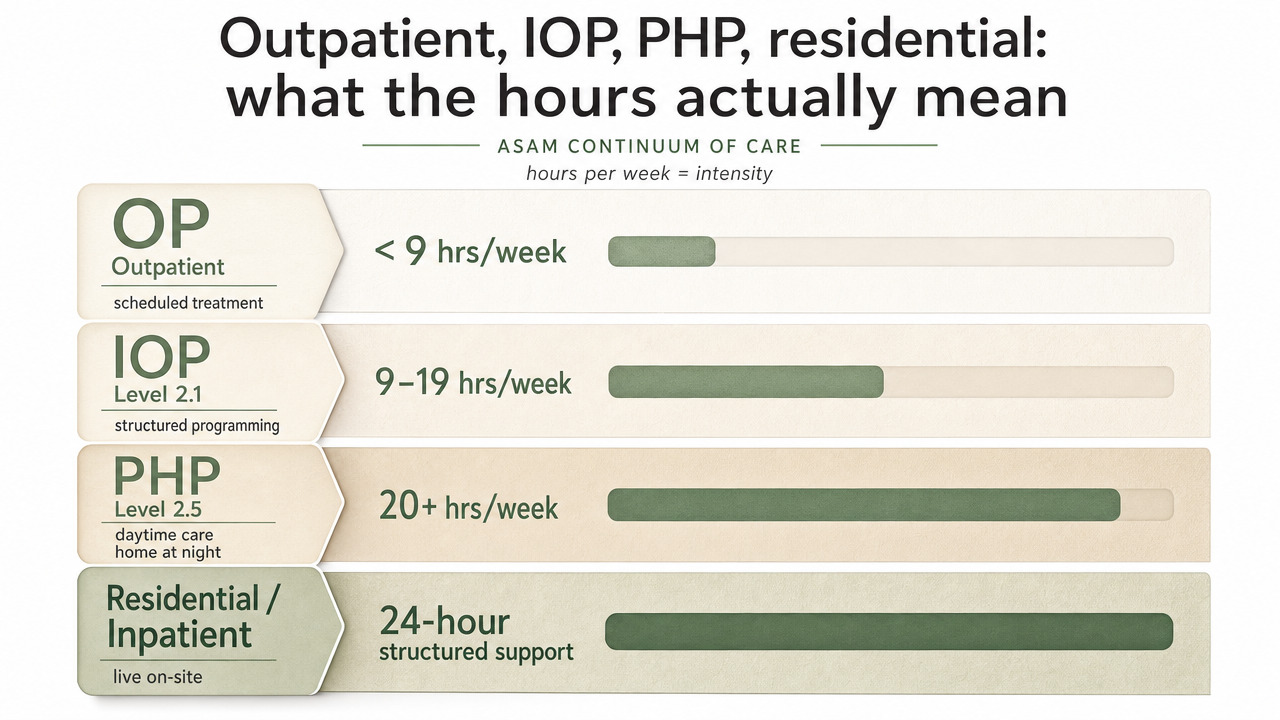
Outpatient, IOP, PHP, residential: what the hours actually mean
The clearest way to understand drug treatment programs is to look at how many hours a week you'd actually spend in care. That's it. The acronyms are just shorthand for intensity.
Here's how the American Society of Addiction Medicine (ASAM) — the standards body most insurers and clinicians follow — sorts things out:
- Standard outpatient (OP): fewer than 9 hours per week of scheduled treatment. 14
- Intensive outpatient (IOP), or Level 2.1: 9 to 19 hours per week of structured programming. 1
- Partial hospitalization (PHP), or Level 2.5: 20 or more hours per week of clinically intensive care, still delivered during the day so you go home at night. 1
- Residential and inpatient care: 24-hour structured support, where you live on-site for the duration of the program.
Read that list again slowly. The difference between IOP and PHP isn't a difference in seriousness — it's a difference in how many hours a week the clinical team wants eyes on you. PHP is not intended for people who need round-the-clock medical supervision; that's what inpatient care is for. 5
Why does this matter? Because when you're scared and scrolling, it's easy to assume that more hours means better outcomes. The research doesn't back that up. Peer-reviewed reviews have found that intensive outpatient programs can produce outcomes comparable to inpatient or residential care for many people who don't need medical detox or 24-hour supervision. 11
So the honest question isn't "what's the strongest program?" It's "how much structure does your week need to have right now, and what does your body need before you start?" A working parent with a supportive home and moderate use might do well at 9–12 hours a week. Someone with unstable housing and heavier use might need 25 hours a week of daytime programming to get real traction. Both are drug treatment. Neither is a compromise.
Where early intervention and continuing care fit on either end
The continuum doesn't start at outpatient and end at residential. There's a piece on each side that most articles skip.
On the front end, there's early intervention — brief education, screening, and short counseling for people whose use is causing problems but hasn't yet met the criteria for a full substance use disorder. 10 Think of it as a chance to change course before things escalate.
On the back end, there's continuing care — sometimes called aftercare or recovery support. This is the check-ins, alumni groups, ongoing counseling, and sober support that come after the main program ends. It matters more than it sounds. A meta-analysis of continuing care programs found a small but statistically significant benefit for substance use outcomes both at the end of treatment and at follow-up. 7
Put simply: treatment isn't a single event with a start and end date. It's a stretch of the road with an on-ramp and an off-ramp, and the supports on either side are part of the picture from day one.
Before treatment starts: assessment and the detox question
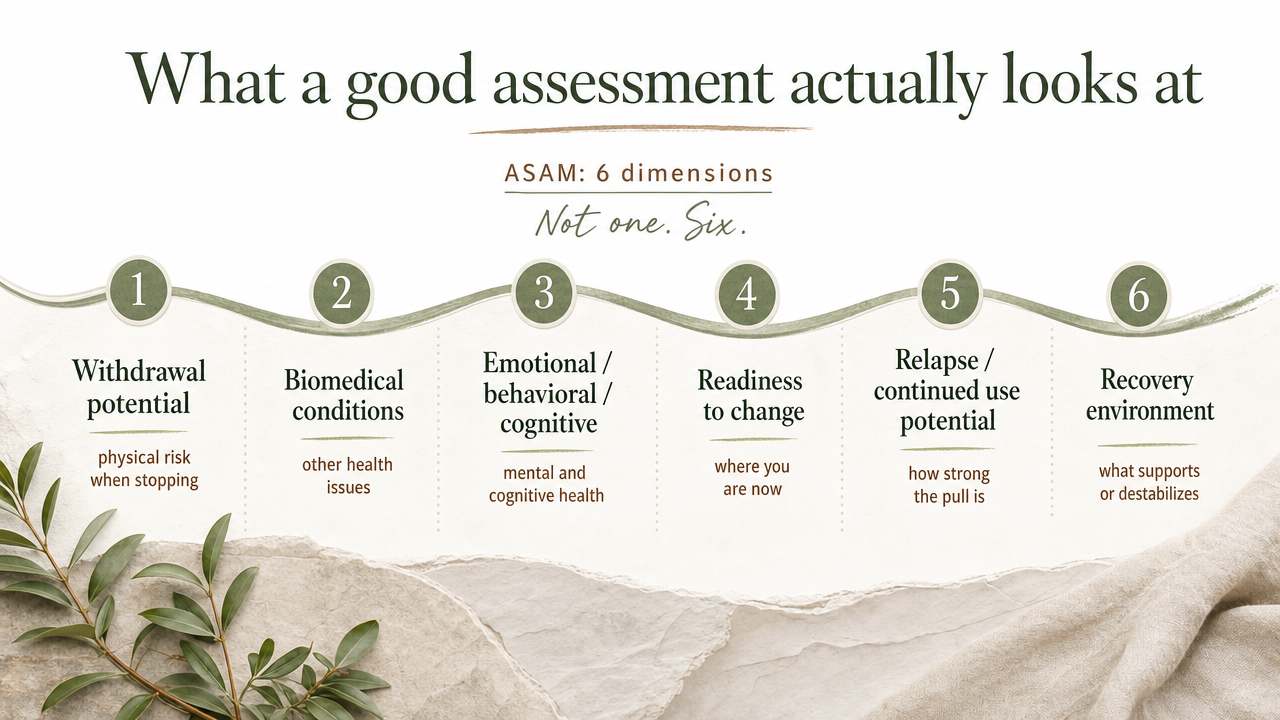
What a good assessment actually looks at
Before anyone tells you which program you "belong in," a solid provider will ask you a lot of questions. Not to gatekeep. To match care to what's actually going on.
The framework most reputable programs use comes from ASAM, and it looks at six dimensions of your situation. Not one. Six. That's the assessment. 2
- Withdrawal potential. What's likely to happen physically when you stop, and how severe could it get?
- Biomedical conditions. Other health issues — pregnancy, liver problems, chronic pain, anything that affects treatment safety.
- Emotional, behavioral, and cognitive conditions. Depression, anxiety, trauma responses, thoughts of self-harm, cognitive changes.
- Readiness to change. Where you actually are, not where you think you should be. Ambivalence is normal and doesn't disqualify you.
- Relapse or continued use potential. How strong the pull is right now, and what's happened in past attempts.
- Recovery environment. Who's in your home. Whether your job supports treatment. Whether the people around you are safe, neutral, or actively making things harder.
Read those again. Notice what's on the list — and what isn't. Nobody is grading you on how bad your use is. Nobody is comparing you to someone else's story. The assessment is trying to build a picture of your life, so the level of care matches your reality.
A good first conversation feels less like an interview and more like someone genuinely trying to understand what would work. If it doesn't feel that way, that's information about the provider, not about you. This is also where care coordination starts — connecting you to detox if you need it, to a therapist for co-occurring conditions, or to a medication provider — before the first group session ever begins.
Do you need detox first, and what kind?
Withdrawal is one of the biggest reasons people put off calling. The fear of what it might feel like — or what it might look like to the people around you — can be louder than the fear of using.
Here's what helps: detox isn't one dramatic scenario. It's a set of graded options, and most people don't need the most intensive version. There are four recognized levels of withdrawal management. 3
- Ambulatory detox (outpatient). You come in for check-ins and medication as needed, then go home. Appropriate for milder withdrawal from many substances, with a stable home environment.
- Clinically managed residential detox. You stay somewhere with 24-hour non-medical support — trained staff, structure, safety — but not a full medical team on-site.
- Medically monitored inpatient detox. A facility with nurses and medical staff available around the clock, for more significant withdrawal risk.
- Medically managed intensive inpatient detox. The most acute setting, essentially hospital-level care, for severe or complicated withdrawal.
Which level fits depends on the substance, how much and how long you've been using, your medical history, and what's at home. Alcohol and benzodiazepine withdrawal can be medically dangerous and often need a monitored setting. Opioid withdrawal is deeply uncomfortable but rarely life-threatening on its own, and it's often managed with medication in a lower-intensity setting.
Recovery Starts With a Conversation
Whether you’re exploring recovery for yourself or seeking guidance for someone you care about, Coastal Recovery Partners is here to help. Our team offers trauma-informed, evidence-based support grounded in structure, compassion, and real connection—without pressure or judgment.
When you’re ready, we’ll meet you where you are and help you take the next step forward.
Outpatient levels, taken seriously
Standard outpatient: for stable footing and step-down
Standard outpatient care, or OP, is the lightest touch on the ASAM continuum — fewer than 9 hours of scheduled treatment per week. 14 That usually looks like one or two individual therapy sessions, a weekly group, or a medication check-in, worked around your job and your life.
Don't mistake "lightest touch" for "not real treatment." OP is where a lot of people land after finishing IOP or PHP, and it's where they hold onto the gains they made. It's also a reasonable starting point if your use is early, your withdrawal risk is low, and your home and work are stable enough to support the change without daily structure.
What OP is not built for: heavy withdrawal, active crisis, or a home environment that keeps pulling you back into use. If any of those are in the picture, a higher level of care first — and then a step-down to outpatient — tends to work better than trying to do it all with one hour a week.
Intensive outpatient (IOP): structure without leaving your life
Intensive outpatient sits in the middle of the continuum: 9 to 19 hours of structured programming a week, usually spread across three to five days. 1 Sessions often run in the morning before work or in the evening after, so you can keep a job, pick up your kids, and sleep in your own bed.
What actually happens in those hours? A mix. Group therapy where you're working on cravings, triggers, and the day-to-day mechanics of not using. Individual sessions with a counselor. Skills-based work — how to sit with a hard feeling, how to say no to an old friend, how to rebuild routines that don't revolve around the substance. When medication for opioid or alcohol use disorder is part of the plan, that's coordinated alongside the therapy work. 9
Here's the part most articles bury: IOP isn't a step down from "real" rehab. Peer-reviewed research on intensive outpatient programs has found outcomes comparable to inpatient and residential care for many people who don't need medical detox or 24-hour supervision. 11 For a working parent, a professional who can't disappear for 30 days, or someone whose home is genuinely a source of support, IOP is often the right level — not a compromise version of it.
What IOP asks of you: showing up several times a week, being honest in group, and having a home environment that isn't actively working against you. What it gives back: treatment that fits inside the life you're trying to protect.
Partial hospitalization (PHP): the most intensive care you can get without staying overnight
Partial hospitalization — Level 2.5 in the ASAM system — means 20 or more hours a week of clinically intensive programming, typically five days a week during business hours. 1 You come in in the morning, spend the day in a mix of group therapy, individual sessions, skills work, and medical or medication check-ins, and go home at night.
Think of PHP as the option for people who need serious structure and clinical attention but don't need someone watching them overnight. It's often the right first step after medical detox. It's often the right choice for someone with a co-occurring mental health condition who needs closer monitoring than IOP can offer. And it's a common bridge for people stepping down from residential care who aren't ready to jump straight to a few evenings a week.
One important line: PHP is not designed for anyone who needs 24-hour medical supervision. 5 If withdrawal is severe or medical instability is a real concern, inpatient care comes first, and PHP picks up after.
The trade-off is time. PHP will occupy your daytime for a stretch — often two to four weeks, sometimes longer — before stepping down to IOP. For a lot of people, that daytime commitment is exactly what makes the difference.
Residential and inpatient care: when 24-hour support is the right fit
Sometimes going home at night is exactly the wrong move. If your body needs medical eyes on it, if the place you'd be returning to is where the using happens, or if you've tried outpatient before and the environment kept pulling you under — that's when residential or inpatient care earns its place.
The two terms get used interchangeably, but there's a useful distinction. Residential treatment means you live at a program for a stretch — often several weeks — with 24-hour structured support, group and individual therapy during the day, and staff on-site around the clock. Medically managed inpatient care is more acute: a hospital-style setting with nurses and physicians available at all times, usually for severe withdrawal, medical instability, or serious co-occurring conditions.
A systematic review of 23 studies found moderate-quality evidence that residential treatment can improve substance use and life outcomes for adults with substance use disorders. 6 The authors also flagged limits — attrition, varied study designs — so this isn't a promise, it's a signal. Residential care does something real for the people who need it.
Who tends to benefit? People with severe withdrawal risk, unstable housing, repeated relapses despite outpatient treatment, or a home environment that isn't safe to recover in. 5 For many others — especially those with jobs, stable homes, and mild to moderate withdrawal — outpatient levels can produce comparable results without the disruption. 11 The choice isn't about being sick enough. It's about what the coming weeks actually need to look like for you to have a fair shot.
Medication for cravings and withdrawal (MAT)
Medication-assisted treatment, or MAT, is one of the most misunderstood pieces of this whole picture. So let's be direct about it.
MAT uses FDA-approved medications — things like buprenorphine, naltrexone, or methadone for opioid use disorder, and naltrexone or acamprosate for alcohol use disorder — alongside counseling and behavioral therapy. 12 For opioid use disorder specifically, NIDA states that medication should be the first line of treatment, usually combined with therapy. 12 That's not a marketing claim. That's the research position.
Here's what MAT actually does: it quiets the cravings and reduces the physical pull, so you can do the harder work in therapy without your body constantly screaming at you. It doesn't replace the therapy. It makes the therapy possible.
The "trading one drug for another" framing you may have heard from well-meaning people gets the biology wrong. Prescribed medications, taken as directed, don't produce the same cycle of use — they stabilize it. 9
MAT is commonly delivered inside outpatient programs, so your medication plan, counseling, and group work are coordinated in one place instead of scattered across three.
Dual diagnosis and trauma-informed care: what changes about the room
A lot of people carry more than one thing into treatment. Depression that's been there for years. Anxiety that gets louder without something to quiet it. A trauma history that never really got addressed. When those are in the picture alongside substance use, you're looking at what clinicians call co-occurring conditions, or dual diagnosis.
Treating one without the other tends to leave the door open for relapse. That's why programs designed for dual diagnosis coordinate the mental health work and the substance use work together — same team, same treatment plan — instead of sending you to two places that don't talk to each other.
Trauma-informed care is a related but distinct piece. It changes how the room feels and how questions get asked. Staff are trained to recognize trauma responses, pace difficult conversations, and avoid the kind of confrontational tactics that used to be common in addiction treatment. A systematic review of trauma-informed care in substance use settings found positive results on substance use, trauma and mental health symptoms, and treatment retention — meaning people are more likely to stay long enough to get better. 8
If any of this sounds like you, ask directly whether a program offers integrated dual diagnosis care and trauma-informed protocols. Those aren't buzzwords. They change what happens once you sit down.
After the program ends: continuing care and why it matters
Finishing IOP or PHP is a real accomplishment. It's also not the end of the story.
Continuing care is the stretch that comes after the main program winds down — regular check-ins with a counselor, alumni groups, ongoing medication management if that's part of your plan, and connections to peer support. It's lower intensity by design. The point is to keep a hand on the wheel while the rest of life gets louder again.
The research is quiet but consistent here. A meta-analysis of continuing care programs found a small but statistically significant benefit for substance use outcomes both at the end of treatment and at follow-up. 7 Small effects, applied over months and years, are how relapse rates come down.
Practically, this means asking your program what happens on week one after you step down — not just on your last day in the room. That handoff is where care coordination earns its keep.
A note on scheduling, insurance, and picking up the phone
Two practical things stop people from calling more than almost anything else: "I can't miss work" and "I don't know what my insurance will cover." Both are solvable, and neither should be the thing that keeps you from getting the first conversation on the calendar.
On scheduling: outpatient programs like IOP and PHP often run in tracks — morning, afternoon, or evening — so you can keep a job, get kids to school, or attend to whatever your week already asks of you. If a program only offers one time slot and it doesn't fit your life, that's a program problem, not a you problem. Ask directly what tracks are available before you assume you can't make it work.
On insurance: most outpatient providers verify your benefits for you. You share your insurance information, they check what's covered, and they tell you what your out-of-pocket looks like before you commit to anything. You don't need to decode a benefits summary on your own.
The first call isn't a commitment. It's a conversation. At Coastal Recovery Partners, that call is where care coordination starts — figuring out the right level, the right schedule, and the right next step for the person actually sitting in your chair.
Frequently Asked Questions
Do I have to go to inpatient rehab, or can I get real treatment while living at home?
You don't have to leave home to get real treatment. Structured outpatient care — IOP and PHP — is clinically serious care, and peer-reviewed research has found IOP outcomes can be comparable to inpatient or residential programs for many people who don't need medical detox or 24-hour supervision. 11 The right level depends on withdrawal risk, home stability, and medical needs, not on which option sounds most intense.
How do I know if I need medical detox before starting a program?
An assessment sorts this out before you start. It looks at the substance, how much and how long you've been using, your medical history, and your home environment. 2 Alcohol and benzodiazepine withdrawal can be medically dangerous and often need monitored detox. Outpatient programs can work for mild to moderate withdrawal, but not for anyone needing 24-hour medical oversight. 5 You don't have to figure this out yourself.
What's the actual difference between IOP and PHP?
The difference is hours per week. IOP runs 9 to 19 hours of structured programming weekly, usually across three to five days, and often fits around a job. PHP runs 20 or more hours, typically five daytime hours a day, and functions more like a full workday of treatment. 1 Both send you home at night. PHP is not designed for anyone needing 24-hour medical supervision. 5
Is medication-assisted treatment (MAT) just replacing one drug with another?
No. For opioid use disorder, NIDA says medication should be the first line of treatment, usually combined with counseling. 12 Prescribed medications like buprenorphine or naltrexone quiet cravings and stabilize the body so therapy can actually work. They don't produce the cycle of use that untreated addiction does. MAT paired with behavioral therapy is one of the most evidence-based approaches available. 9
What if I'm also dealing with depression, anxiety, or past trauma?
Then you want a program that treats both together — often called dual diagnosis care. Treating substance use without addressing what's underneath tends to leave the door open for relapse. Trauma-informed care also matters: a systematic review found trauma-informed approaches in substance use settings improved substance use outcomes, mental health symptoms, and treatment retention. 8 Ask directly whether a program offers integrated dual diagnosis and trauma-informed protocols.
What happens when I call a treatment program for the first time?
The first call is a conversation, not a commitment. Someone will ask about your situation — the substance, how you've been sleeping, what's happening at home and work, whether you've tried treatment before. They'll verify your insurance and talk through what's covered. If detox is needed first, they'll coordinate that hand-off. You'll leave the call with a clearer next step, not a signed contract.
References
- Overview of Substance Use Disorder Care: Clinical Guidelines for Medicaid Programs. https://www.medicaid.gov/state-resource-center/innovation-accelerator-program/iap-downloads/reducing-substance-use-disorders/asam-resource-guide.pdf
- TIP 45 Detoxification and Substance Abuse Treatment. https://www.govinfo.gov/content/pkg/GOVPUB-HE20_400-PURL-gpo124442/pdf/GOVPUB-HE20_400-PURL-gpo124442.pdf
- Quick Guide For Clinicians Based on TIP 45 Detoxification and Substance Abuse Treatment. https://nida.nih.gov/sites/default/files/samhsa_detoxification_and_substance_abuse_treatment.pdf
- Principles of Drug Addiction Treatment: A Research-Based Guide (Third Edition). https://www.nida.nih.gov/sites/default/files/podat-3rdEd-508.pdf
- 2 Settings, Levels of Care, and Patient Placement. https://www.ncbi.nlm.nih.gov/books/NBK64109/
- The effectiveness of residential treatment services for individuals with substance use disorders: A systematic review. https://pubmed.ncbi.nlm.nih.gov/31254749/
- Impact of Continuing Care on Recovery From Substance Use Disorder. https://pmc.ncbi.nlm.nih.gov/articles/PMC7813220/
- A Systematic Review of Trauma Informed Care in Substance Use Settings. https://www.pubmed.ncbi.nlm.nih.gov/39641885/
- Treatment Options: For Drug Addiction and Dependence. https://nida.nih.gov/sites/default/files/pdf/treatment_options_download_nidamed.pdf
- Chapter 3. Intensive Outpatient Treatment and the Continuum of Care for Substance Abuse Treatment. https://www.ncbi.nlm.nih.gov/books/NBK64088/
- Substance Abuse Intensive Outpatient Programs: Assessing the Evidence. https://pmc.ncbi.nlm.nih.gov/articles/PMC4152944/
- Treatment and Recovery. https://nida.nih.gov/publications/drugs-brains-behavior-science-addiction/treatment-recovery
- Principles of Drug Addiction Treatment: A Research-Based Guide (Third Edition). https://nida.nih.gov/sites/default/files/podat-3rdEd-508.pdf
- ASAM Criteria – Part 2: Levels of Care Overview (NEIAS 2019). https://www.mass.gov/files/documents/2020/01/24/ASAM_Part2_NEIAS1DAY2019-compressed.pdf
- DrugFacts: Treatment Approaches for Drug Addiction. https://nida.nih.gov/publications/drugfacts/treatment-approaches-drug-addiction