
What Options Are There for Oxycodone Addiction Treatment?

Key Takeaways
- Oxycodone addiction is treated as opioid use disorder using two combined pieces: FDA-approved medication (buprenorphine, methadone, or naltrexone) alongside structured therapy like CBT and DBT.
- Detox alone isn't treatment — the CDC warns it raises the risk of return to use and overdose death because tolerance drops without medication to steady cravings 4.
- The right level of care matches your actual week: PHP for daily instability, IOP when evenings unravel, and standard outpatient once medication holds and cravings quiet.
- When choosing a program, ask whether it prescribes all three FDA-approved medications, pairs MAT with individual therapy, and screens for trauma and co-occurring conditions early.
The Real Treatment Playbook for Oxycodone Use
If you're reading this, you probably already know oxycodone stopped being about the pain a while ago. Maybe it started after a surgery or an injury. Maybe you've tried to stop and the withdrawal knocked you back. You don't need another lecture about how addiction works. You need to know what actually helps.
Here's the short version: oxycodone addiction is treated as opioid use disorder, and the evidence-based playbook has two main pieces that work together. One is medication — buprenorphine, methadone, or naltrexone, all approved by the FDA and shown to reduce overdose risk and improve day-to-day functioning 5. The other is structured therapy, usually cognitive behavioral therapy (CBT) and skills work like DBT, paired with recovery support 1.
That combination gets delivered at a level of care that fits your week — standard outpatient, intensive outpatient (IOP), or partial hospitalization (PHP). For many people, that means keeping the job, staying with the kids, and sleeping in your own bed while you rebuild.
The rest of this guide walks you through the real menu, honestly. What each medication does. Why detox alone isn't enough. How therapy earns its place next to the prescription. And how to pick a level of care without upending your life to get well.
Why Detox Alone Isn't Treatment
Here's something a lot of programs won't say plainly: getting the oxycodone out of your system is not the same as treating the addiction. Detox handles the acute withdrawal — the sweating, the cramps, the sleeplessness, the crawling-out-of-your-skin days. That's the physical piece. The part of your brain that learned to reach for oxycodone when life gets hard? That doesn't get fixed by five days of misery.
If you've been through a detox before and it didn't hold, that's not a personal failure. It's what the evidence predicts when withdrawal management is treated as the whole plan instead of the first hour of one. Real treatment starts where detox stops — with a medication that keeps cravings quiet, therapy that gives you something to reach for when the urge shows up, and a schedule you can actually keep. If a program is offering you a week of withdrawal management and calling it done, that's your cue to ask what comes next.
The Three FDA-Approved Medications for Opioid Use Disorder
Comparing Buprenorphine, Methadone, and Naltrexone
Three medications are approved by the FDA to treat opioid use disorder: buprenorphine, methadone, and naltrexone 5. They are not interchangeable. Each one works on your brain chemistry in a different way, gets prescribed in a different setting, and asks something different of you before you start. Knowing the shape of each one makes the conversation with a clinician a lot less overwhelming.
- Buprenorphine
- A partial opioid agonist. In plain terms, it turns the receptor on partway — enough to quiet cravings and withdrawal, not enough to produce the high you had on oxycodone. It's typically prescribed through a doctor's office or outpatient program and taken at home, often as a daily film that dissolves under the tongue or as a monthly injection.
- Methadone
- A full opioid agonist. It occupies the same receptors oxycodone did, at a steady dose that doesn't spike and crash. It's dispensed through federally regulated opioid treatment programs, usually starting with daily clinic visits, with take-home doses earned over time 3.
- Naltrexone
- The opposite approach. It's an opioid antagonist — it blocks the receptor entirely, so oxycodone can't get in and produce an effect. It's non-addictive and available as a monthly injection (extended-release) or a daily pill. The catch is you have to be fully off opioids before you start, or the medication triggers immediate withdrawal 2.
A simple way to hold it in your head: buprenorphine steadies you, methadone stabilizes you, and naltrexone blocks the door. All three are proven safe and effective when used as prescribed, and all three lower overdose risk compared with no medication at all 5. Which one fits depends on your history, how long you've been using, whether you have chronic pain, and how your week is built.
Buprenorphine: Steadying Cravings Without a Clinic Visit Every Day
Buprenorphine is often the first medication people are offered, and for good reason. The 2024 national guideline update lists it alongside methadone as a standard first-line treatment for opioid use disorder 7. It works because it's a partial agonist — it gives your opioid receptors just enough activity to shut down the withdrawal and craving noise, without the euphoria or the sedation.
For someone coming off oxycodone, that means the shakes, the restless legs, and the constant mental pull toward the next dose get quieter, usually within the first day or two of induction. You take it at home, most often as a small film or tablet that dissolves under your tongue in the morning. Some formulations are given as a monthly injection, which removes the daily decision entirely.
Because buprenorphine can be prescribed in outpatient offices, you don't have to reorganize your life around clinic hours. You come in for appointments, get your prescription, and keep going to work, school, or your kids' pickup line. When it's paired with counseling and structured therapy, it becomes the platform the rest of your recovery gets built on 1.
Methadone: Daily Structure and Take-Home Flexibility
Methadone has been used to treat opioid addiction for decades, and for people with heavier or longer-term oxycodone use, it can be the medication that finally holds. It's a full opioid agonist, which means it fully occupies the receptors oxycodone used to reach — at a stable dose that doesn't produce a high once you're properly titrated. Cravings drop. Withdrawal ends. The mental static quiets down.
Methadone is dispensed through federally regulated opioid treatment programs, which historically meant a daily clinic visit for your dose. The 2024 federal guidelines expanded take-home flexibility, so patients who are stable can earn multi-day supplies rather than showing up every morning 3. Those same guidelines also encourage integrating methadone care with mental health and medical treatment, which matters if you're managing depression, anxiety, or chronic pain alongside recovery.
If your history includes previous failed attempts on lighter medications or high-tolerance opioid use, methadone deserves a real conversation, not a dismissal.
Naltrexone: The Non-Opioid Option and Its Real Trade-Offs
Naltrexone is the medication people ask about when they don't want an opioid in the mix at all. It blocks the opioid receptor rather than activating it, so if you did use oxycodone while on it, the drug essentially can't get through. It's non-addictive, doesn't produce physical dependence, and the extended-release injection lasts about a month.
The trade-off shows up before you even start. To avoid precipitated withdrawal — a sudden, brutal version of the withdrawal you're already trying to escape — you need to be fully opioid-free first. That means at least 7 days off short-acting opioids and 10 to 14 days off long-acting opioids before your first dose 2. For someone deep in daily oxycodone use, that opioid-free window is a real barrier.
There's also an honesty piece worth naming. The 2024 guideline update notes that oral naltrexone has limited evidence of benefit and higher rates of treatment discontinuation compared with buprenorphine or methadone 7. The monthly injection performs better than the pill, mostly because you're not deciding to take it every morning. Naltrexone can work — particularly for people who've completed a supervised opioid-free period and want a non-agonist option — but it isn't automatically equal to the other two.
"Am I Just Trading One Addiction for Another?"
This is the question that keeps a lot of people out of treatment that would help them. It's an understandable one. If you've spent months or years fighting your relationship with a pill, the idea of taking a different pill every day can feel like losing rather than winning.
Here's what the FDA and SAMHSA say plainly: at therapeutic doses, buprenorphine and methadone stabilize brain function rather than produce a high 5. You're not chasing anything. You're not sedated. You go to work, you show up for your kids, you sleep. What these medications replace isn't the drug — it's the chaos of chasing the drug. Research consistently shows they lower overdose risk and improve overall functioning 5.
Physical dependence on a prescribed, stable medication is not the same as active addiction, any more than someone on insulin is addicted to insulin. You can be on medication and be in recovery. Those two things are not in conflict.
If the First Medication Doesn't Fit
Sometimes the first medication you try isn't the one you stay on, and that's a normal part of the process — not a setback. Maybe buprenorphine doesn't hold your cravings at the dose your prescriber can offer. Maybe methadone's clinic schedule collides with your work. Maybe naltrexone's opioid-free window turned out to be more than you could manage alone.
Clinical guidance supports switching between medications when the first choice isn't working, with careful timing to avoid precipitated withdrawal — particularly when moving to or from naltrexone 6. Tell your prescriber the truth about what you're feeling. The plan is supposed to bend around you, not the other way around.
Recovery Starts With a Conversation
Whether you’re exploring recovery for yourself or seeking guidance for someone you care about, Coastal Recovery Partners is here to help. Our team offers trauma-informed, evidence-based support grounded in structure, compassion, and real connection—without pressure or judgment.
When you’re ready, we’ll meet you where you are and help you take the next step forward.
Why Therapy Belongs Next to the Medication
What CBT Actually Does for Cravings and Relapse
Medication does the biological work of quieting cravings. Therapy does the work of teaching your brain what to do instead of using. Cognitive behavioral therapy — CBT — is the most studied of these, and randomized trials have found CBT-based relapse prevention outperforms minimal or no treatment for substance use disorders 10. In practice, it looks less like a couch and more like a workbook. You map the situations that pull you toward oxycodone. You catch the thought patterns that talk you into the next dose. You rehearse different responses until they become the reflex.
How much this matters shows up in a 2024 study of a single opioid treatment program that changed its policy to add 60 minutes of individual CBT every other week on top of existing group counseling and MAT. Treatment retention climbed from 8% to 56% after the change 11. That's one clinic's policy shift, not a national average — but the direction is hard to miss. Medication holds the ground. Therapy is how you learn to stand on it.
DBT Skills for the Hardest Hours
CBT is great at the thinking piece. Dialectical behavior therapy — DBT — is built for the moments when thinking isn't going to save you. The 2 a.m. craving. The fight with your partner that lights up every old coping habit. The hour when the pain flares and the old bottle isn't in the drawer anymore.
DBT teaches concrete skills for those moments: how to slow a spiraling emotion, how to tolerate distress without acting on it, how to stay grounded when your body is telling you to reach. In a study of DBT adapted for intensive outpatient settings, completing skills homework and using phone coaching between sessions were linked to reduced urges for illicit or non-prescribed substance use across treatment 12. The skills work only if you practice them, which is the point — you're building muscle memory for the hardest hours before they arrive.
Trauma-Informed Care Isn't a Buzzword
Trauma-informed sounds like marketing until you look at who actually walks into treatment. More than half of people who seek substance use treatment report one or more lifetime traumas 8. If you're one of them, the story of your oxycodone use probably has a chapter that started long before the prescription — a car accident, a childhood you don't like to describe, a loss that never got named. Ignoring that chapter and going straight after the pills tends to work for a while and then stop working, because the reason the pills were useful in the first place is still there.
Trauma-informed care means the program screens for trauma early, and clinicians adjust how they ask questions, run groups, and pace exposure to hard material so that treatment doesn't accidentally recreate what hurt you 8. It also means being honest about the evidence: many trauma-treatment studies exclude people with active substance use, so brief CBT, psychoeducation, and paced skill-building are often the safest starting points until you're steadier 13. You're not doing recovery wrong if trauma work has to wait a few months. You're doing it in the right order.
Choosing a Level of Care That Fits Your Life
Outpatient, IOP, and PHP: What Each Week Actually Looks Like
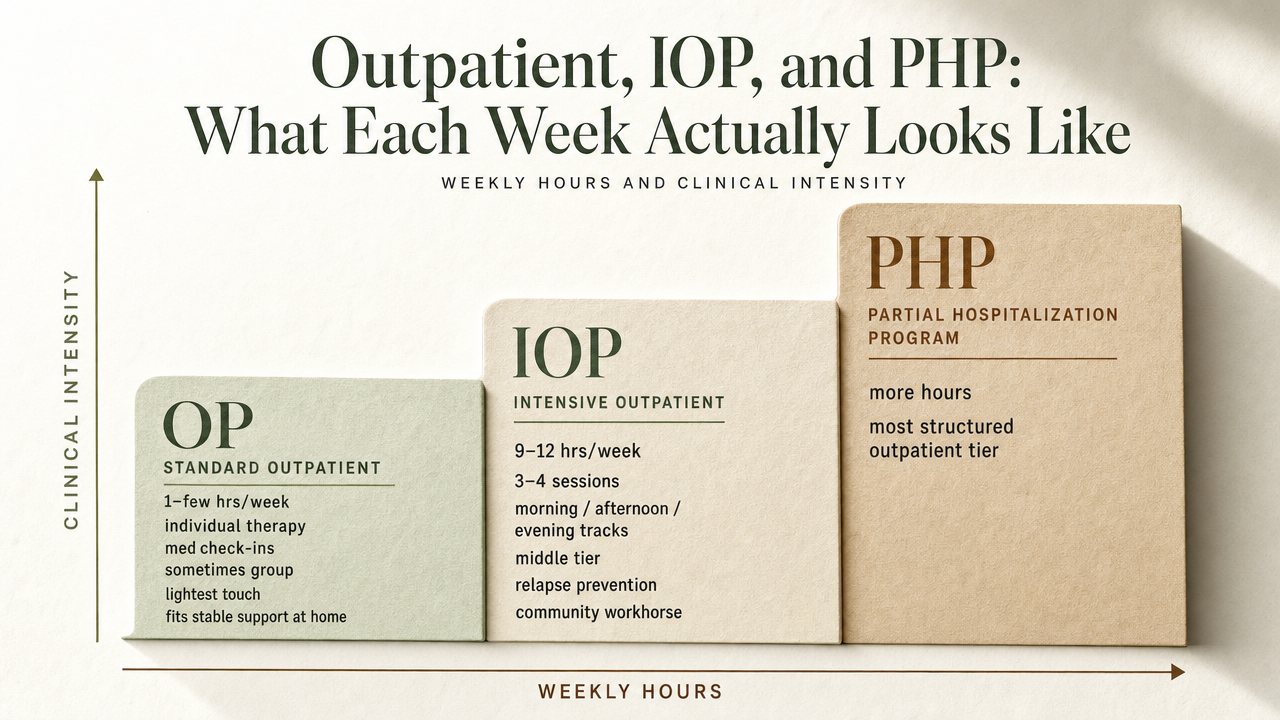
Level of care is really a question about hours. How many hours of treatment a week can your life absorb, and how many hours do you actually need to get steady? Three main tiers exist in outpatient addiction care, and each one carries a different rhythm.
Standard outpatient (OP) is the lightest touch. You come in one to a few hours a week for individual therapy, med-management check-ins, and sometimes a group. It fits people who are already stable on medication, have solid support at home, and mostly need a place to keep the work going.
Intensive outpatient (IOP) is the middle tier and the workhorse of community addiction care. Most programs run around 9 to 12 hours a week, spread across three or four sessions — often morning, afternoon, or evening tracks so you can pick around your schedule. Groups focus on relapse prevention, CBT and DBT skills, and psychoeducation, with individual therapy and MAT coordination layered in. A systematic review of IOPs found they are as effective as inpatient treatment for most people seeking care, with substantial reductions in substance use between baseline and follow-up 9. That's the sentence to hold onto if someone is telling you that only 30 days away from your life will work.
Partial hospitalization (PHP) is the top tier of outpatient care. Roughly 20 or more hours a week, five days a week, with the same clinical elements as IOP but at a much higher dose. You sleep at home. You spend most of your day in treatment. It's the option for people stepping down from residential, coming out of a detox, or hitting a stretch where a lighter schedule just isn't holding.
Matching the Level to Your Actual Week
The right level isn't the most intensive one you can tolerate. It's the one that matches where you actually are.
- If you're still using daily, if your last few attempts to stop unraveled within a week, or if you're stepping down from a residential program or a hospital stay, PHP is often the honest starting point. Five days of structure gives your medication time to steady you and your nervous system time to reset before life gets a full vote again.
- If you can get through the workday without using but the evenings and weekends are where things fall apart, IOP tends to be the fit. Evening tracks let you keep the job. Morning tracks let you be present for school pickup. The point of IOP isn't to disappear from your life — it's to build recovery inside it, with enough clinical hours to make the skills stick.
- Standard outpatient is where you land once the acute risk has quieted. You're stable on your medication, cravings are manageable, and you need a consistent place to keep therapy going, refine relapse prevention, and address anything underneath — trauma, depression, chronic pain — that the busier weeks didn't have room for.
Many people move down through these tiers over months, and some move back up briefly when life gets loud. Neither direction is failure. It's the plan doing its job.
What the First 90 Days Can Look Like
Nobody hands you a map on day one, so here's a rough sketch of what the first three months can feel like when medication and therapy are working together.
- The first two weeks are mostly about getting steady. Induction on buprenorphine or methadone happens under a clinician's eye, doses get adjusted, and the withdrawal noise starts to quiet. Sleep is often the first thing to come back. You'll probably meet your therapist, get screened for trauma and mental health concerns early rather than months in 8, and start showing up to groups even when you don't feel like it.
- Weeks three through six are where the skills start to stick. CBT sessions map your triggers. DBT skills give you something to do at 9 p.m. when the craving spikes and you can't call anyone. You'll notice small wins that feel almost too small to name — a full night's sleep, a Tuesday without a spiral, a hard conversation you didn't run from.
- By day 60 to 90, the plan usually shifts. Some people step down from PHP to IOP, or IOP to standard outpatient, as retention holds and life absorbs more of the weight 9. The medication keeps doing its quiet work. You keep doing yours.
Finding a Program Worth Calling
When you start looking, most programs will sound about the same on their websites. Here's what actually separates the ones worth your first call.
- Ask whether they prescribe or coordinate all three FDA-approved medications, not just one. A program that only offers naltrexone, or only detox followed by a referral elsewhere, is not built for the full playbook 5.
- Ask how they combine medication with individual therapy — not just group — because the retention gains show up when structured CBT sits alongside MAT 11.
- Ask when they screen for trauma and co-occurring mental health, because early screening is the marker of a program that will actually treat what's underneath 8.
- Ask about scheduling. Morning, afternoon, and evening IOP tracks exist because recovery has to fit around work and kids, not the other way around.
If a program in the South Portland area matches that description, Coastal Recovery Partners is worth a conversation. The right first call is the one you actually make.
Frequently Asked Questions
Can I get treated for oxycodone addiction without going to residential rehab?
Yes. Intensive outpatient programs are as effective as inpatient care for most people seeking treatment, with substantial reductions in substance use between baseline and follow-up 9. You can live at home, keep working, and still get medication, individual therapy, and group skills work several times a week. Residential is one option, not the only door.
How long do I need to stay on medication like buprenorphine or methadone?
There's no fixed timeline. Some people stay on medication for a year, some for several years, and some indefinitely. Federal guidance treats these medications as long-term tools, not short courses 1. What matters is how you're functioning, not how quickly you can taper. Discontinuation is a decision you and your prescriber make together when the ground under you is steady.
What happens if I try to quit oxycodone cold turkey or only do detox?
Detox alone isn't recommended by the CDC because it raises your risk of returning to use and of overdose death 4. Your tolerance drops fast during the opioid-free stretch, so a dose that felt normal weeks ago can be fatal now. Withdrawal management gets the drug out. It doesn't quiet the cravings that pull you back.
Will my employer or family have to know I'm in treatment?
No. Federal privacy protections cover addiction treatment records, and clinicians don't share information without your written consent. Outpatient programs offer morning, afternoon, and evening tracks specifically so people can attend without disrupting work or family logistics. Who you tell, and when, is your call — not the program's. Many people share nothing until they choose to.
What if the first medication I try doesn't feel right?
Tell your prescriber. Switching between medications is a normal clinical decision when the first choice isn't holding cravings, causing side effects, or fitting your life 6. The timing matters — especially when moving to or from naltrexone — to avoid precipitated withdrawal. This isn't starting over. It's tuning the plan. The right medication is the one you can actually stay on.
How do I know whether outpatient, IOP, or PHP is the right starting point?
A clinical assessment sorts this out, but a rough guide: if you're still using daily or stepping down from a hospital or detox, PHP's five-day structure is usually the honest starting point. If evenings and weekends are where things fall apart, IOP fits. Standard outpatient works once your medication is steady and cravings are manageable. Levels can move up or down as life shifts.
References
- TIP 63: Medications for Opioid Use Disorder. https://library.samhsa.gov/product/tip-63-medications-opioid-use-disorder/pep21-02-01-002
- Medications for Opioid Use Disorder (full TIP 63 PDF). https://library.samhsa.gov/sites/default/files/SAMHSA_Digital_Download/PEP20-02-01-006_050820.pdf
- Federal Guidelines for Opioid Treatment Programs (2024). https://library.samhsa.gov/product/federal-guidelines-opioid-treatment-programs-2024/pep24-02-011
- Opioid Use Disorder: Treating. https://www.cdc.gov/overdose-prevention/hcp/clinical-care/opioid-use-disorder-treating.html
- Information about Medications for Opioid Use Disorder (MOUD). https://www.fda.gov/drugs/food-and-drug-administration-overdose-prevention-framework/information-about-medications-opioid-use-disorder-moud
- Medication Assisted Treatment for Opioid Use Disorder (Federal Bureau of Prisons clinical guidance). https://www.bop.gov/resources/pdfs/opioid_use_disorder_cg.pdf
- Management of opioid use disorder: 2024 update to the national clinical practice guideline. https://pmc.ncbi.nlm.nih.gov/articles/PMC11573384/
- Trauma-Informed Care in Behavioral Health Services (full manual). https://library.samhsa.gov/sites/default/files/sma15-4912.pdf
- Substance Abuse Intensive Outpatient Programs: Assessing the Evidence. https://pmc.ncbi.nlm.nih.gov/articles/PMC4152944/
- Chapter 8. Intensive Outpatient Treatment Approaches (from Treating Substance Use Disorder in Primary Care). https://www.ncbi.nlm.nih.gov/books/NBK64102/
- Outcomes of adding cognitive behavioral therapy to medication-assisted treatment for opioid use disorder. https://pubmed.ncbi.nlm.nih.gov/37682021/
- Skills-homework completion and phone coaching as predictors of change and outcomes in DBT. https://canlab.yale.edu/sites/default/files/Edwards_et_al_2021_Skills_homework_completion_and_phone_coaching_as_predictors_of_change_and_outcomes_in_DBT.pdf
- Trauma-Informed Care in Behavioral Health Services, Part 3: A Review of the Literature. https://library.samhsa.gov/sites/default/files/sma14-4816_litreview.pdf