
A Guide to Finding the Right Rehab Close to Me

Key Takeaways
- "Close to me" isn't about distance — it's about matching level of care, evidence-based methods, respectful treatment, and affordability to the life you're actually living.
- Rehab comes in four levels — outpatient, IOP, PHP, and residential — differing mainly by weekly hours and where you sleep, so structure can fit real schedules.
- Use vetted directories like Treatment Connection™, FindTreatment.gov, and the NIAAA Navigator, then confirm Maine licensing and ask ten specific questions before enrolling 5.
- Insist on trauma-informed practices and integrated dual-diagnosis care, because treating substance use without addressing anxiety, depression, or PTSD rarely holds long-term 11.
- Federal parity law and Maine's CMS rule require comparable coverage for substance use treatment, so ask for a free benefits verification and written medical necessity criteria 19.
- The fear of employers, neighbors, or a diagnosis label is real but manageable — outpatient scheduling and federal record protections give you more privacy than most people assume.
- Making the call is a twenty-to-thirty-minute intake conversation, not a commitment, and a good program will refer you elsewhere if their level of care doesn't fit 10.
What "close to me" actually means when you're the one making the call
If you typed "rehab close to me" into a search bar, chances are your hands were shaking a little, or you were sitting in a parked car, or it was late and the house was quiet. That takes something. Before you scroll another list of programs, take a breath — you're already doing the hard part.
Here's the thing most articles get wrong: "close to me" is not really about miles. A rehab that's fifteen minutes from your house but doesn't understand trauma, doesn't take your insurance, or wants to pull you out of work for a month isn't actually close to your life. And a program a little farther away that has evening group times, treats anxiety and substance use together, and lets you sleep in your own bed every night might be a much better fit — even if the drive is longer.
So when you're asking "where should I go," you're really asking four quieter questions at once:
- What level of care do I actually need?
- Does the program use methods that research supports?
- Will they treat me like a person, not a diagnosis?
- Can I afford it, both in money and in time away from the people who depend on me?
Federal and state health agencies frame the search the same way. The CDC points to treatment settings that range from outpatient counseling to inpatient rehabilitation and highlights federal locators that help you filter by geography, program type, and payment 1. NIDA is even more direct: no single treatment fits everyone, and matching the setting and services to your specific situation is what makes care work 9.
That's the frame for the rest of this guide. Not a list of the nearest buildings. A short, honest walk through how to figure out which nearby program is actually right for the life you're trying to hold together.
The four levels of care, translated into a real week
Outpatient, IOP, PHP, and residential in plain language
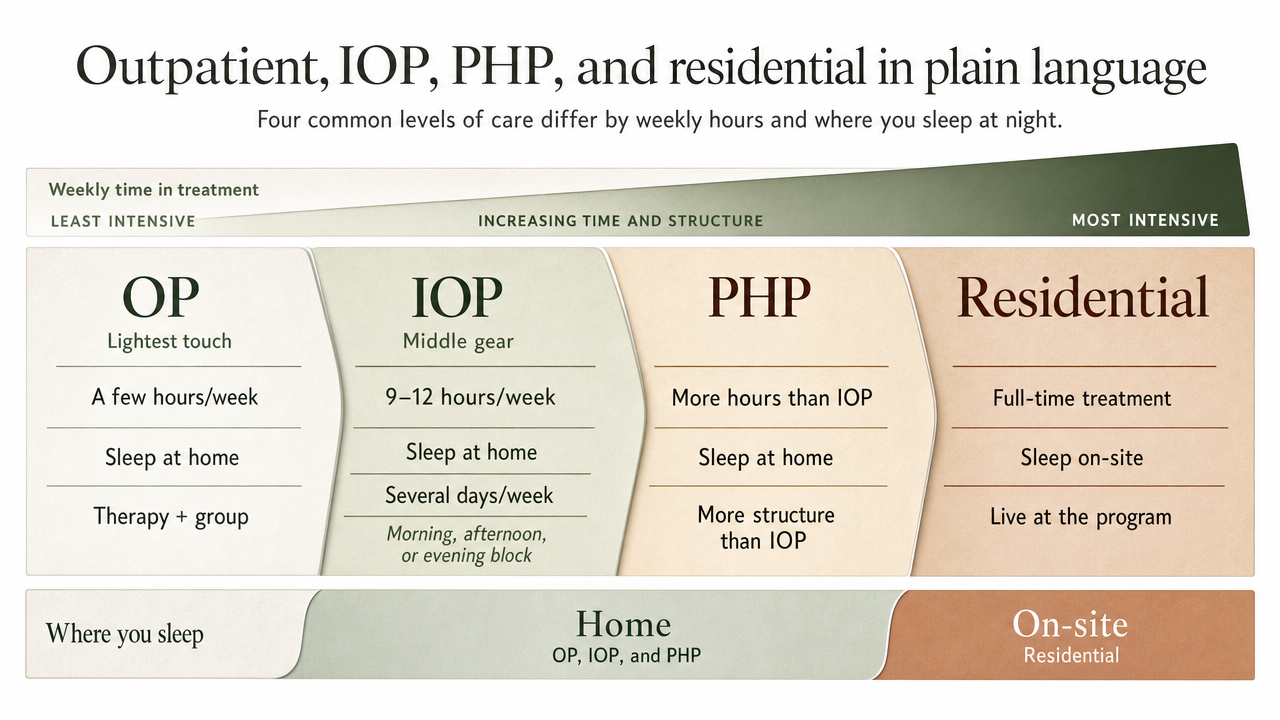
The word "rehab" gets used like it's one thing. It isn't. There are four common levels of care, and they mostly differ by how many hours a week you spend in treatment and where you sleep at night. Once you see them side by side, the decision gets a lot less scary.
- Standard outpatient (OP)
- is the lightest touch. You might see a therapist and a group once a week, maybe a few hours total. It's a good fit if your substance use is caught early, your home life is stable, and you don't need a lot of structure to keep momentum.
- Intensive outpatient (IOP)
- is the middle gear. You attend group therapy and individual sessions several days a week, usually about nine to twelve hours total, often in a morning, afternoon, or evening block so you can still work. NIAAA describes IOP and partial hospitalization as "coordinated outpatient care for complex needs" that lets you keep your routines 16.
- Partial hospitalization (PHP)
- is the most intensive form of outpatient care. Think of it like a part-time job you show up to — roughly five to six hours a day, most days of the week. You still sleep at home. It's often used when someone needs close clinical support but doesn't need a locked door.
- Residential or inpatient
- is the top of the ladder. You live at the facility, usually for weeks, and treatment fills most of your waking hours. It exists for people who need medical stabilization, a break from a dangerous environment, or a level of monitoring the other options can't provide 16.
The chart below stacks those weekly hours side by side, because that's usually what decides which option is realistic for someone with a job, a kid getting off the school bus, or a parent to look after. NIDA is clear on this point: matching the setting and services to your particular problems and needs is what makes treatment work, not picking the most intensive box on the menu 9.
Why intensive outpatient is the right fit for most working adults
Here's the part almost nobody tells you up front: for most adults, you don't have to disappear for 30 days to get real treatment.
A large evidence review of intensive outpatient programs found that across randomized and naturalistic studies, 50% to 70% of participants reported abstinence at follow-up — and for most patients, those outcomes did not differ between inpatient and outpatient settings 7. A separate randomized trial comparing intensive outpatient-style treatment with more traditional formats found no significant differences between modalities on any outcome measured at nine-month follow-up 8. That is a big deal. If you can keep working, stay in your bed, and see your kids in the evening, and the research says your odds of getting better are essentially the same, the calculation changes.
For everyone else — the accountant who's been drinking too much since the divorce, the nurse who started with a legitimate prescription and can't stop, the parent hiding a bottle in the garage — an IOP built around morning, afternoon, and evening groups can do the clinical work without blowing up your job or your family life. You get the intensity of daily therapy, medication support if you need it, and a group of people going through the same thing. Then you go home and practice what you're learning in the actual environment where your life happens. NIDA's guide puts it plainly: no single treatment is right for everyone 9. For a lot of working adults in coastal Maine, the right one lets you sleep in your own bed.
Vetting a program before you enroll: Search, Ask, Choose
Where to actually search in Maine
Google will hand you a page of paid ads that all look about the same. That's not searching — that's shopping in the dark. The people who study this for a living use trusted directories first, then narrow down from there. NIAAA calls it "Search-Ask-Choose," and step one is starting with sources that actually vet who's on the list 5.
For someone in southern Maine, three tools do the heavy lifting.
Treatment Connection™ is Maine's own directory, run through the Department of Health and Human Services. It lists more than 500 substance use and mental health treatment services across the state, and you can search confidentially without being a MaineCare member 18. If you're in South Portland, Scarborough, or anywhere along the coast, this is the fastest way to see what's actually near you and reach out privately.
FindTreatment.gov is SAMHSA's federal locator. Its advanced filters let you narrow by program type (outpatient vs residential), whether the facility offers medications for opioid or alcohol use disorder, and what insurance or payment options they accept 4. Turn on the filters. A generic search returns hundreds of options; a filtered search returns the ones that fit your actual situation.
The NIAAA Alcohol Treatment Navigator is worth a look if drinking is the primary concern. It helps you find licensed specialty programs, therapists, and doctors, and it flags telehealth options in case your schedule or geography makes an in-person program hard 5.
Ten questions that separate a good program from a marketing website
Every rehab website says the same three things: caring staff, evidence-based care, individualized plans. That language is free. What actually tells you if a program is any good is what happens on the phone when you call — how they answer, what they ask you, and what they're willing to explain without a sales pitch.
NIAAA's Navigator toolkit includes a worksheet called "10 Questions to Ask Providers," designed for exactly this moment 6. Adapted for the reader who's also weighing dual diagnosis and trauma-informed care, here's what to ask before you enroll:
- Are you licensed by the state of Maine, and what accreditations do you hold? Licensing is the floor, not the ceiling.
- What evidence-based therapies do you use? You're listening for specifics — cognitive behavioral therapy (CBT), dialectical behavioral therapy (DBT), motivational interviewing, relapse prevention. Vague answers are a warning sign.
- Do you offer medication-assisted treatment, and how is it coordinated with therapy? For opioid or alcohol use disorder, medication combined with counseling has some of the strongest evidence in the field 3.
- Can you treat co-occurring anxiety, depression, PTSD, or bipolar disorder alongside the substance use? If the answer is "we refer out for that," you're looking at two providers instead of one integrated team.
- Is your program trauma-informed, and what does that mean in practice? A good answer describes screening, pacing, and staff training — not just a poster in the lobby.
- What levels of care do you offer, and how do people step down? You want a program that can move you from PHP to IOP to standard outpatient without starting over somewhere new.
- What are the group times? Morning, afternoon, evening blocks matter if you're keeping a job.
- Do you accept my insurance, and can you verify benefits before I commit?
- Who is on the clinical team, and what are their credentials? A medical director, licensed counselors, and case managers should all be named.
- What does aftercare look like when I finish? Alumni support, ongoing therapy, and relapse prevention planning should be part of the answer, not an afterthought.
Write the answers down. NIAAA's toolkit includes a Choices Chart specifically so you can compare programs side by side on the signs of quality that matter 6. If a program can't answer half of these, or gets defensive when you ask, that's information too. You are allowed to interview them.
Trauma-informed and dual-diagnosis care: what to insist on
If your drinking or drug use is tangled up with anxiety, depression, PTSD, or old wounds you don't talk about, you already know this: treating the substance without treating what's underneath usually doesn't hold. This is the part of the search where you get specific.
Trauma-informed is a phrase that shows up on nearly every rehab website. It means something real, though. SAMHSA's guidance describes trauma-informed care as realizing how widespread trauma is, recognizing the signs, and building that understanding into every policy and practice — not slotting it in as one workshop 15. In a good program, that shows up as trauma screening at intake, pacing that doesn't force you to unpack your worst memories on day one, staff trained to notice when someone is dissociating or shutting down, and specific therapies like CBT and DBT that build coping skills before diving into trauma content 12. Ask them to describe it that way. If the answer is "we're really compassionate here," keep looking.
Dual diagnosis — sometimes called co-occurring disorders — means treating the substance use and the mental health condition together, in the same program, by the same team. SAMHSA's evidence review is direct about this: a majority of dual-diagnosis clients respond well to integrated outpatient services, with staged, long-term approaches and skill-building built in 11. The alternative — one clinic for your drinking, a separate therapist for your anxiety, no one coordinating — is how people fall through the cracks.
So when you call, ask two questions plainly:
- Do you screen for trauma and treat it inside this program?
- If I have depression or PTSD alongside the substance use, does the same clinical team handle both?
A yes to both, with specifics, is what you're listening for.
Recovery Starts With a Conversation
Whether you’re exploring recovery for yourself or seeking guidance for someone you care about, Coastal Recovery Partners is here to help. Our team offers trauma-informed, evidence-based support grounded in structure, compassion, and real connection—without pressure or judgment.
When you’re ready, we’ll meet you where you are and help you take the next step forward.
Insurance, cost, and your right to a clear answer
Money is where a lot of people quietly give up. Don't. The rules are more on your side than you think, and a good intake team will do most of the work for you if you ask them to.
Start with the basics. Federal parity law requires many insurance plans to cover mental health and substance use treatment on comparable terms to medical care — meaning the copays, deductibles, prior authorization hoops, and treatment limits for rehab can't be more restrictive than what your plan uses for a knee surgery or a heart condition 19. For people on MaineCare or CHIP, CMS finalized a rule requiring those plans to comply with parity too, and to disclose the medical necessity criteria they use to approve or deny treatment 14. Medical management techniques like pre-authorization must be applied no more stringently to substance use benefits than to medical/surgical ones 13.
In plain English: you have the right to know why a plan is or isn't covering IOP, PHP, or outpatient care. You can ask for the written criteria. You can appeal.
Here's what to actually do when you call a program:
- Ask them to run a verification of benefits before you commit — most outpatient programs do this for free, and it should take a day or two, not a week.
- Get the numbers in writing: your deductible, your copay per session or per day, your out-of-pocket max, and whether they're in-network or out-of-network with your plan.
- Ask if prior authorization is required and who handles that paperwork — you or them. Good programs handle it for you.
If you're uninsured or under-insured, ask about sliding scale fees, MaineCare eligibility, and whether the program offers care coordination to help you sort out coverage. That last piece matters more than people realize — a program with case managers who fight benefits denials is worth more than a slightly cheaper one that leaves you on the phone with your insurer alone.
The emotional block: fear of the job, the neighbors, the diagnosis
Here's what usually keeps people from making the call, and it isn't the treatment. It's the story you're telling yourself about what happens if you do.
You picture your boss finding out. You picture the neighbor seeing your car in a rehab parking lot. You picture the word "addict" getting written down somewhere and following you around. Maybe you picture your kids being told, or your parents, or the friend who already thinks you drink too much. That fear is real, and pretending it isn't doesn't help anyone.
A few honest things to hold onto. Outpatient care is designed around exactly this problem. You go to group in the morning before work, or in the evening after dinner, and the rest of your day looks like your day. You are not required to tell your employer you're in treatment — and under federal law, substance use treatment records are protected in ways most people don't realize. If you use FMLA or accommodations, that's your decision to make with information, not out of panic.
The diagnosis fear is trickier because it's really a shame fear wearing a paperwork costume. NIDA is clear that substance use disorder is a treatable health condition, not a character verdict 9. A clinician writing it down is the same act as a doctor writing down high blood pressure — it's how they get you the right care.
Calling doesn't commit you to anything. It's a conversation. That's all it needs to be today.
Making the call and what happens next
Okay. You've read this far. That counts.
Here's what actually happens when you pick up the phone. You'll get an intake coordinator, not a doctor and not a salesperson. They'll ask about your substance use, your mental health history, whether you're safe right now, what medications you take, and what your schedule looks like. It usually takes twenty to thirty minutes. You can stop and ask questions anytime. You don't have to have your answers polished — messy is fine.
From there, most quality outpatient programs will schedule a clinical assessment, often within a few days, to figure out which level of care actually fits — standard outpatient, IOP, or PHP — and whether medication support makes sense for you 10. If they think you need something they don't offer, a good program will tell you that and help you find it. That's a feature, not a rejection.
Then they verify your insurance, walk you through the schedule, and give you a start date. Groups usually begin within a week or two.
You don't have to tell anyone yet. You don't have to commit today. You just have to make one call and ask one question. If you're in the South Portland area and want a trauma-informed outpatient program built around real work and family schedules, Coastal Recovery Partners is one place to start that conversation. Whichever number you dial, dial one. That's the step that matters.
Frequently Asked Questions
Do I have to go to inpatient rehab, or can I keep working while I get treatment?
For most working adults, no — you don't have to disappear. A large evidence review found that outcomes for intensive outpatient programs are comparable to inpatient care for most patients, with 50% to 70% of participants reporting abstinence at follow-up 7. Programs with morning, afternoon, or evening group blocks are built so you can keep your job and family routines. Detox needs or unsafe home environments are the main reasons someone genuinely needs to start inpatient first.
What's the difference between outpatient, IOP, and PHP?
The difference is mostly hours per week and how much clinical structure you get. Standard outpatient is usually a few hours a week — one therapist, maybe one group. Intensive outpatient (IOP) is nine to twelve hours across several days. Partial hospitalization (PHP) is the most intensive, roughly five to six hours a day, most days of the week. You sleep at home in all three 16. Most people step down from PHP to IOP to outpatient over time.
How do I find a licensed rehab program near me in Maine?
Start with Maine's own directory, Treatment Connection™, which lists more than 500 substance use and mental health services across the state and lets you search confidentially 18. Then cross-check with FindTreatment.gov, SAMHSA's federal locator, which lets you filter by program type, medications offered, and insurance 4. If alcohol is the primary concern, the NIAAA Alcohol Treatment Navigator adds licensed specialty programs and telehealth options 5. Always confirm the provider is licensed in Maine before scheduling.
Will my insurance actually cover outpatient rehab?
Usually more than you'd expect. Federal parity law requires many plans to cover mental health and substance use treatment on comparable terms to medical care — same copays, same prior authorization rules, same treatment limits 19. For MaineCare and CHIP members, a CMS final rule adds the right to see the written medical necessity criteria a plan uses to approve or deny treatment 14. Ask the program to run a free verification of benefits before you commit.
What does 'trauma-informed' care actually mean in a rehab program?
It means the whole program is built around the reality that trauma is common and affects how people respond to treatment 15. In practice, look for trauma screening at intake, pacing that doesn't force you to unpack painful memories on day one, staff trained to recognize dissociation or shutdown, and skill-building therapies like CBT and DBT layered in before deeper trauma work 12. If a program's only answer is "we're compassionate," that's marketing, not a trauma-informed model.
What if I also struggle with anxiety, depression, or PTSD alongside substance use?
You want a program that treats both together — often called dual diagnosis or co-occurring disorders care. SAMHSA's evidence review is direct: a majority of dual-diagnosis clients respond well to integrated outpatient services delivered by one coordinated team, using staged, long-term approaches and skill-building 11. When you call, ask specifically whether the same clinical team handles both the mental health condition and the substance use. Referring you out for the mental health piece is a red flag.
References
- Treatment of Substance Use Disorders. https://www.cdc.gov/overdose-prevention/treatment/index.html
- Substance Use Disorder Treatment. https://www.samhsa.gov/substance-use/treatment
- Treatment Options for Substance Use Disorder. https://www.samhsa.gov/substance-use/treatment/options
- Substance Use Disorders Treatment Options. https://www.samhsa.gov/blog/substance-use-disorders-treatment-options
- How to Search and What to Ask - NIAAA Alcohol Treatment Navigator. https://alcoholtreatment.niaaa.nih.gov/how-to-find-alcohol-treatment/step-1-search-trusted-sources-to-find-providers
- Toolkit for Your Search. https://alcoholtreatment.niaaa.nih.gov/toolkit-niaaa-alcohol-treatment-navigator
- Substance Abuse Intensive Outpatient Programs: Assessing the Evidence (Open Access Version). https://pmc.ncbi.nlm.nih.gov/articles/PMC4152944/
- A randomized controlled study of the effectiveness of intensive .... https://pubmed.ncbi.nlm.nih.gov/9634157/
- Principles of Drug Addiction Treatment: A Research-Based Guide (Third Edition). https://nida.nih.gov/sites/default/files/podat-3rdEd-508.pdf
- Principles of Drug Addiction Treatment (Supplemental Materials). https://nida.nih.gov/sites/default/files/podat_1.pdf
- Integrated Treatment for Co-Occurring Disorders: The Evidence. https://library.samhsa.gov/sites/default/files/ebp-kit-the-evidence-10242019.pdf
- Study protocol: implementing and evaluating a trauma-informed model of care in residential substance use treatment. https://pmc.ncbi.nlm.nih.gov/articles/PMC10572352/
- Application of the Mental Health Parity and Addiction Equity Act to Medicaid MCOs, CHIP, and Alternative Benefit Plans. https://www.hhs.gov/guidance/sites/default/files/hhs-guidance-documents/AID/SHO-13-001.pdf
- CMS finalizes mental health and substance use disorder parity rule for Medicaid and CHIP. https://www.cms.gov/newsroom/press-releases/cms-finalizes-mental-health-and-substance-use-disorder-parity-rule-medicaid-and-chip
- TIP 57: Trauma-Informed Care in Behavioral Health Services. https://library.samhsa.gov/sites/default/files/sma15-4925.pdf
- What Types of Alcohol Treatment Are Available?. https://alcoholtreatment.niaaa.nih.gov/what-to-know/types-of-alcohol-treatment
- Recommend Evidence-Based Treatment: Know the Options. https://www.niaaa.nih.gov/health-professionals-communities/core-resource-on-alcohol/recommend-evidence-based-treatment-know-options
- Treatment Connection™ A Free Online Substance Use and Mental Health Directory in Maine. https://www.maine.gov/dhhs/oms/member-resources/treatment-connectiontm-free-online-substance-use-and-mental-health-directory-maine-2025-08-29
- Mental Health and Substance Use Disorder Parity. https://www.hhs.gov/programs/topic-sites/mental-health-parity/index.html