
Types of Drug Treatment Programs Explained

Key Takeaways
- Drug treatment works as a continuum of care, not a single choice, with the goal of matching the least intensive setting that safely fits your situation.
- Levels range from standard outpatient under 9 hours weekly, to IOP at 9-19 hours, PHP at 20+ hours, up to residential and inpatient care with 24/7 support.
- A clinical assessment — not a self-guess — drives placement by weighing withdrawal risk, mental health, home environment, and history, and plans should shift as needs change.
- Medication for opioid or alcohol use disorder and integrated care for co-occurring conditions cross every level, and continuing care should extend 3 to 6 months after intensive treatment ends 9.
Treatment Isn't One Door — It's a Continuum
If you're reading this, you're already doing something hard. Just researching treatment — quietly, maybe late at night, maybe with a knot in your stomach — is a real step. So take a breath. You don't have to have it all figured out before you make a call.
Here's the thing most people don't realize: drug treatment isn't a single choice between "go to rehab" and "do nothing." It's a continuum of care, with different levels of intensity designed for different situations. You're not alone in facing that decision either. The CDC reports that in 2022, more than one in six Americans aged 12 or older experienced a substance use disorder 1. Whatever brought you here, it's more common than the silence around it suggests.
The levels of care range from a weekly therapy session to round-the-clock medical support, with several structured options in between. The goal isn't to pick the most intense program you can find. It's to match the least intensive setting that safely fits what you're actually dealing with — your withdrawal risk, your mental health, your home life, your work 3.
The rest of this guide walks you through those levels, in plain language, so you can figure out where to start asking questions.
The Five Levels of Care, From Least to Most Intensive
Standard Outpatient: Fewer Than 9 Hours a Week
Standard outpatient is the lightest-touch level of formal treatment. You'll typically spend fewer than 9 hours a week in care — often that's one or two therapy sessions, sometimes a group meeting, sometimes a check-in with a prescriber 5. The rest of your week belongs to you.
That doesn't mean it's casual. Standard outpatient is designed for people whose substance use is real but hasn't overtaken their day-to-day functioning. Maybe you're holding down a job. Maybe your withdrawal risk is low, or you've already stabilized after a more intensive program. Maybe you're catching things earlier than most people do, which is genuinely something to feel good about.
You might work one-on-one with a counselor using approaches like cognitive behavioral therapy or motivational interviewing. You might attend a weekly group. If you're on medication for opioid or alcohol use disorder, your prescriber visits usually fold into this level too 1.
The honest question at this level is whether it's enough structure for what you're facing. If you're finding that one session a week isn't holding — that cravings are winning between appointments, or you're isolating more than showing up — that's not a failure. That's useful information. It means the next level up may be a better match, and stepping up is a normal part of how this works 6.
Intensive Outpatient (IOP): 9 to 19 Hours a Week
Intensive outpatient — usually shortened to IOP — is where a lot of first-time treatment seekers actually land. It sits in the middle of the continuum: more structure than a weekly therapy session, but you still sleep in your own bed and keep most of your life intact.
The weekly hours are the anchor. Under ASAM guidelines used by state Medicaid programs, adult IOP (Level 2.1) runs 9 to 19 hours of clinical services per week 3. The classic NIH continuum-of-care definition matches that floor: at least 9 hours weekly, compared to fewer than 9 for standard outpatient 5. Medicare's coverage rules line up here too, requiring at least 9 hours of therapeutic services each week, including group and individual therapy, education, and medication management 12. Partial hospitalization sits above IOP at 20 or more weekly hours, and residential or inpatient care runs 24/7 3.
In practical terms, an IOP week often looks like three days of programming, three to four hours per day. Some programs run morning tracks. Others run evenings so you can work during the day. You'll usually have a mix of group therapy, individual counseling, psychoeducation, and skill-building — think coping tools, relapse prevention, and communication work. The SAMHSA clinical manual for IOP describes this blend of services and staffing as the standard structure 13.
Why do so many people start here? Because it gives you real accountability and clinical depth without pulling you out of your life. If you have a job, kids, or school, that matters. And if you're stepping down from a higher level of care, IOP is often the first place you land.
Partial Hospitalization (PHP): 20+ Hours a Week
Partial hospitalization — PHP for short — is the most intensive level of outpatient care. You'll spend 20 or more hours a week in structured programming, often five days a week, several hours each day 3. But you still go home at night. That's the key distinction from residential care.
PHP is designed for people who need something close to full-time clinical support but don't require 24-hour medical supervision. It's a common fit if you have mild-to-moderate withdrawal symptoms that can be managed without an inpatient bed, or if co-occurring anxiety, depression, or trauma is making standard outpatient too thin a net 7. It's also a frequent step-down from residential — a way to keep the clinical intensity high while you start reintegrating into daily life.
A PHP day looks a lot like a work day, just with therapy instead of meetings. You might have group therapy in the morning, individual counseling or a family session in the afternoon, psychiatric or medication management woven in, and skill-building groups covering coping, communication, and relapse prevention.
The upside of PHP is that it gives you serious clinical weight — closer to residential-level hours — without asking you to leave your home, your kids, or your community. If your assessment lands you here, it's not a punishment. It's a match to what you need right now.
Residential and Inpatient Care: 24/7 Support
Residential and inpatient care are the most intensive settings on the continuum. You live on-site, and clinical support is available around the clock. The two aren't the same, though.
Inpatient care is medically supervised. It's typically shorter and used when withdrawal is severe, when there are serious medical complications, or when someone needs stabilization before any other treatment can begin 7. Think hospital-level care with a treatment focus.
Residential care is longer and more community-based. You still live on-site, but the setting is less medical and more therapeutic — structured programming during the day, communal living, and clinical staff on-site. It's often the right fit when your home environment isn't safe or supportive enough for recovery, or when previous outpatient attempts haven't stuck 6.
Both levels tend to be time-limited. A common pattern in the research is a progression from withdrawal management to residential care, then intensive outpatient, then standard outpatient — with each step down protecting the gains of the last 6. So if you or someone you love needs this level right now, it doesn't mean you'll need it forever. It's a starting place, not a permanent address.
How a Real Assessment Places You
Here's what a lot of people don't realize: you don't have to figure out which level fits before you call. That's what the assessment is for.
A clinical assessment looks at more than which substance and how much. It looks at withdrawal risk, medical health, mental health, your readiness to change, your history of relapse, and your recovery environment — the whole picture. Those dimensions are what actually drive placement decisions, not a guess based on how bad you think things are 7. Matching treatment to a person's specific needs is one of the treatment principles with the strongest research support 10.
Screening can be quick — some tools take under two minutes — but a fuller assessment usually happens before you're placed at a specific level 14. That conversation is confidential, and it's not a test you can fail. If you show up honestly, a good assessor can point you toward the least intensive setting that will safely hold what you're dealing with. And if your needs change once you're in care, your plan should change with them — reassessment is built into how good treatment works 10.
Recovery Starts With a Conversation
Whether you’re exploring recovery for yourself or seeking guidance for someone you care about, Coastal Recovery Partners is here to help. Our team offers trauma-informed, evidence-based support grounded in structure, compassion, and real connection—without pressure or judgment.
When you’re ready, we’ll meet you where you are and help you take the next step forward.
What Your Week Actually Looks Like
The weekly hours make more sense when you picture them landing on your actual calendar. So let's do that.
At standard outpatient, your week barely shifts. You might have one therapy session on a Tuesday evening and a prescriber check-in every few weeks. Under 9 hours total, often much less 5. Work, school pickups, dinner at home — all of it stays where it is. The treatment fits around your life.
At IOP, treatment starts to have a real footprint. A typical week might be three days of programming, three to four hours each day — 9 to 19 hours total 3. If you're on an evening track, that could look like Monday, Wednesday, and Thursday from 5:30 to 8:30, so you can still work a normal shift. A morning track flips it: you're in group by 9, out by noon, and the afternoon is yours. Either way, you're sleeping at home, eating dinner with your family most nights, and keeping the routines that anchor you. Services usually include a mix of group work, individual counseling, education, and medication management if that's part of your plan 12.
At PHP, it starts to feel like a full-time job. Five days a week, four or more hours a day, 20+ hours total 3. You're often there from mid-morning through mid-afternoon. Work usually pauses. School may need a conversation. But your evenings and weekends are still yours, and you're still going home at night.
MAT and Dual Diagnosis: Features That Cross Every Level
Medication for Opioid and Alcohol Use Disorders
Medication-assisted treatment — usually shortened to MAT — is one of the most misunderstood parts of addiction care. It's also one of the most effective, especially for opioid and alcohol use disorders.
Here's what it actually is. For opioid use disorder, three main medications are used: methadone, buprenorphine, and naltrexone. They work in different ways, but they share a purpose — reducing cravings and withdrawal, cutting overdose risk, and helping you stay in treatment long enough for the therapy part to take hold 2. For alcohol use disorder, medications like naltrexone and others play a similar role, easing the pull of the substance so the rest of the work becomes possible.
The most important thing to know about MAT is that it isn't a separate program you have to choose instead of therapy. It cuts across every level of care. You can be on buprenorphine while attending standard outpatient. You can start medication during PHP and continue through IOP. Medicare's IOP definition even includes medication management as part of what those weekly hours can cover 12.
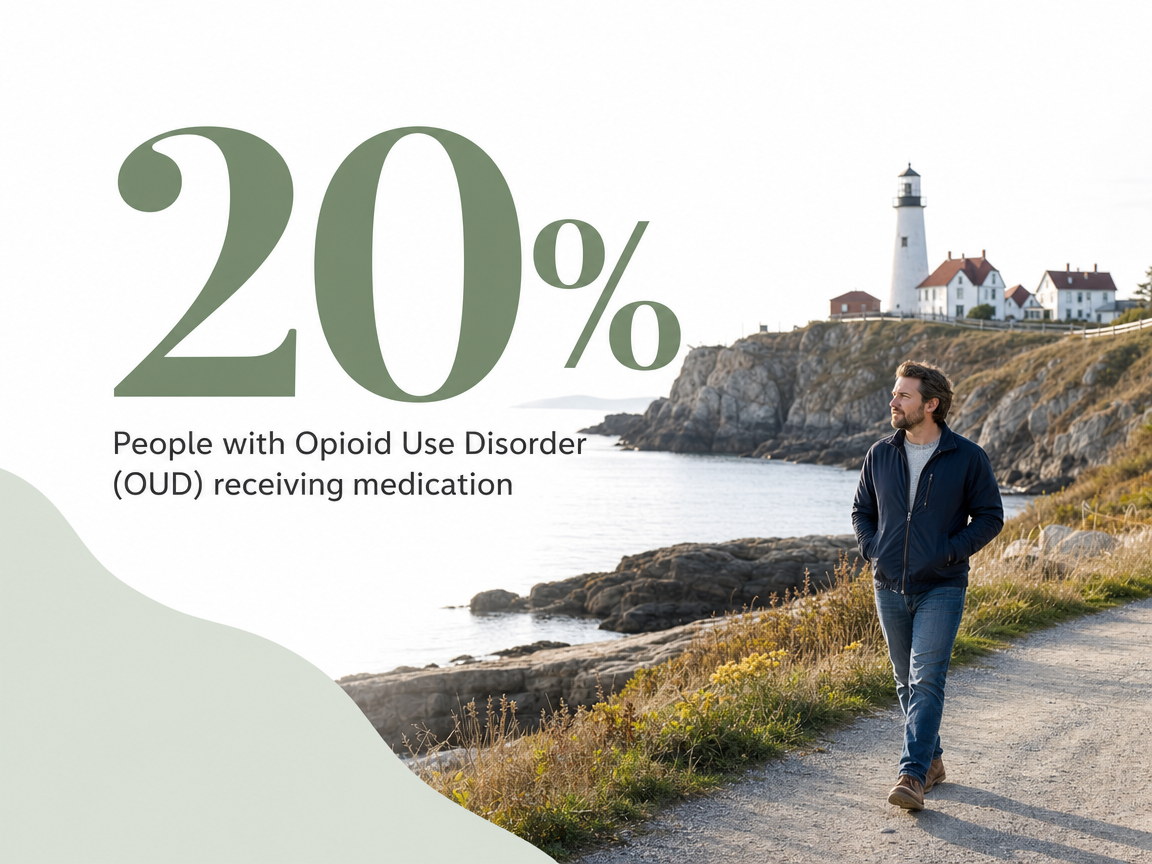
And yet, according to NIDA, fewer than 1 in 5 people with opioid use disorder actually receive these medications — despite clear evidence they reduce overdose deaths and improve treatment retention 2. That gap is often about stigma or access, not effectiveness. If you or someone you love has an opioid or alcohol use disorder, asking about MAT during an assessment is a fair, smart question. It doesn't mean trading one drug for another. It means giving the rest of treatment a real chance to work.
When Anxiety, Depression, or Trauma Come Too
For a lot of people, substance use doesn't show up by itself. Anxiety comes with it. Or depression. Or old trauma that never really got addressed. If any of that sounds familiar, you're not complicated — you're common.
When a mental health condition and a substance use disorder show up together, clinicians call it a co-occurring disorder, or dual diagnosis. And it matters, because treating one without the other tends not to hold. If you get sober but the panic attacks are still running the show, the odds of relapse climb. If you treat the depression but leave the drinking alone, the depression stays stubborn.
Good treatment addresses both at the same time, inside the same plan. That's true whether you're at standard outpatient, IOP, or PHP — the level of care shifts, but the integrated approach shouldn't 6. A trauma-informed program takes this further, meaning the way sessions are run, the way groups are structured, and the way staff respond are all built to feel safe for people carrying hard histories.
If you're not sure whether what you're feeling counts as a mental health issue, that's okay. Bring it up at the assessment anyway. Naming it is enough to start.
Is Outpatient 'Enough'? What the Evidence Actually Says
This is the fear that keeps a lot of people up at night: if I don't check into a residential program, am I not taking this seriously enough? Will outpatient actually work?
Here's what the research says, plainly. A peer-reviewed evidence review compared intensive outpatient programs to inpatient and residential care and found that, across randomized and quasi-experimental studies, IOP generally produced equivalent reductions in problem severity and comparable increases in days abstinent 8. Equivalent. Not "almost as good." For many patients, the outcomes hold up side by side.
That doesn't mean outpatient is right for everyone. If your withdrawal risk is high, if your home isn't safe, if previous attempts at lower levels haven't held — a higher level of care is the right call, and the research supports that too 7. The point isn't that outpatient beats residential. It's that they're different tools, and the best one is the one matched to your actual situation.
So if an honest assessment lands you in IOP or PHP instead of a residential bed, you're not cutting corners. You're getting care that fits — and, for a lot of people, that fit is what makes the treatment stick.
After the Program: Continuing Care Is Part of Treatment
Finishing a program isn't the finish line. It's more like the point where the road gets quieter and you keep walking.
Recovery research treats continuing care as its own phase of treatment, not an optional bonus tacked onto the end. The Continuing Care Model review recommends this phase generally extend for a minimum of 3 to 6 months after more intensive treatment ends 9. That's not a scare tactic. It's a reflection of how the brain and daily habits actually rebuild — slowly, with support that tapers instead of vanishes.
For intensive outpatient specifically, the commonly cited minimum duration is 90 days 11. So a realistic arc might look like this: a stretch in PHP or IOP to build the foundation, then a step down to standard outpatient for several more months, then longer-term supports like alumni groups, mutual-help meetings, or ongoing counseling. Medication management, if it's part of your plan, often continues right through those transitions.
Stepping down doesn't mean stepping away. It means the level of care is finally light enough to hold on its own, with real life carrying more of the weight. That's the goal — not to stay in treatment forever, but to leave with enough scaffolding underneath you that the next hard week doesn't undo the work.
Questions to Bring to Your First Assessment Call
Making the call is the hardest part. Once you're on the phone, though, it helps to have a short list in front of you — not to interrogate the person on the other end, but to make sure you leave the conversation knowing what happens next.
Here's what's worth asking:
- What level of care do you think fits my situation, and why? A good program should walk you through their reasoning, not just quote a schedule. Placement should reflect withdrawal risk, mental health, and your recovery environment — not a one-size answer 7.
- How does the assessment work, and how long does it take? Screening can be quick, but a fuller assessment usually happens before you're placed at a specific level 14. Ask what to expect.
- If I have anxiety, depression, or trauma alongside the substance use, how do you treat both? Integrated care for co-occurring conditions matters, and you deserve a clear answer on how they handle it 6.
- Is medication for opioid or alcohol use disorder part of what you offer? If MAT could be relevant, ask how it fits into the program 2.
- What does a typical week look like at the level you're recommending? Hours, schedule options, evening or morning tracks — the practical stuff that determines whether you can actually show up.
- How do you handle insurance, and what will this cost me? A real answer, not a shrug.
- What does continuing care look like after the program ends? Continuing support should extend for at least 3 to 6 months after more intensive treatment 9, so ask what that transition looks like.
- What happens if my needs change partway through? Treatment plans should be reassessed as you go — that's one of the principles with the strongest evidence behind it 10.
You don't need to ask all of these. Pick the three that matter most to you and start there. The goal is to leave the call less anxious than you started it — with a clearer sense of what's next, not a stack of new worries.
A Small Next Step
If you've read this far, you already know more than you did an hour ago. That counts.
Here's what a next step can look like — small, doable, no big decision required. Save the number of a program that offers an assessment. Write down two or three questions from the list above. Tell one person you trust that you're looking into this. That's it. You don't have to know which level of care fits yet. An honest conversation with someone trained to listen will get you closer than more research will.
When you're ready, teams like the one at Coastal Recovery Partners can walk you through an assessment, help you understand your options, and coordinate the pieces — therapy, medication, aftercare — so you're not holding it all alone. Wherever you start, start gently. That's still starting.
Frequently Asked Questions
How much does drug treatment cost, and will my insurance cover it?
Cost varies by level of care, program length, and your insurance plan. Most private insurance, Medicaid, and Medicare cover substance use treatment, including outpatient, IOP, and PHP services 12. The most useful thing you can do is ask a program to run a benefits check for you before your first appointment. That call will tell you what's covered, what a copay might look like, and whether you owe anything up front.
Can I keep working or going to school while in treatment?
Yes, for most outpatient levels. Standard outpatient barely touches your schedule. IOP is designed around real life — many programs offer evening or morning tracks so you can keep a job or classes going. PHP is more demanding at 20+ hours a week and usually means pausing work, at least temporarily. Bring your schedule to the assessment so the clinician can help you find a track that actually fits.
What happens if I relapse during or after a program?
Relapse isn't the end of treatment — it's information. It usually means your plan needs adjusting, not that you've failed. Good programs build reassessment into how they work, and treatment plans are meant to shift as your needs shift 10. That might mean stepping back up to a more intensive level for a while, adding medication support, or bringing in help for a co-occurring condition. Tell someone. Keep going.
Should my family be involved in my treatment?
If it feels safe, yes — family involvement often strengthens recovery. Many programs offer family sessions, education for loved ones, and coaching on how to support you without taking over. That said, you get to decide who's involved and how much. Confidentiality is protected, so nothing is shared without your permission. If family dynamics are complicated, bring that up at the assessment. A good clinician can help you set the pace.
How long does drug treatment usually last?
Longer than most people expect, but not forever. Intensive outpatient often runs a minimum of around 90 days 11, and continuing care — lighter outpatient, alumni support, ongoing counseling — should extend for at least 3 to 6 months after more intensive treatment ends 9. The exact arc depends on your situation. Think of it less as a program length and more as care that tapers as you build steady ground.
Do I need to detox before starting an outpatient program?
Sometimes, but not always. If your withdrawal risk is mild to moderate, outpatient or PHP settings can often manage withdrawal safely alongside treatment 7. If withdrawal is likely to be severe — especially with alcohol or benzodiazepines — medically supervised detox comes first, then you step into outpatient care. The assessment sorts this out. You don't have to know the answer before you call; that's what the clinical team is there for.
References
- Treatment of Substance Use Disorders | Overdose Prevention - CDC. https://www.cdc.gov/overdose-prevention/treatment/index.html
- Medications for Opioid Use Disorder. https://nida.nih.gov/research-topics/medications-opioid-use-disorder
- Overview of Substance Use Disorder Care Clinical Guidelines and Recommendations. https://www.medicaid.gov/state-resource-center/innovation-accelerator-program/iap-downloads/reducing-substance-use-disorders/asam-resource-guide.pdf
- ASAM Criteria Fourth Edition. https://www.medicaid.gov/medicaid/section-1115-demonstrations/downloads/1115-sud-asam-webinar-slides.pdf
- Chapter 5—Specialized Substance Abuse Treatment Programs. https://www.ncbi.nlm.nih.gov/books/NBK64815/
- Early Intervention, Treatment, and Management of Substance Use Disorders. https://www.ncbi.nlm.nih.gov/books/NBK424859/
- 2 Settings, Levels of Care, and Patient Placement. https://www.ncbi.nlm.nih.gov/books/NBK64109/
- Substance Abuse Intensive Outpatient Programs: Assessing the Evidence. https://pmc.ncbi.nlm.nih.gov/articles/PMC4152944/
- The Continuing Care Model of Substance Use Treatment. https://pmc.ncbi.nlm.nih.gov/articles/PMC4007701/
- Meta-Analyses of Seven of NIDA's Principles of Drug Addiction Treatment. https://pmc.ncbi.nlm.nih.gov/articles/PMC3290709/
- Chapter 3. Intensive Outpatient Treatment and the Continuum of Care. https://www.ncbi.nlm.nih.gov/books/NBK64088/
- Intensive Outpatient Program Services | Medicare Coverage. https://www.medicare.gov/coverage/mental-health-care-outpatient-intensive-outpatient-program-services
- Substance Abuse: Clinical Issues in Intensive Outpatient Treatment. https://library.samhsa.gov/product/tip-47-substance-abuse-clinical-issues-intensive-outpatient-treatment/sma13-4182
- Screening and Treatment of Substance Use Disorders among Adolescents. https://library.samhsa.gov/sites/default/files/pep20-06-04-008.pdf