
Factors That Decide How Long Is Rehab

Key Takeaways
- Rehab length is set by clinical need, not by fixed programs like 28-day rehab, with progress through levels of care guiding when you step down.9,10
- NIDA points to about three months of engagement as the threshold for meaningful improvement, though a meta-analysis found similar outcomes past 12 weeks, meaning what happens during treatment matters as much as duration.1,6
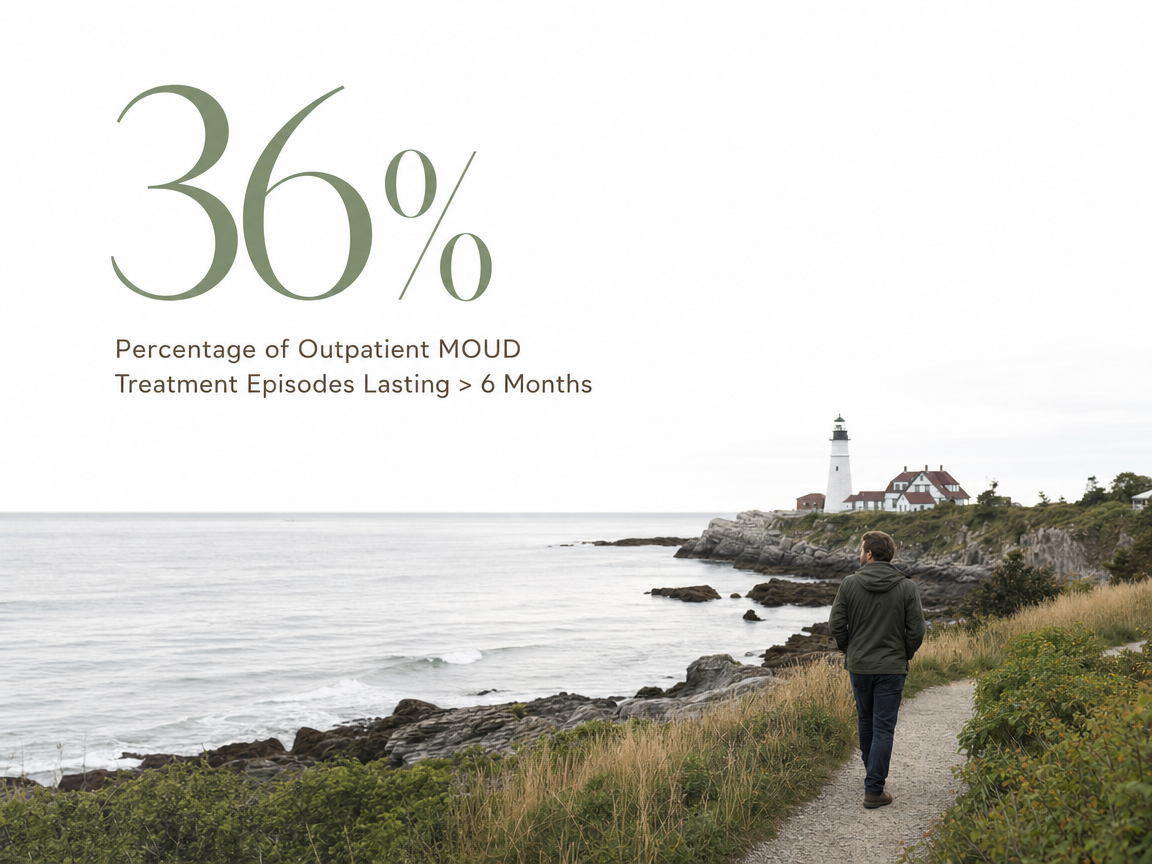
- Medication for opioid use disorder runs on a longer clock, with 12 months considered a minimum for methadone, yet only 36% of national outpatient episodes lasted beyond six months.1,7
- Retention is the piece you can influence: a primary care connection, food security, and attending six or more self-help meetings during treatment predict longer episodes and better outcomes.5,7
The honest answer to "how long?"
You typed "how long is rehab" into a search bar, and you probably weren't looking for a philosophical answer. You wanted a number. Thirty days. Sixty. Something you could fit into a calendar, tell your boss, explain to your kids.
Here's the truthful version: there isn't one number, and the programs that promise you one are usually working from a template, not from your situation. The most current clinical guidance from the American Society of Addiction Medicine puts it bluntly, warning that treatment length should be based on assessed clinical need rather than a program's preset structure like "28-day rehab". Patients are meant to move through care based on progress, not a wall calendar.9,10
That can feel frustrating when you're trying to plan. It can also be a relief. It means your timeline is yours. It's not decided the day you walk in.
What research does offer is a rough shape. The National Institute on Drug Abuse points to about three months of engagement as the point where most people start showing meaningful improvement. But that number is a starting frame, not a finish line, and there's real debate about how tightly it holds up. We'll get into that.1
For now, know this: the better question isn't "how many days?" It's "what does my recovery actually need?" The rest of this article walks you through what shapes the answer.
Why the 28-day program is a marketing artifact, not a clinical standard
If you've been reading about rehab online, you've probably noticed how often the same numbers come up. Twenty-eight days. Thirty. Sixty. Ninety. They sound like they came from a study somewhere. They didn't.
The 28-day model traces back to how insurance and older residential programs were structured decades ago, not to research showing that four weeks is when recovery clicks into place. Current clinical guidance is direct about this. The American Society of Addiction Medicine's 2024 utilization management training states plainly that "length of treatment should vary based on the assessed clinical need of the individual…rather than a result of a program's preset structure (i.e., 28-day rehab)". The ASAM Fourth Edition adds the other half of the equation: "Patients move along the clinical continuum of care based on their progress and outcomes rather than arbitrary predetermined lengths of stay".9,10
Read those two sentences again. They're doing something important. They're saying that a program advertising a fixed number of days is describing its billing structure, not your treatment plan.
That distinction matters for you as a reader. If you're weighing outpatient care, you're likely going to hear numbers early in the conversation — from a program's website, from an insurance representative, maybe from a friend who went through something similar. Those numbers aren't lies. They're averages and defaults. But they aren't a clinical answer to your situation.
What a good assessment does instead is look at where you are right now, what you're using, what else is going on in your life and health, and what kind of support surrounds you when you go home at the end of the day. Then a plan gets built around that, and it gets adjusted as you go. The calendar follows the care. Not the other way around.
What actually shapes your timeline: the six dimensions clinicians assess
When you sit down for a real assessment, the clinician isn't reaching for a program brochure. They're working through six specific areas that come from the ASAM Criteria — the same framework NIDA describes in its guidance on youth treatment, though the dimensions apply to adults too. These six areas are what decide how intense your care starts, and how long you stay at each level.9,11
Here's what they look at, in plain terms:11
- Intoxication and withdrawal. Are you physically dependent on something that has a dangerous withdrawal, like alcohol or benzodiazepines? Do you need medical monitoring in the first days? This one often determines whether you start at a higher level of care before stepping down.
- Other medical conditions. Liver issues, chronic pain, pregnancy, diabetes that hasn't been managed well because of your use. These don't just complicate treatment — they can extend it, because your body is doing more healing at once.
- Other emotional, behavioral, or cognitive conditions. Depression, anxiety, PTSD, ADHD. If something else is going on alongside the substance use, the clock stretches. Treating one without the other tends not to hold.
- Readiness to change. Not a judgment — a measurement. Someone showing up unsure about quitting needs different pacing than someone who's already tried to stop three times. Both are valid starting points.
- Relapse, continued use, or continued problem potential. Your history with previous attempts, your triggers, how quickly cravings escalate for you. This shapes how much structure you'll need and for how long.
- Recovery environment. What you're going home to at the end of the day. A partner in recovery, a stable job, a supportive family — those shorten timelines. A roommate who still drinks, financial stress, unresolved legal issues — those lengthen them, honestly.
You can read those and get a rough sense of where you land. That's the point. A good program will walk through these with you in the first days, not just once, and adjust as things shift. If you've been assessed at one level of care and something in dimension three or six changes a month in, the plan should change with it. That flexibility is the whole idea.9
Levels of care and what people actually spend in them
PHP, IOP, and standard outpatient: what the labels mean
Outpatient care isn't one thing. It's a ladder, and where you start on it depends on that six-dimension assessment we just walked through.
Partial hospitalization (PHP) is the most intensive outpatient step. You're at the treatment center most of the day, usually five days a week, and you go home at night. It's for people who need close clinical structure — early recovery, medical instability, a recent step-down from residential, or a home life that isn't quite safe enough yet for less contact. PHP is often measured in weeks, not months.
Intensive outpatient (IOP) is the middle rung. You're typically in group and individual sessions three to five days a week, for a few hours at a time, with the rest of your day free for work, school, or family. SAMHSA's clinical protocol places IOP within the ASAM continuum and describes it as the level where most of the therapy work — relapse prevention, skills, processing — happens in a structured group format.4
Standard outpatient (OP) is the lightest touch. Weekly or twice-weekly sessions, often with a therapist and possibly a medication provider. It's where many people finish the formal episode and where long-term follow-up lives.4
The idea isn't to pick one and stay there. You move down the ladder as your stability grows.10
Guideline duration vs. real-world duration
Here's where the honest picture gets interesting — and where you'll want to know both what the guidelines say and what actually tends to happen.
On paper, the benchmarks are fairly consistent. NIDA points to at least three months of engagement as the threshold where most people start showing meaningful improvement, and it frames anything shorter than 90 days as generally of limited effectiveness. SAMHSA's IOP protocol echoes that number, citing a 90-day minimum for the IOP phase specifically, with standard outpatient often running around 60 days plus long-term follow-up sessions after that.1,4
Now the real world. A national study of intensive outpatient programs found the average length of stay was 42 days, with the substance use cohort averaging about 41 days and roughly 16 sessions per episode. That's less than half the guideline minimum. For medication treatment for opioid use disorder, a national analysis of 130,300 outpatient episodes found only 36% lasted more than six months — even though NIDA considers 12 months the floor for methadone.1,7,8
So what do you do with that gap?
First, don't read it as a failure of programs or patients. It reflects a mix of things: insurance benefit limits, life pressures, dropout, clinical judgment that someone was ready to step down, and the honest fact that a formal episode ending doesn't mean recovery ending. Follow-up sessions, mutual-help groups, and continued medication all extend care past the day the chart closes.
Second, use the gap to set your own expectations. If you enter IOP thinking of it as a six-week commitment, you're planning around the average, not the guideline. If you can plan around the guideline — closer to three months of active engagement, plus a step down into weekly outpatient — the evidence suggests you're giving yourself a better foundation. Even the studies that complicate the 90-day rule (we'll get there in the next section) don't argue for shorter care. They argue that duration alone isn't the whole story.1,4
Third, ask your program directly: what's your typical length of stay, and what determines when someone steps down? A program that can answer specifically — and that ties the answer to your progress rather than a fixed slot — is showing you how it actually thinks about care.
The 90-day rule, and why the evidence is messier than it sounds
You've probably seen the "90 days" number by now. NIDA cites it as the point where most people begin showing meaningful improvement, and it's become the closest thing addiction treatment has to a magic threshold. It's a useful benchmark. It's also not the whole story.1
Here's the wrinkle. A meta-analysis of 230 studies looked directly at whether the ≥3-month rule holds up when you stack the evidence side by side. The finding: participants in treatment for 12 weeks or more had "virtually the same drug use outcomes" as those with shorter durations. That's not a small footnote. It's a serious challenge to the idea that days in treatment, by themselves, do the work.6
So which is right?
Both, in a way. The 3-month figure captures a real pattern — people who stay engaged longer tend to do better, and studies of outpatient care consistently find that clients with three or more months of treatment show higher abstinence rates than those with shorter episodes. But the meta-analysis is telling you something the headline number doesn't: duration alone isn't a treatment. What happens during those weeks — the therapy, the medication, the relationships, the skills you actually build — is what moves the needle. A person who spends 90 days going through the motions won't necessarily do better than someone who spends six weeks fully engaged.15
The takeaway for you isn't to shrink your timeline. It's to stop treating the calendar as the point. Ask what your program is doing with the time, not just how much of it they're asking for.
Medication for opioid use disorder: a different clock
If opioids are part of your story, the timeline changes shape. Not because you're doing something wrong, but because the medication itself is the treatment — and it works on a longer horizon than talk therapy alone.
NIDA is direct about this: for methadone maintenance, 12 months is considered the minimum, and many people benefit from staying on it for years. Buprenorphine follows a similar logic. A review of methadone research reached the same conclusion, finding that longer continuous treatment is associated with better retention and reduced illicit opioid use. Coming off medication too early is one of the most common paths back to use.1,18
The real-world data tells a harder story. In a national study of 130,300 outpatient episodes of medication for opioid use disorder — often called MOUD — only 36% lasted more than six months. Most people stopped before the recommended floor.7
Read that gently. It doesn't mean those people failed. It means the clock for this kind of treatment is longer than most life circumstances make easy, and that staying on medication is itself a skill you build with support. If you're starting MOUD, plan for a year as a working assumption, not a ceiling. The therapy and group work around it can step down. The medication piece usually shouldn't, at least not on someone else's schedule.
Recovery Starts With a Conversation
Whether you’re exploring recovery for yourself or seeking guidance for someone you care about, Coastal Recovery Partners is here to help. Our team offers trauma-informed, evidence-based support grounded in structure, compassion, and real connection—without pressure or judgment.
When you’re ready, we’ll meet you where you are and help you take the next step forward.
Co-occurring depression, anxiety, or trauma changes the math
If you're carrying depression, anxiety, PTSD, or the weight of unprocessed trauma alongside a substance use issue, your timeline is almost certainly going to be longer than someone whose picture is simpler. That's not a punishment. It's what the evidence says works.
SAMHSA's guidance on co-occurring disorders is clear that people managing both a mental health condition and substance use often need ongoing, long-term treatment that flexes across outpatient, IOP, and higher levels of care rather than a single short episode. Treating one side without the other tends to leave the other side pulling you back. If you get sober but your PTSD is untouched, the same nervous system that reached for a drink at 9 p.m. is still reaching. If you treat depression but keep drinking, the medication is fighting a moving target.14
Practically, this means two things for you. Your program should be doing real mental health work — not a checkbox screening at intake — from the first weeks. And your step-down should be slower. What might have been a six-week IOP for someone without co-occurring issues could reasonably extend into three or four months, with standard outpatient continuing after that.
Retention: the part of your timeline you can influence
Most of what shapes your timeline sits outside your control. Your withdrawal risk, your co-occurring conditions, whether you've been through this before — those are what they are. But one variable is genuinely in your hands, and it's the one the research keeps pointing at: staying in treatment.
In that same national study of 130,300 outpatient episodes of medication for opioid use disorder, the most common reason people left care wasn't completing the program. It was dropout, at 38.1% of all discharges, followed by transfer and then completion. Dropout was more common than finishing.7
That number is heavy. It's also useful, because it means the single biggest predictor of whether your treatment works long enough to work is whether you keep showing up. Retention has been called one of the strongest and most consistent predictors of positive outcomes in outpatient care. Not the fanciest therapy. Not the perfect diagnosis. The showing up.17
Here's what the evidence says actually helps people stay. A 2023 study of what determines how long people last in outpatient SUD treatment found three concrete factors linked to longer episodes: being connected to a primary care provider during treatment, being enrolled in food assistance (SNAP), and attending six or more self-help group sessions during the treatment episode. Read that list again. None of it is about willpower. It's about scaffolding — a doctor who knows you, food security, and a group of people outside the treatment center who expect to see you on Thursday night.5
What does that mean for you, practically? Get a primary care doctor if you don't have one, and let your treatment team coordinate with them. Sort out the boring logistics — food, housing, transportation — because unstable basics pull people out of care faster than cravings do. Start attending mutual-help meetings during treatment, not after, so the support system is already built when the formal episode ends. These aren't extras. In the data, they're what keeps the calendar moving.
What happens if 30 days isn't enough
Here's a fear worth naming out loud: you start a program, you do the work, and at the end of the standard window you don't feel done. What then?
The short answer is that a well-run outpatient program expects this. It's why the levels of care exist as a ladder rather than a set of one-way doors. If you finish an IOP phase and your assessment still shows real relapse risk, unresolved co-occurring symptoms, or a shaky home environment, the clinical response isn't to discharge you on schedule. It's to extend, adjust, or step you down to standard outpatient with continued therapy and medication support. Progress determines the move, not the calendar.9,10
Recovery also isn't always one clean episode. NIDA describes it as a long-term process that often requires multiple rounds of care over time. That's not a setback narrative. That's the shape of the illness for many people, and returning for more treatment is a clinical decision, not a personal verdict.3
If 30 days doesn't feel like enough, say so. A good team would rather stretch the plan than watch you leave before you're ready.
What insurance typically covers, in plain terms
Insurance is often the quiet driver behind how long people actually stay in care, and it helps to know how the conversation usually goes.
Most commercial plans and Medicaid cover outpatient substance use treatment — PHP, IOP, and standard outpatient — when a licensed program documents medical necessity using the ASAM Criteria. Coverage isn't approved in one lump. It's authorized in blocks, and your program has to justify continued stay based on your progress and remaining clinical need. That's why your clinician keeps reassessing you: those notes are also what keeps your care authorized.9
If your plan pushes back or caps sessions before your team thinks you're ready to step down, you have options. Your program can appeal, request peer review, or advocate for a different level of care. The ASAM framework is designed to support that conversation on clinical grounds rather than a calendar.10
Ask upfront: what does my plan authorize, what's the copay, and who handles the reauthorizations? A program that answers clearly is one that's done this before.
Questions to ask before you commit to a program
Before you sign paperwork or hand over an insurance card, there are a handful of questions worth asking out loud. The answers tell you a lot about whether a program is going to treat you as a person or as a slot on a schedule.
How will you decide when I'm ready to step down? A good answer names specific clinical markers and points to reassessment on a regular cadence, not a set number of weeks.10
What does your typical length of stay look like, and what determines when it's longer? You want a program that can talk honestly about averages and about the factors that stretch care — co-occurring conditions, unstable housing, MOUD.9
How do you handle mental health alongside substance use? Integrated care from the first weeks, not a separate referral you have to chase, is what the evidence supports.14
Who coordinates my primary care, medication, and outside supports? Care coordination isn't a bonus. It's part of what keeps people in treatment. If a team like Coastal Recovery Partners can walk you through that answer specifically, you're in the right conversation.5
Frequently Asked Questions
How long is rehab, on average?
There isn't one clean average, because rehab spans many levels of care. For intensive outpatient specifically, a national study found the average length of stay was 42 days across a substance use cohort. NIDA points to about three months of engagement as the threshold for meaningful improvement. Your own timeline depends on the level of care you start at and how your progress unfolds.1,8
Do I have to go to residential rehab, or can I stay in outpatient care?
For many people, outpatient care is clinically appropriate and just as effective when matched to the right needs. The ASAM Criteria place partial hospitalization, intensive outpatient, and standard outpatient on the same continuum as residential, and the decision is based on your assessment — not on which option sounds more serious. If you're stable enough to sleep at home safely, outpatient is often the right starting point.10
What happens if 30 days isn't enough time for me?
Your care extends or your level of care shifts. A good program reassesses you regularly and continues treatment when your clinical picture — cravings, co-occurring symptoms, home stability — still shows real need. You might move from IOP into standard outpatient, keep therapy going, or continue medication support. NIDA also notes that recovery often takes more than one episode of care, and that's a clinical reality, not a failure.3,9
Does a shorter program actually work?
It can, depending on what happens during that time. A meta-analysis of 230 studies found that clients with 12 or more weeks of treatment had virtually the same drug use outcomes as those with shorter durations, which suggests engagement and treatment quality matter as much as calendar length. What that means for you: a shorter, actively engaged episode with strong follow-up can genuinely work.6
How long will I need to be on medication for opioid use disorder?
Plan for at least a year as a working assumption. NIDA considers 12 months the minimum for methadone maintenance, and many people benefit from staying on medication considerably longer. A review of methadone research reached the same conclusion — longer continuous treatment is linked to better retention and less illicit opioid use. The therapy around the medication can step down before the medication itself does.1,18
Can I keep working or caring for my family while in rehab?
Yes, and that's exactly what outpatient care is designed for. IOP and standard outpatient programs typically run in morning, afternoon, or evening blocks so you can hold onto your job, your kids' schedules, and your daily life while getting real clinical treatment. Being connected to primary care, food security, and support groups during treatment also predicts staying in care longer— so protect those, too.4,5
References
- Principles of Drug Addiction Treatment: A Research-Based Guide (Third Edition). https://nida.nih.gov/sites/default/files/podat-3rdEd-508.pdf
- Principles of Drug Addiction Treatment (Earlier Edition). https://nida.nih.gov/sites/default/files/podat_1.pdf
- NIDA Treatment Guidelines (Drexel Medicine SBIRT Module). https://webcampus.med.drexel.edu/nida/module_1/content/5_0_Treatment.htm
- Chapter 3. Intensive Outpatient Treatment and the Continuum of Care. https://www.ncbi.nlm.nih.gov/books/NBK64088/
- Determinants of Outpatient Substance Use Disorder Treatment Length-of-Stay. https://pmc.ncbi.nlm.nih.gov/articles/PMC10460408/
- Meta-Analyses of Seven of NIDA's Principles of Drug Addiction Treatment. https://pmc.ncbi.nlm.nih.gov/articles/PMC3290709/
- Who Stays in Medication Treatment for Opioid Use Disorder? A National Study of Outpatient Specialty Treatment Settings. https://www.ncbi.nlm.nih.gov/pmc/articles/PMC8197774/
- Intensive Outpatient Treatment (IOP) of Behavioral Health: Average Length of Stay and Service Intensity. https://pubmed.ncbi.nlm.nih.gov/32043237/
- The ASAM Criteria and Utilization Management Self-Led Training (2024). https://hcpf.colorado.gov/sites/hcpf/files/The%20ASAM%20Criteria%20and%20UM%20Self%20Led%20Training%202024.pdf
- The ASAM Criteria (Fourth Edition Dissemination Summary). https://hcpf.colorado.gov/sites/hcpf/files/ASAM-Fourth-Ed-Disseminate-Summary.pdf
- Principles of Adolescent Substance Use Disorder Treatment: A Research-Based Guide. https://health.uconn.edu/sbirtacademy/wp-content/uploads/sites/101/2018/03/NIDA-Principles-of-Adolescent-Substance-Use-Disorder-Treatment-A-Research-Based-Guide_2016.pdf
- Treatment Episode Data Set (TEDS): 2019 Admissions and Discharges. https://www.samhsa.gov/data/sites/default/files/reports/rpt35314/2019_TEDS_Proof.pdf
- Treatment Episode Data Set (TEDS): 2011 Discharge Report, Chapter 1. https://www.samhsa.gov/data/sites/default/files/TEDS_2011_discharges/TEDS_2011_discharges/TEDS2011DChap1.htm
- Substance Use Disorder Treatment for People With Co-Occurring Disorders (TIP 42). https://www.ncbi.nlm.nih.gov/books/NBK425780/
- Duration of Outpatient Substance Abuse Treatment and Outcomes in a National Sample. https://pubmed.ncbi.nlm.nih.gov/19530709/
- Length of Residential Substance Abuse Treatment in Pregnant and Parenting Women: Does Longer Stay Improve Outcomes?. https://pubmed.ncbi.nlm.nih.gov/18295435/
- Retention in Outpatient Substance Abuse Treatment and its Relationship with Outcomes. https://pubmed.ncbi.nlm.nih.gov/21138661/
- Treatment Duration and Outcomes in Methadone Maintenance: A Review. https://pubmed.ncbi.nlm.nih.gov/15009666/