
How to Find Cocaine Rehab Near Me That Fits Your Schedule

Key Takeaways
- Sorting by distance misses what matters; filter first for level of care, cocaine-specific evidence-based therapies, and capacity to treat co-occurring conditions.4,7
- Match the intensity to your actual week: standard outpatient, IOP at 6-20 hours weekly, or PHP, using ASAM placement criteria.17,18
- No FDA-approved medication treats cocaine use disorder; ask specifically about contingency management, CBT, and the Matrix Model, which have the strongest evidence.4,7
- Treat schedule as clinical: pick a morning, afternoon, or evening track you can attend consistently, since IOP depends on a prearranged core of services.1
- Hybrid care works for therapy and groups, but abstinence-based contingency management needs in-person CLIA-waived testing with immediate incentives.8,13
- Check a Maine program's license for ASAM-based placement, MAT authorization if medication applies, and a clinical menu that names CM and CBT.16,17
- Use a short intake script focused on schedule and levels of care; SAMHSA's National Helpline offers a free, confidential warm-up call.14
- Expect week one to center on assessment and orientation, with week two settling into groups, individual sessions, and testing if CM is included.9
Why 'near me' is the wrong first filter
If you're reading this between meetings, or after the kids are asleep, or in your car in a parking lot, that's okay. A lot of people find this page at exactly that hour. And most of them are typing the same thing into a search bar: cocaine rehab near me.
Here's the honest problem with that search. "Near me" sorts by distance. It doesn't sort by whether a program can treat cocaine use with the therapies that actually work, whether it runs an evening track you can attend after work, or whether it can also handle the drinking or anxiety that often shows up alongside cocaine use. A clinic three miles away that only meets Tuesdays at 10 a.m. is not closer than one across town that runs a 5:30 p.m. group four nights a week. Not in any way that matters to your recovery.
A better first filter is fit. Three things, really: a level of care your week can hold, behavioral treatments with strong cocaine-specific evidence, and a program licensed and staffed to handle whatever else is going on Distance is the last question, not the first.4,7
The rest of this guide walks you through that match, in plain language, with a phone script and a checklist you can actually use. You don't have to figure it out tonight. You just have to know what you're looking at.
The three-part match: level of care, evidence, and co-occurring capacity
Picking a level of care your week can actually hold
Outpatient care for cocaine use disorder comes in three main intensities, and the difference between them is mostly hours per week and how tightly the schedule is structured.
Standard outpatient (OP) is the lightest. Think one or two sessions a week, often an individual therapy hour plus a group. It fits a full-time job easily, but it's usually not enough on its own if cocaine use is frequent, if you're also drinking heavily, or if you've tried to stop before and slipped back.
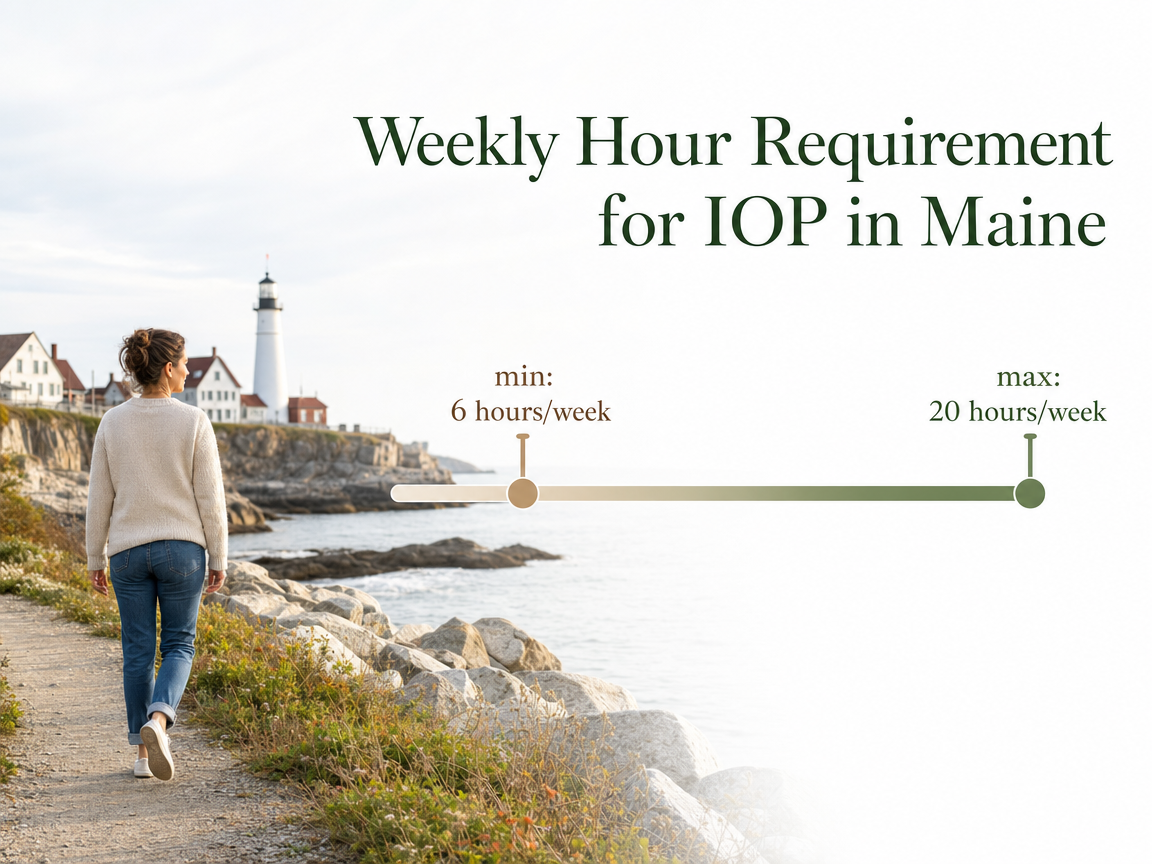
Intensive Outpatient (IOP) is the level most working adults land in when they're serious about stopping cocaine but can't step away from life. In Maine, IOP is defined as a structured program with no overnight stay, running a minimum of 6 and a maximum of 20 hours per week. SAMHSA sets the adult floor a little higher, at 9 hours per week, delivered on a prearranged schedule of core services. In practice, that usually looks like three group sessions of about three hours each, plus an individual session, held in morning, afternoon, or evening blocks.1,18
Partial Hospitalization (PHP) sits above IOP. It runs most of the day, most days of the week. It's still not residential — you sleep at home — but it's not compatible with a normal work schedule. PHP tends to fit people stepping down from inpatient care, or people whose use and mental health are unsteady enough that a lighter level would probably fail.
Here's the practical read. If you can carve out three evenings a week and one weekend session, IOP is realistic. If your week already has zero flex, standard outpatient may be the honest starting point, with the option to step up if it isn't holding. Maine rules require programs to use ASAM placement criteria to make this call with you, not for you, so a good intake conversation will actually ask about your work, your family hours, your commute, and your sleep — not just your substance use.17
Pick the level your calendar can hold for twelve weeks, not the level that sounds most impressive. A program you attend beats a program you admire from a distance.
What 'evidence-based' means for cocaine, specifically
Programs love the phrase "evidence-based." For cocaine, that phrase should point to a very specific short list, and it's worth knowing that list before you walk in.
Start with the part that surprises most people: there is no FDA-approved medication to treat cocaine use disorder. That doesn't mean nothing works. It means the strongest tools are behavioral, and it means you should be skeptical of any program pitching a "medication for cocaine" as its centerpiece. The core interventions with real evidence are contingency management, cognitive behavioral therapy, and the Matrix Model, often used together.4,7
Contingency management (CM) is the one to ask about by name. It's a structured program where you earn small, tangible incentives — often gift cards or prize draws — for verified cocaine-negative urine tests, usually two or three times a week over about 12 weeks. It sounds almost too simple. It isn't. CM is the current standard of care for stimulant use disorder in the ASAM/AAAP clinical guideline, and NIDA calls it especially effective for stimulants like cocaine and methamphetamine.5,7,9
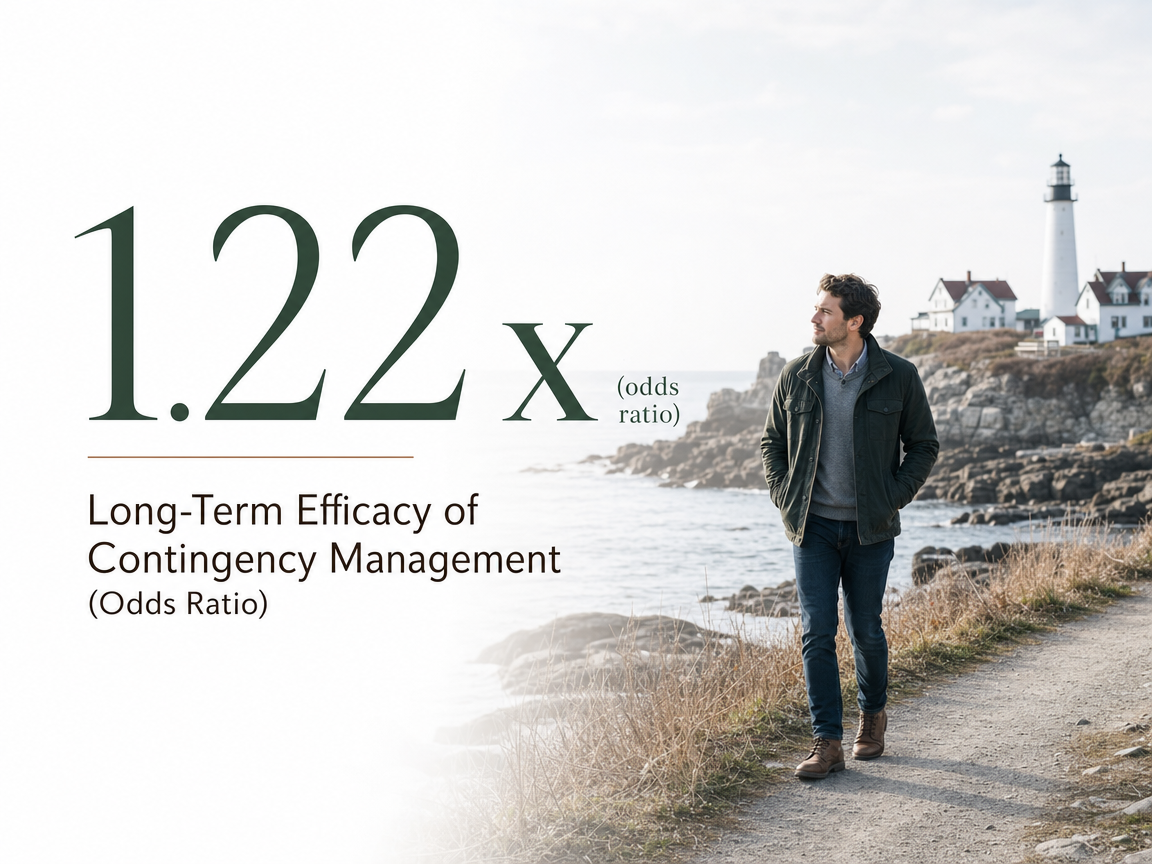
How much does it help? A meta-analysis of 23 randomized trials found CM improved long-term abstinence with an odds ratio of 1.22, measured by objective abstinence indicators at post-treatment follow-up. That is a modest, real effect that holds up after the incentives stop — which is the piece that matters if you're trying to build a life, not just get through a program.20
Two honest caveats. First, CM requires rapid on-site drug testing and immediate incentive delivery to work as designed, and not every outpatient program has the operational setup to run it well. That's why asking "Do you offer contingency management?" is a useful screening question. Second, CM's biggest effects show up during active treatment; benefits taper somewhat after, which is why it's usually paired with something more skills-based.8
Cognitive behavioral therapy (CBT) is that pair. CBT teaches you to spot the situations, thoughts, and feelings that pull you toward using, and to rehearse different responses. A systematic review of CBT versus CM for cocaine dependence found that CM reduced use more reliably during active treatment, while CBT's effects tended to appear later and last. That's the case for using both. CM gets you traction. CBT builds the muscle you'll need when the incentives are gone.22
The Matrix Model combines CBT-style skills work, family education, drug testing, and 12-step support in a manualized outpatient package. If a Maine program you're considering names it, that's a reasonable sign the clinical menu is stimulant-appropriate.7
Programs that can actually handle alcohol, opioids, and mental health at the same time
Cocaine rarely shows up alone. A lot of people using it are also drinking more than they want to, taking opioids, or living with anxiety, depression, ADHD, or trauma that never got proper care. If that's you, you're not a complicated case — you're a common one. The question is whether the program you call can actually hold all of it.
Federal guidance is clear that concurrent alcohol or opioid use alongside cocaine calls for integrated treatment, not sequential referrals that leave you managing your own handoffs. Ask any program two direct questions: Do you treat co-occurring mental health conditions in the same building, with the same team? and If I also need medication for alcohol or opioid use, can you do that here?
The second question has a specific Maine wrinkle worth knowing. To deliver IOP services that include medication management, a Maine SUD program must have medication-assisted treatment (MAT) on its license. If cocaine is your main concern but alcohol or opioids are in the mix, that license detail decides whether you get one coordinated team or a stack of referrals. Outpatient opioid treatment settings are separately required to maintain referral arrangements for co-occurring disorders— useful, but not the same as integrated care under one roof.16,19
A good program will screen for depression, anxiety, PTSD, and other substances at intake, then build one treatment plan that addresses all of it. If the intake person can't answer clearly how they handle dual diagnosis, that's your answer.
Recovery Starts With a Conversation
Whether you’re exploring recovery for yourself or seeking guidance for someone you care about, Coastal Recovery Partners is here to help. Our team offers trauma-informed, evidence-based support grounded in structure, compassion, and real connection—without pressure or judgment.
When you’re ready, we’ll meet you where you are and help you take the next step forward.
Reading a Maine program's license before you enroll
A program's license is a short document that tells you what it's actually allowed to do. Most people never look. You should — it takes five minutes and answers questions the website won't.
Maine's Division of Licensing and Certification lists behavioral health programs and specifies which services each one is authorized to provide, including outpatient SUD care and the module that used to be called non-residential IOP. If a program isn't on that list under the service you need, that's not a small paperwork issue. It's a red flag.15
Three things are worth checking on any Maine program you're considering.7,16,17
- First, ASAM-based placement. Maine rule requires outpatient SUD services to use ASAM criteria to decide what level of care fits you, and to complete a comprehensive assessment within 30 days of starting services. If the intake person can't explain how they'll place you or when your full assessment happens, ask again.
- Second, MAT on the license — if it applies to you. Any Maine SUD program that delivers IOP with medication management must have medication-assisted treatment on its license. Cocaine itself has no FDA-approved medication, but if you're also drinking heavily or using opioids, that license detail decides whether one team handles it or whether you're routed elsewhere mid-treatment.
- Third, the clinical menu. Ask whether the program offers contingency management and CBT for stimulant use, and how they handle co-occurring mental health care. A licensed program running the right services will answer directly. A vague answer is itself an answer.
Making the first call without feeling judged
A short script for the intake line
The first call is the hardest one. Not the treatment. Not the groups. The call. If you're staring at a phone number and feeling your chest tighten, that reaction is normal, and it doesn't say anything about whether you can do this.
You don't need a speech. You need about four sentences. Something like:
"Hi, I'm looking into outpatient treatment for cocaine use. I work [days/hours], and I'm trying to figure out if you have a track that fits my schedule. Can you tell me what levels of care you offer and when your groups meet?"
That's it. You haven't committed to anything. You haven't given your full history. You've asked a scheduling question, which is what an intake coordinator answers all day.
If they ask more, share what you're comfortable sharing. You can say you're using cocaine, or you can say you're using stimulants, or you can say substances. All of it lands the same on their end. Intake staff are not there to react. They're there to match you to a level of care and route your call.
If you get stuck, or if the program you call isn't a fit, SAMHSA's National Helpline is free, confidential, and available 24/7 in English and Spanish. You can call them first as a warm-up. It's a real option, not a lesser one.14
Questions to ask before you say yes to a start date
Before you commit to an intake appointment, ask a few specific things. The answers tell you more than any brochure will.7,16,17,22
- What level of care are you recommending for me, and how did you decide? A Maine program should reference ASAM placement criteria and complete a full assessment within 30 days of starting services.
- Do you offer contingency management for stimulant use? CM is the standard of care for cocaine, and not every outpatient program runs it.
- What about CBT or the Matrix Model? These are the behavioral treatments most likely to hold up alongside CM.
- How do you handle co-occurring anxiety, depression, or trauma? You want one team, not a stack of referrals.
- If I'm also drinking or using opioids, can you treat that here? If medication is part of the plan, the program needs MAT on its license to deliver IOP services that include medication management.
- What are my schedule options — morning, afternoon, evening? Pick the track your real week can hold.
- What can I do by video, and what has to be in person?
If any answer is vague, ask again. A program that runs the right services will tell you plainly.
What a workable first two weeks tends to look like
The first two weeks are less dramatic than most people expect. That's a good thing.
Week one usually starts with an intake and a comprehensive assessment — in Maine, that assessment has to be completed within 30 days of services starting, and it's what drives your ASAM-based level-of-care placement. Expect questions about your cocaine use, other substances, mental health history, work schedule, sleep, and who's at home. Bring your insurance card and a rough sense of your weekly calendar. You may leave with a start date for group, an individual therapist assigned, and a plan for drug testing if the program runs contingency management.9,17
By the end of week one, you've usually attended one or two groups. They're smaller than TV suggests. People talk about their week, not their worst day. You listen more than you speak.
Week two is when the schedule starts feeling real. If you're in IOP, that's three groups of about three hours plus an individual session — landing somewhere in the 9-to-12-hour range that SAMHSA describes as a prearranged core. If CM is part of your plan, you're testing two or three times a week, and small incentives arrive immediately after a negative result.1,8
You won't feel fixed. You'll feel tired, a little exposed, and quietly relieved that the week held. That's the win in week two.
Where care coordination fits in
Between the first call and a workable weekly plan, there's a gap most people underestimate. Insurance verification. An intake appointment. A prior authorization if medication is involved. A therapist assignment. A drug testing schedule if contingency management is part of your plan. Maybe a primary care handoff. Maybe a conversation with a psychiatrist about the anxiety you've been ignoring for two years.9
That's the work of care coordination — the connective tissue between deciding to get help and actually being in a group on Tuesday night. It's not glamorous, and it's the part people quietly abandon when they try to do it alone at 11 p.m. after a long day.
A recovery planning conversation walks you through your schedule, your insurance, what level of care ASAM criteria point to, and what a realistic first week looks like — before you ever commit. Coastal Recovery Partners offers that kind of coordinated intake. One call, one team, one plan you can actually hold.17
Frequently Asked Questions
Can I keep working while I'm in cocaine rehab?
Yes, for most people, that's the whole point of outpatient care. Intensive Outpatient runs 6 to 20 hours a week in Maine, usually in three-hour blocks that fit around a job — evenings work for standard business hours, mornings work for shift workers. Standard outpatient is lighter still. You'd tell your intake coordinator your work hours on the first call and pick a track from there.18
Will my employer or family find out I'm getting treatment?
Treatment records are protected by federal privacy rules, and a program will not contact your employer without your written permission. Your family is the same — you decide who knows. If you need documentation for time off, most programs can provide a generic medical note without listing a diagnosis. If confidentiality is the barrier, say that on the intake call. It's a normal question.
Does insurance cover outpatient or IOP cocaine treatment in Maine?
Most commercial plans and MaineCare cover outpatient and IOP services for substance use disorder, though coverage details vary by plan. A program's intake team will verify your benefits before you commit to a start date and tell you what your copay or deductible looks like. If cost is a barrier, ask about sliding-scale options or care coordination help. SAMHSA's National Helpline can also route you to covered options.14
What does the first week of outpatient cocaine treatment actually look like?
Week one usually opens with a comprehensive assessment — required within 30 days of starting services under Maine rule— plus your first group or two. You'll answer questions about your use, mental health, work, and home life. You may leave with a therapist assigned, a group schedule, and a drug testing plan if contingency management is part of care. It's less intense than most people brace for.9,17
Can I do cocaine treatment fully by telehealth, or do I have to show up in person?
You can do a lot by video — individual therapy, many groups, check-ins. HHS maintains full best-practice guidance for tele-treatment of substance use disorders. The catch is contingency management: abstinence-based CM requires rapid in-person, CLIA-waived drug testing with incentives delivered right after a verified result. If CM is part of your plan, expect a hybrid schedule rather than fully virtual care.8,12
What if I'm also drinking heavily or using opioids alongside cocaine?
That's common, and federal guidance says concurrent use should be treated together, not in separate handoffs. Ask any program whether they treat co-occurring alcohol or opioid use in-house. If medication is part of that plan, a Maine IOP provider needs MAT on its license to deliver IOP services that include medication management. One coordinated team is easier to attend than three appointments in three buildings.10,16
References
- CLINICAL ISSUES IN INTENSIVE OUTPATIENT TREATMENT FOR SUBSTANCE USE DISORDERS. https://library.samhsa.gov/sites/default/files/pep20-02-01-021.pdf
- TIP 47: Substance Abuse: Clinical Issues in Intensive Outpatient Treatment. https://library.samhsa.gov/product/tip-47-substance-abuse-clinical-issues-intensive-outpatient-treatment/sma13-4182
- Treatment of Stimulant Use Disorders. https://library.samhsa.gov/product/treatment-stimulant-use-disorders/pep20-06-01-001
- Cocaine | National Institute on Drug Abuse (NIDA). https://nida.nih.gov/research-topics/cocaine
- Treatment | National Institute on Drug Abuse (NIDA). https://nida.nih.gov/research-topics/treatment
- Stimulants | National Institute on Drug Abuse. https://nida.nih.gov/stimulants-3
- The ASAM/AAAP Clinical Practice Guideline on the Management of Stimulant Use Disorder. https://pmc.ncbi.nlm.nih.gov/articles/PMC11105801/
- Contingency Management Advisory. https://library.samhsa.gov/sites/default/files/contingency-management-advisory-pep24-06-001.pdf
- Contingency Management for the Treatment of Substance Use Disorders: Recommendations from the 2023 HHS Report to Congress. https://aspe.hhs.gov/sites/default/files/documents/a0cc6fcdb2968be95f60bb1c2c94eb70/contingency-management-sub-treatment.pdf
- Treating Concurrent Substance Use Among Adults. https://odphp.health.gov/healthypeople/tools-action/browse-evidence-based-resources/treating-concurrent-substance-use-among-adults
- Telehealth for the Treatment of Serious Mental Illness and Substance Use Disorders. https://library.samhsa.gov/sites/default/files/pep21-06-02-001.pdf
- Tele-treatment for substance use disorders. https://telehealth.hhs.gov/providers/best-practice-guides/telehealth-for-behavioral-health/tele-treatment-for-substance-use-disorders
- Integrating telehealth into a substance use disorder practice. https://telehealth.hhs.gov/providers/best-practice-guides/telehealth-substance-use-disorder/getting-started-integrating
- National Helpline for Mental Health, Drug, Alcohol Issues. https://www.samhsa.gov/find-help/helplines/national-helpline
- Behavioral Health - Division of Licensing and Certification. https://www.maine.gov/dhhs/dlc/licensing-certification/behavioral-health
- Licensing Requirements for Intensive Outpatient Program Providers. https://www.maine.gov/dhhs/oms/providers/provider-bulletins/licensing-requirements-intensive-outpatient-program-iop-providers-2025-06-06
- 10-144 C.M.R. ch. 123, § 23 - Substance Use Disorder Services. https://www.law.cornell.edu/regulations/maine/10-144-C-M-R-ch-123-SS-23
- 14-118 C.M.R. ch. 5, § 19 - Substance Abuse Treatment Programs. https://www.law.cornell.edu/regulations/maine/14-118-C-M-R-ch-5-SS-19
- Office Based Treatment of Opioid Use Disorder. https://www.maine.gov/osteo/sites/maine.gov.osteo/files/inline-files/Chapter%2012%20-%20Office%20Based%20Treatment%20of%20Opioid%20Use%20Disorder.pdf
- Long-Term Efficacy of Contingency Management Treatment Based on Objective Indicators of Abstinence: A Meta-Analysis. https://pmc.ncbi.nlm.nih.gov/articles/PMC8034391/
- A Randomized, Controlled Trial of Combined Cognitive-Behavioral Therapy plus Prize-Based Contingency Management for Cocaine Dependence. https://pubmed.ncbi.nlm.nih.gov/25456571/
- A systematic review comparing cognitive-behavioral therapy and contingency management for cocaine dependence. https://pubmed.ncbi.nlm.nih.gov/24074193/