
Why Dual Diagnosis Group Therapy Is So Effective

Key Takeaways
- Integrated care treats mental health and substance use in the same room, with the same clinician, rather than sequentially or in parallel tracks that force you to translate between teams.
- Group sessions combine CBT, DBT, and motivational approaches, teaching concrete skills for cravings and emotional regulation before asking anyone to share personal stories.
- Evidence from modified therapeutic community studies and the BRIGHT trial shows integrated group work improves substance use, mental health, housing, and employment outcomes together.4,1
- When choosing a program, ask whether one trained clinician holds both conditions in a single session, how trauma is handled, and whether scheduling fits real life.
The Moment You Realize It's One Conversation, Not Two
You've tried to separate them before. A therapist for the panic. A meeting for the drinking. Two calendars, two vocabularies, two versions of yourself walking into two different rooms.
And somewhere along the way, you started to suspect what most treatment systems have been slow to admit: it was never two conversations. It was one.
If you're living with a mental health condition and a substance use disorder at the same time, you already know how tightly they're braided together. The depression tells you a story, and the drinking answers it. The PTSD flares, and the pills quiet it. Treat one and leave the other alone, and the untreated half keeps pulling you back. That's not a personal failing. That's what the research has been saying for years. Federal guidance from SAMHSA now names integrated care—treating both conditions together, by the same team, often in the same room—as the preferred model for co-occurring disorders.8
Dual diagnosis group therapy is one of the clearest expressions of that model. Not a support circle. Not a lecture. A structured, clinical space where both halves of what you're carrying finally get to sit down at the same table. This piece is about why that works, what it actually feels like inside the room, and how it can fit around the life you're already living.
What Actually Happens Inside a Dual Diagnosis Group
A 90-Minute Session, From Check-In to Closing
Picture a room with eight chairs pulled into a loose circle. A clinician sits in one of them, not behind a desk. There's coffee. Sometimes tea. The door closes at the top of the hour, and for the next ninety minutes, you are somewhere that treats what's actually happening in your life.
Most sessions start with a check-in. Not a performance. Just a sentence or two: where your mood is, whether you used or thought about using this week, what's loud in your head today. This first stretch usually takes fifteen or twenty minutes, and it tells the clinician what the room needs.
Then comes the skill or the topic. Maybe it's how to interrupt a craving that shows up on the drive home. Maybe it's how to sit with a panic wave without reaching for something to shut it off. The clinician teaches for a bit, then hands it back to the group. You practice out loud. You watch other people practice. Someone says something that lands in your chest, and you write it down.
The last twenty minutes are for closing. A commitment for the week. A moment to notice what you're leaving with. On the harder days, a grounding exercise so you don't walk to your car still cracked open. You come in as one person. You leave, more often than not, a little steadier than you arrived.
The Therapies You'll Recognize by How They Feel, Not Their Names
You don't need to memorize acronyms to get better. But it helps to know what the clinician is doing when they do it, because good group work is less about a technique and more about a technique showing up at the right moment.
Cognitive behavioral therapy, or CBT, is the workhorse. In a group, it looks like tracing a thought back to the feeling that fired it, and the behavior that followed. You'll draw the map on a whiteboard. You'll notice how the story your depression tells at 9 p.m. is almost always the same story, and how it almost always ends the same way. Then you practice a different ending. A meta-analysis of 34 CBT trials for substance use disorders found an overall effect size of d=0.45, with larger effects for cannabis and cocaine than for polysubstance use. This indicates a moderate, durable effect, meaning people who engage in this work tend to maintain their progress after leaving the treatment setting.6
Dialectical behavior therapy, or DBT, shows up when the feelings are too big to think your way out of. You'll learn to name what you're feeling before you argue with it. You'll practice a skill called opposite action, which is exactly what it sounds like: your urge says isolate, so you text one person. Your urge says drink, so you take a cold shower and set a timer for ten minutes. Small, unglamorous, effective.
Motivational interviewing is less a technique the clinician performs on you and more a way the room talks. Instead of being told why you should change, you're asked what you actually want, and the group helps you hear yourself say it out loud. This matters because research indicates that motivational approaches improve engagement and encourage continued participation in aftercare, where sustained change occurs.5
A newer systematic review noted that CBT-based interventions consistently help mental health and substance use symptoms, though they aren't always dramatically superior to strong addiction-focused care alone. Translation: the therapy matters, but so does the room. A well-run integrated group weaves these approaches together instead of picking one and calling it done.10
Why Treating Both Conditions in the Same Room Changes the Outcome
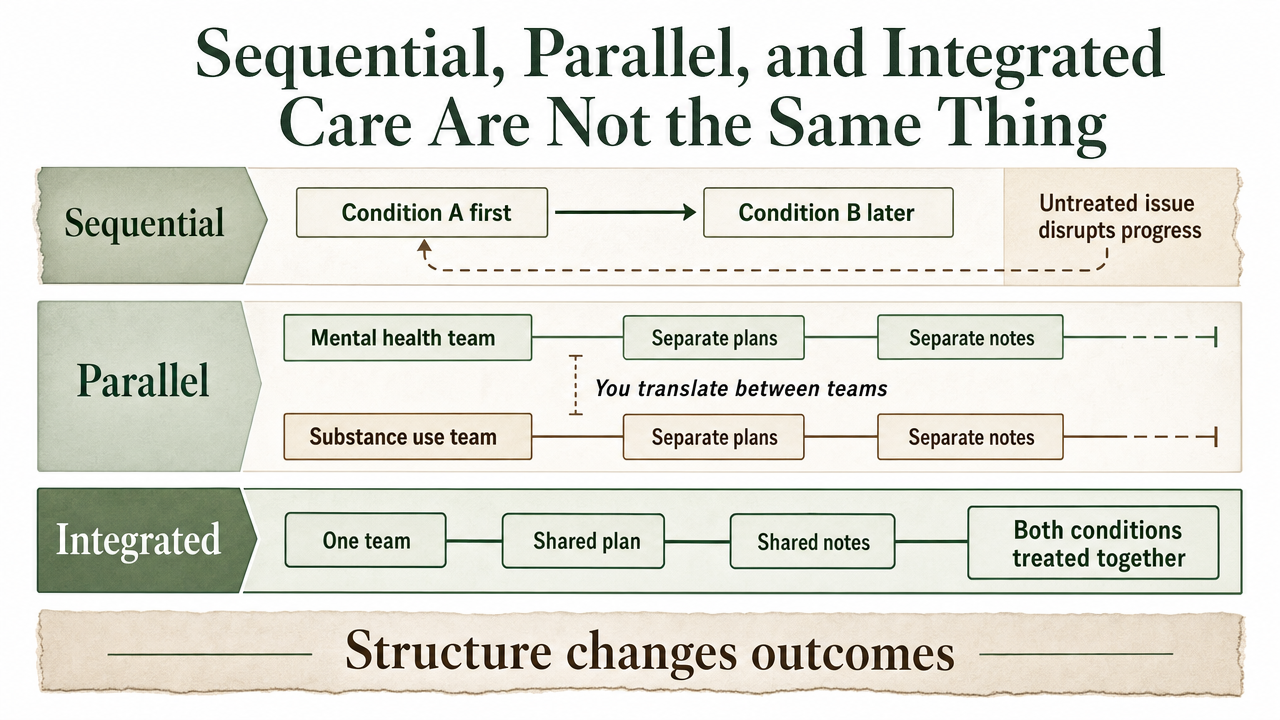
Sequential, Parallel, and Integrated Care Are Not the Same Thing
When people say they've tried treatment before, they usually mean one of three things. And the difference between those three things is bigger than most brochures let on.
Sequential care means you treat one condition, then the other. Get sober first, then we'll deal with the depression. Or, stabilize the mood first, then we'll talk about the drinking. It sounds orderly. It rarely works, because the untreated condition keeps setting fires under the one you're trying to put out.
Parallel care is closer, but still off. You see a therapist for the mental health piece on Tuesdays and go to a substance use program on Thursdays. Two teams, two treatment plans, two sets of notes that don't always talk to each other. You end up being the translator between them, which is a job no one should have when they're already this tired.
Integrated care is the third path, and it's the one federal guidance now names as the preferred model for co-occurring disorders. SAMHSA's updated TIP 42 puts it plainly: interventions for both the substance use disorder and the mental health disorder are combined in a single session or series of sessions, delivered by clinicians trained to hold both at once. In a dual diagnosis group, that means the same room, the same clinician, the same peers. When your anxiety and your drinking come up in the same sentence, no one asks you to file them separately.8
The model isn't a preference. It's a design choice that changes what the hour is capable of doing.
What the Evidence Shows When Both Conditions Are Treated Together
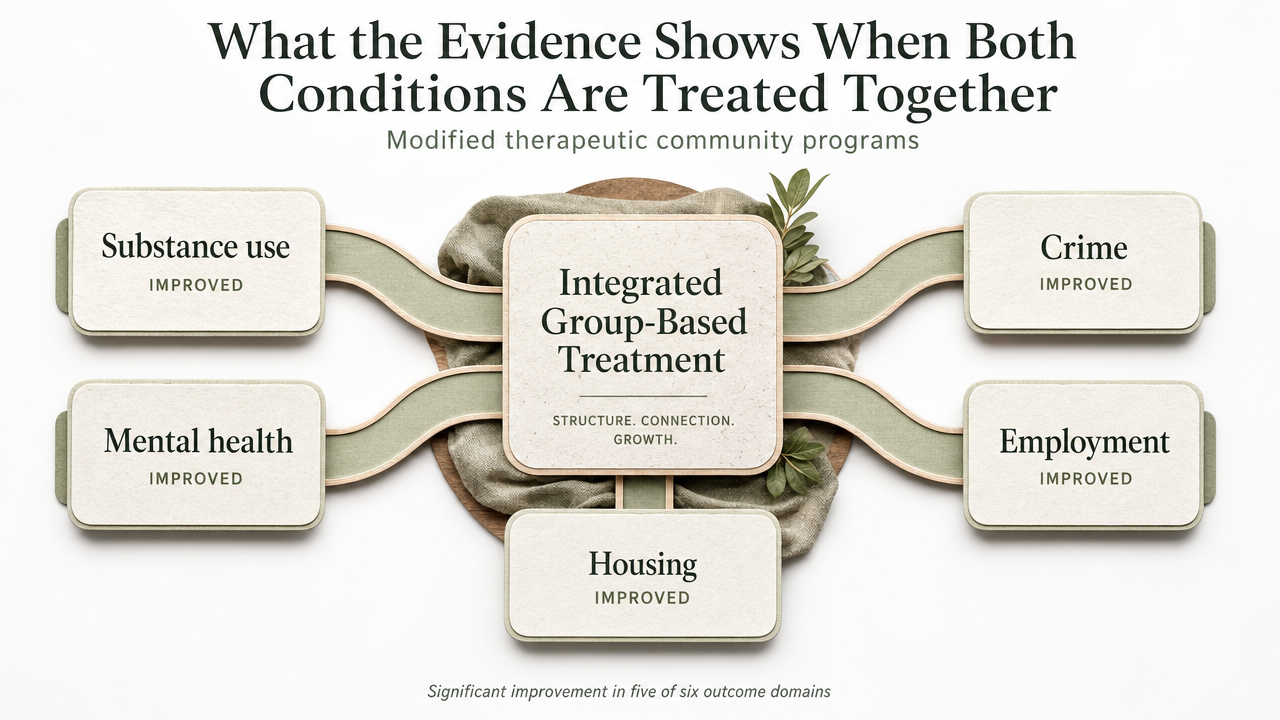
The clearest data on what integrated, group-based dual diagnosis care can do comes from a meta-analysis of modified therapeutic community programs, a treatment model built around structured group work and peer community for people with co-occurring disorders. Across the studies reviewed, the model produced significantly greater improvements than comparison conditions in five of six outcome domains: substance use, mental health, crime, employment, and housing.4
Read that list again, because it's not just about staying sober. It's about being able to hold a job. Keep an apartment. Stay out of the courtroom. Feel less panicked at 3 a.m. Those are the things people actually mean when they say they want their life back, and they don't come from treating half of what's going on.
Federal guidance echoes what the trial data shows. SAMHSA's summary of integrated treatment outcomes lists reduced or discontinued substance use, improvement in psychiatric symptoms and functioning, decreased hospitalization, increased housing stability, and fewer arrests. The gains cluster, because the conditions cluster. Steady mood makes it easier to stay sober. Sobriety makes it easier to treat the mood. The two feed each other in the right direction once they're being treated at the same time.2
There's also a quieter finding worth naming. A systematic review of 27 studies on treatment satisfaction found that clients in integrated dual diagnosis programs consistently reported higher satisfaction than clients in standard, non-integrated care. That matters because satisfaction predicts whether you keep showing up, and showing up is where the work compounds. A treatment that feels like it sees the whole of you is a treatment you're more likely to finish.9
The One Study That Anchors the Case for Group CBT
If you want a single trial to hang your understanding on, it's the BRIGHT study. Researchers added a 16-session group cognitive behavioral therapy program for depression on top of standard residential substance use treatment, then compared those clients to clients receiving usual care. The intervention group's depressive symptoms and mental health functioning improved significantly more than the control group's. Among clients who had the opportunity to use, substance use dropped by more than half compared to usual care 1.
Two things about that finding are worth holding onto. First, the group didn't just treat the depression and hope the drinking followed. It taught skills that spoke to both, and both moved. Second, the setting was residential, which means the numbers don't map cleanly onto outpatient life. Someone doing this work while going home each night has more triggers between sessions and more chances to practice, which cuts both ways.
What the study does prove is the mechanism. When you build a group around the mental health piece that's driving the use, and you keep the substance use in the same conversation, the numbers on both sides move together. That's the argument for integrated group care in one paragraph. Everything else in a good program is about making sure that mechanism has room to work in the life you actually have.
The Fear No One Names: What If You Don't Want to Talk?
Here's the thing most program brochures skip past: the idea of walking into a room full of strangers and cracking yourself open is, for a lot of people, the single biggest reason they never call. If that's you, it's not resistance. It's not a character flaw. It's a completely reasonable response to being asked to trust people you've never met with the parts of your life you barely show anyone.
A well-run dual diagnosis group knows this before you walk in. Trauma-informed facilitation isn't a buzzword on the wall. It's a set of specific choices about how the room runs. You get to pass. You get to listen for a whole session and say nothing but your name. You get to sit closer to the door if that helps your body settle. The clinician sets these norms out loud on day one, so no one is waiting to be called on like it's high school.
The pacing matters too. Groups don't ask you to disclose the hardest thing first. Early sessions tend to focus on skills, not stories: how to notice a craving, how to name a feeling, how to breathe when your chest goes tight. You practice something concrete before anyone asks you to share something personal. Trust builds because the room proves, week by week, that it can hold what's said in it.
Client satisfaction data backs this up. Across studies of dual diagnosis programs, people consistently rated integrated care higher than standard treatment, and the factors they named most often were emotional safety and feeling seen as a whole person, not just a diagnosis. You don't have to be ready to talk on day one. You just have to be willing to walk in and see what the room feels like. That's enough to start.9
Recovery Starts With a Conversation
Whether you’re exploring recovery for yourself or seeking guidance for someone you care about, Coastal Recovery Partners is here to help. Our team offers trauma-informed, evidence-based support grounded in structure, compassion, and real connection—without pressure or judgment.
When you’re ready, we’ll meet you where you are and help you take the next step forward.
Why Peers in the Room Do Something a Clinician Alone Cannot
A clinician can teach you what a craving is. A person sitting three chairs away, who felt one at 2 p.m. on a Tuesday and didn't act on it, can teach you that surviving one is actually possible. Those are two different kinds of knowing, and you need both.
Something happens in a dual diagnosis group that individual therapy, no matter how skilled, can't quite deliver. You watch someone else name the exact thought loop that's been running in your head for a decade. You realize you're not uniquely broken. You realize your PTSD and your drinking aren't a private shame, they're a pattern other people are also working on, out loud, in the same room. That recognition does something to the nervous system that no reassurance from a professional can match.
Peers also hold you accountable in a way that lands differently. When someone who's been where you are asks how the week actually went, you tend to answer honestly. And when they share what worked for them on Wednesday night, it's not advice from above. It's field notes from someone still walking the same road.
SAMHSA's TIP 42 guidance explicitly names dual recovery mutual-support and peer connection as core components of effective co-occurring care, not extras bolted on after the clinical work. The group is the treatment. The other people in it are part of why it works.7
Fitting Real Care Into a Working, Parenting, Regular Life
Morning, Evening, and Part-Time Group Structures
You have a job. Or kids who need lunches packed. Or a parent you're helping care for. The idea that treatment requires disappearing from all of it for thirty days is one of the biggest reasons people put off calling in the first place. It's also, for most people with co-occurring disorders, no longer true.
Dual diagnosis group therapy in an outpatient setting is built around the assumption that you're still living your life while you do this work. A partial hospitalization program, or PHP, usually meets five days a week for most of the day, and it's the closest structure to residential care without the overnight piece. An intensive outpatient program, or IOP, typically runs three or four days a week for about three hours per session. Standard outpatient scales down from there.
The scheduling is where a lot of programs quietly separate themselves. Morning tracks let you finish group by mid-morning and get to work by lunch. Evening tracks meet after the workday ends, so you don't have to explain a two-hour absence to a boss you're not ready to tell. Some programs run afternoon options for people on second shift or handling school pickup. You pick the block that lets you keep the rest of your life intact, and the group meets you there.
When Outpatient Group Care Is the Right Level, Not the Lesser One
There's a persistent myth that residential is the real treatment and outpatient is what you settle for. That framing gets the question wrong. The right level of care isn't the most intensive one you can afford. It's the one that matches what you actually need to get well.
For a lot of people with co-occurring conditions, outpatient group care is the better clinical fit, not the compromise. You're practicing skills in the exact environment where you'll need them, then bringing what came up back into group the next day. The craving you felt in your own kitchen on Tuesday night gets worked on in Wednesday morning's session, while it's still fresh. That kind of real-time practice is something a residential setting, by design, can't quite replicate.
Federal guidance supports this. SAMHSA's TIP 42 update names integrated outpatient care, including structured group therapies and staged interventions, as a core delivery model for co-occurring disorders, not a step-down afterthought. If you can live at home safely, hold a routine, and show up consistently, an outpatient group track can carry the same clinical weight as a residential one, with the added benefit of teaching you to be well in your actual life.8
How to Tell If a Program Is Actually Doing Integrated Care
Plenty of programs use the phrase "dual diagnosis" on their website. Far fewer are actually doing the work behind it. When you're calling around, or sitting in an intake meeting, there are a handful of questions that separate real integrated care from a substance use program that added a mental health line to the brochure.
Ask who runs the groups. In a truly integrated program, the same clinician is trained to treat both conditions and holds both in the same session. If the answer is that the mental health piece happens with a different provider on a different day, that's parallel care, not integrated care. SAMHSA's TIP 42 update is explicit that integrated treatment means interventions for both disorders are combined in a single session or a coordinated series, delivered by clinicians trained in both.8
Ask how they handle trauma. A program that names trauma-informed care as a specific protocol, with rules about pacing, opt-outs, and how the room is set up, is a program that has thought about safety before you walked in.
Ask about scheduling. Morning, evening, and part-time tracks tell you the program was built for people still living their lives. Ask about medication support, because coordinated medication-assisted treatment alongside group work is a marker of a program that treats the whole picture. Coastal Recovery Partners in South Portland builds their IOP, PHP, and outpatient tracks around exactly these pieces, and it's a reasonable place to start if you're in Maine and looking for care that doesn't ask you to choose which half of yourself to bring in the door.
Frequently Asked Questions
What is dual diagnosis group therapy, and how is it different from a regular support group?
A dual diagnosis group is a clinical treatment session, not a peer meeting. A licensed clinician trained in both substance use and mental health leads structured work using approaches like CBT and DBT, and both conditions get treated in the same room at the same time. Federal guidance names this integrated model the preferred standard for co-occurring disorders. Support groups add value, but they don't replace clinical care.8
Do I have to share personal details in front of strangers on my first day?
No. Trauma-informed groups let you pass, listen, and take your time. Early sessions usually focus on skills rather than stories, so you're practicing something concrete before anyone asks you to share anything personal. Trust builds week by week. Client satisfaction research consistently ties higher ratings of integrated care to emotional safety and feeling seen as a whole person. You set the pace.9
Can dual diagnosis group therapy work if I need to keep working or caring for my family?
Yes, and for many people it's the better fit. Outpatient tracks are built around real life. IOPs typically run three or four days a week for about three hours, with morning and evening options so you can work around a job or school pickup. You practice skills in your actual environment and bring what came up back to the next session, which is where the work compounds.
Is outpatient group care strong enough, or do I need residential treatment?
Outpatient isn't a lesser option. It's the right clinical level when you can live at home safely and show up consistently. SAMHSA's updated TIP 42 names integrated outpatient care, including structured group therapies and staged interventions, as a core delivery model for co-occurring disorders, not a step-down. Residential makes sense when safety, withdrawal, or environment demand it. Talk with an intake clinician about which level fits.8
How do I know if a program is actually delivering integrated care and not just treating one condition at a time?
Ask who runs the groups. In real integrated care, the same clinician is trained in both conditions and holds them in one session. If mental health happens on a different day with a different provider, that's parallel care. TIP 42 defines integrated treatment as interventions for both disorders combined in a single session or coordinated series by clinicians trained in both. Also ask about trauma-informed protocols.8
What kinds of mental health conditions fit alongside substance use in a dual diagnosis group?
Depression, anxiety, PTSD, bipolar disorder, and other mood conditions commonly show up alongside substance use. The BRIGHT trial built a group specifically around persistent depression in substance use clients and saw significant gains on both sides. A well-designed group teaches skills that speak to shared drivers, like emotion regulation and craving management, so the specific diagnosis matters less than whether the clinician is trained to treat both.1
References
- An effectiveness trial of group cognitive behavioral therapy for depression among substance abuse treatment clients (BRIGHT study). https://pmc.ncbi.nlm.nih.gov/articles/PMC3230556/
- Managing Life with Co-Occurring Disorders. https://www.samhsa.gov/mental-health/serious-mental-illness/co-occurring-disorders
- Integrated Treatment for Co-Occurring Disorders: Building Your Program (Evidence‑Based Practices KIT). https://library.samhsa.gov/sites/default/files/ebp-kit-building-your-program-10112019.pdf
- Modified Therapeutic Community for Co-Occurring Disorders: A meta‑analysis of outcome studies. https://pmc.ncbi.nlm.nih.gov/articles/PMC3058619/
- Behavioral therapy for co‑occurring mood and substance use disorders: Conclusions and challenges. https://pmc.ncbi.nlm.nih.gov/articles/PMC3693566/
- Cognitive‑Behavioral Therapy for Substance Use Disorders: A Review of Evidence. https://pmc.ncbi.nlm.nih.gov/articles/PMC2897895/
- Quick Guide for Mental Health Professionals: Based on TIP 42 – Substance Use Disorder Treatment for People with Co‑Occurring Disorders. https://library.samhsa.gov/sites/default/files/sma10-4531.pdf
- Substance Use Disorder Treatment for People with Co‑Occurring Disorders (TIP 42 update). https://library.samhsa.gov/sites/default/files/pep20-06-04-006.pdf
- Dual diagnosis clients’ treatment satisfaction: A systematic review. https://pmc.ncbi.nlm.nih.gov/articles/PMC3101156/
- Cognitive Behavioural Therapy and Dual Diagnosis: A Systematic Review Exploring Its Effectiveness and Implications for Nursing Practice. https://pubmed.ncbi.nlm.nih.gov/41108580/